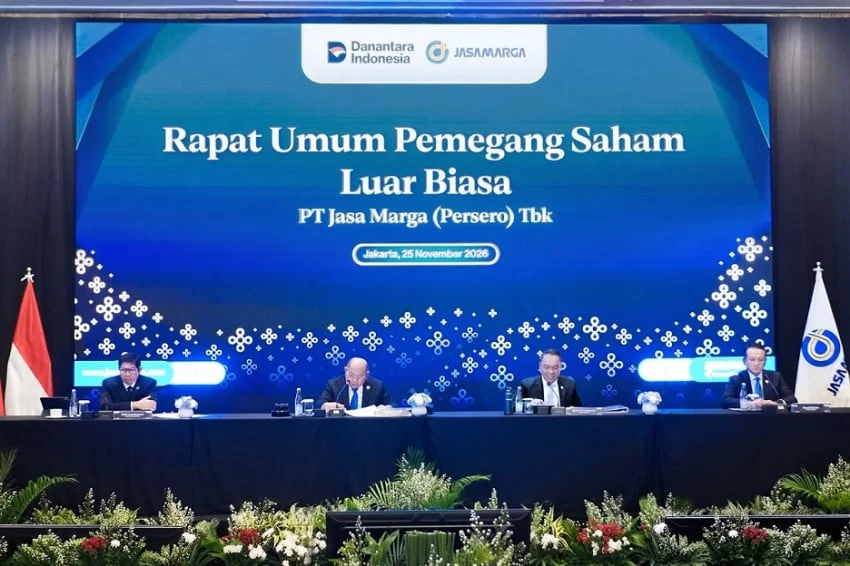
PT Jasa Marga (Persero) Tbk, Indonesia’s largest toll road operator, has officially advanced its corporate restructuring initiative by simplifying its subsidiary structure, aiming to streamline the management of its extensive toll road portfolio. The strategic consolidation involves merging two of its specialized financial entities, PT Lintas Marga Jawa (LMJ) and PT Trans Optima Luhur (TOL), directly into PT Jasamarga Transjawa Tol (JTT). This landmark corporate action was formally endorsed and approved by shareholders during an Extraordinary General Meeting of Shareholders (EGMOS) held in Jakarta.
The restructuring marks a pivotal chapter in Jasa Marga’s ongoing efforts to enhance corporate governance, optimize operational efficiency, and consolidate its investment footprint along the vital Trans-Java toll road corridor. By bringing LMJ and TOL under the singular umbrella of JTT, the state-owned enterprise seeks to eliminate administrative redundancies, harmonize cross-subsidiary coordination, and accelerate strategic decision-making processes across its operational network.
Origins of LMJ and TOL: Fulfilling Historic Financing Objectives
To fully understand the significance of this corporate consolidation, it is necessary to examine the foundational context of both PT Lintas Marga Jawa and PT Trans Optima Luhur within Jasa Marga’s capital-raising history. Both entities were originally established not as direct operational management firms, but as specialized corporate vehicles designed to unlock alternative funding sources for massive infrastructure developments during a period of rapid national expansion.
In 2018, the Indonesian infrastructure sector witnessed a major financial innovation when Jasa Marga launched the Limited Participation Mutual Fund, known locally as Reksa Dana Penyertaan Terbatas (RDPT) Transjawa, through LMJ. This initiative allowed the company to monetize operational toll road assets, drawing institutional capital into equity-based investment instruments to fund further construction without over-relying on conventional bank loans or sovereign budgets.
Following this precedent, PT Trans Optima Luhur (TOL) was established in 2019 to issue alternative equity and infrastructure-backed financial instruments, specifically through the Collective Investment Contract for Infrastructure Investment Funds (Kontrak Investasi Kolektif Dana Investasi Infrastruktur, or KIK-DINFRA). These innovative financing mechanisms played an instrumental role in accelerating the completion of the Trans-Java toll road network, a backbone logistics corridor that fundamentally transformed Indonesia’s domestic supply chain, inter-city mobility, and economic connectivity.
However, as these financial instruments matured and the initial capital-raising mandates were successfully fulfilled, the continued independent existence of LMJ and TOL became structurally redundant. Recognizing that maintaining separate corporate entities for finished funding vehicles added unnecessary administrative overhead, Jasa Marga’s executive leadership initiated the streamlining process that culminated in the recent EGMOS approval.
Strategic Implications of the Merger into Jasamarga Transjawa Tol
Following the completion of the merger, PT Jasamarga Transjawa Tol (JTT) will assume direct ownership and oversight of five major Toll Road Business Entities (Badan Usaha Jalan Tol – BUJT) that were previously held indirectly through LMJ and TOL.
The five strategically vital toll road sections now consolidated under JTT’s direct operational purview include:
- PT Jasamarga Semarang Batang
- PT Jasamarga Solo Ngawi
- PT Jasamarga Ngawi Kertosono Kediri
- PT Trans Marga Jateng
- PT Jasamarga Pandaan Tol
This structural consolidation significantly simplifies the ownership chain. Rather than navigating multi-tiered subsidiary holdings, Jasa Marga can now manage these high-traffic commercial arteries through a consolidated corporate framework. Industry analysts note that simplifying corporate structures often leads to reduced auditing complexity, lower compliance costs, and enhanced transparency for institutional investors and regulatory bodies alike.

Executive Perspectives on Corporate Transformation
Addressing shareholders and media representatives following the EGMOS, Jasa Marga’s Corporate Secretary and Chief Administration Officer, Trias Andriyanto, emphasized that the subsidiary restructuring is a core component of the company’s broader long-term transformation strategy.
"Through the integration of LMJ and TOL into JTT, Jasa Marga is systematically streamlining the management architecture of its toll road investments to ensure a higher degree of integration," Trias stated. He further underscored that a streamlined corporate structure directly translates into tangible operational benefits. "With a simpler framework, our business management is expected to achieve optimal performance. Coordination between entities will become much more seamless, and executive decision-making processes can be executed with greater speed and precision."
The move aligns with broader mandates from the Ministry of State-Owned Enterprises (SOEs), which has consistently urged state enterprises to prune unproductive or redundant subsidiaries, focus on core competencies, and improve capital efficiency in an increasingly competitive macroeconomic environment.
Macroeconomic Context and the Evolution of Indonesia’s Toll Road Sector
The consolidation of Jasa Marga’s subsidiary network occurs against the backdrop of a maturing Indonesian toll road sector. Over the past decade, Indonesia has experienced an unprecedented boom in infrastructure development, spearheaded by the construction of the Trans-Java and Trans-Sumatra toll road networks. These mega-projects have dramatically reduced travel times, lowered logistics costs, and stimulated regional economic centers outside of traditional metropolitan hubs.
However, as the primary construction phase transitions into an operational and optimization phase, the strategic priorities of state-backed operators have necessarily shifted. The focus has moved away from aggressive capital acquisition financed through complex off-balance-sheet instruments toward balance-sheet consolidation, organic revenue growth, and superior asset management.
By integrating the assets previously managed by LMJ and TOL, Jasa Marga is reinforcing its financial resilience. A unified corporate structure allows for more agile treasury management, simplified cash-pooling arrangements, and a clearer financial profile for lenders and rating agencies evaluating the company’s creditworthiness.
Looking Ahead: Implementation and Future Outlook
The formal approval granted during the November 2026 EGMOS sets in motion the legal, administrative, and operational integration of the merging entities. Over the coming months, Jasa Marga’s corporate legal and financial teams will execute the final phases of the consolidation, ensuring full compliance with Indonesian corporate law, capital market regulations, and the requirements stipulated in the company’s Articles of Association.
For motorists and commercial logistics providers utilizing the Trans-Java corridor, the corporate restructuring will remain largely invisible on the ground, as daily operations, toll tariffs, and service standards across the affected road segments will continue under existing management frameworks. However, the internal efficiency gains realized by JTT are expected to indirectly benefit consumers through sustained service excellence, enhanced maintenance protocols, and accelerated technological integration across the toll road network.
Ultimately, this corporate maneuver underscores Jasa Marga’s proactive approach to corporate governance. By shedding obsolete structural layers that served their purpose during the capital-raising era of the late 2010s, the company has positioned itself advantageously for the next phase of Indonesia’s infrastructure evolution—one defined by operational excellence, fiscal discipline, and integrated asset management.