
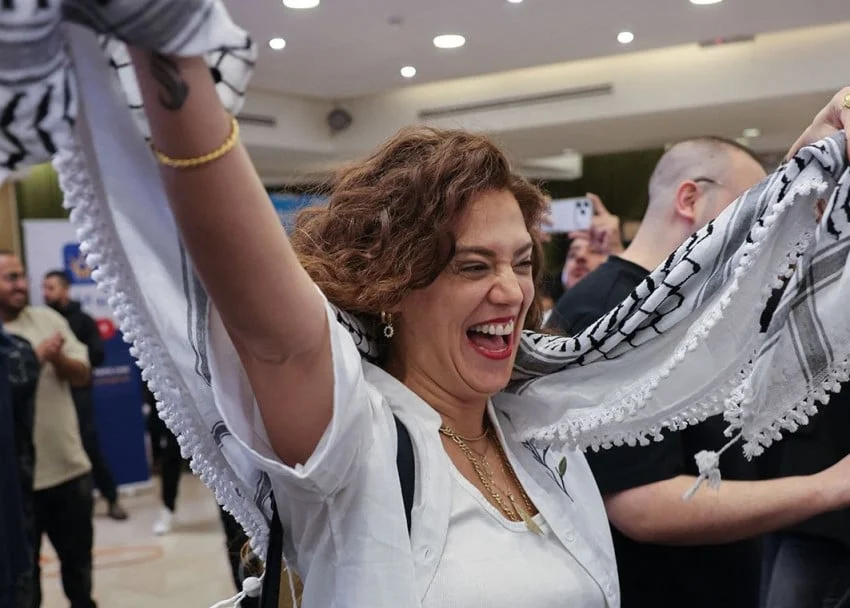
The political landscape of Israel has experienced a profound and unexpected shift as preliminary election results indicate a historic surge in voter participation among Palestinian citizens of Israel. According to recent polling data and early vote counts from Tuesday’s national election, political factions representing the Arab minority are projected to secure up to 19 seats in the 120-member Knesset. This unprecedented mobilization highlights a strategic awakening within a demographic that has historically faced systemic marginalization, political fragmentation, and voter apathy.
As over a third of the national ballots were tabulated, major Arab-led political formations—specifically the Joint List and Ra’am (United Arab List)—demonstrated robust electoral performances. The Joint List alone captured more than 9 percent of the counted vote share, far exceeding pre-election expectations. Meanwhile, the broader political arena remains fiercely contested. The right-wing Likud party, led by incumbent Prime Minister Benjamin Netanyahu, has maintained a competitive edge over the centrist opposition bloc spearheaded by the Yashar party, founded by former military chief of staff Gadi Eisenkot. Nevertheless, the definitive balance of power increasingly hinges on the extraordinary performance of Arab electorate coalitions.
Unprecedented Turnout Levels and Statistical Breakdown
Mainstream Israeli media outlets, including Channel 12, reported that voter turnout among Palestinian citizens of Israel reached an astonishing 80 percent on Tuesday. This figure shatters previous modern records, surpassing even the watershed participation rates observed during the 1999 general elections. Political analysts attribute this surge to a collective realization regarding the untapped leverage inherent in collective political participation.
Mansour Abbas, leader of Ra’am, emphasized the pivotal role his party and other Arab factions play in shaping the country’s executive branch. Speaking to Channel 12 prior to the release of early returns, Abbas asserted that no single political bloc could realistically secure the mandatory 61-seat majority required to form a stable governing coalition without addressing the demands and presence of Arab lawmakers.
"With the current vote distribution, no government can be formed in a vacuum," Abbas stated. He further revealed that high-level communications had already been initiated between major Zionist political blocs and his party, underscoring the indispensable kingmaker role that Arab factions currently occupy within the parliamentary arithmetic. Ra’am, which previously held five seats and made history by participating in the ideologically diverse ‘change coalition’ government led by Naftali Bennett and Yair Lapid from 2021 to 2022, continues to position itself as pragmatic pragmatists willing to negotiate across the political aisle for community gains.
Historical Context and Chronology of Arab Political Representation in Israel
To understand the gravity of the current political juncture, it is necessary to examine the trajectory of Palestinian citizens of Israel—frequently referred to inside Israel as Arab Israelis—within the state’s legislative apparatus. Comprising roughly 20 percent of Israel’s total population, Palestinian citizens possess voting rights and have maintained parliamentary representation since the founding of the state in 1948. However, for decades, their political influence was circumscribed by military administration until 1966, subsequent surveillance, and intentional political fragmentation.
For much of the late 20th and early 21st centuries, Arab political parties were systematically excluded from executive coalitions, relegated to the perpetual opposition. This dynamic shifted marginally in 2015 when major Arab factions united under the banner of the Joint List, achieving a historic high of 13 seats. This unity, however, proved fragile. Internal ideological rifts—particularly concerning whether to support Zionist-led opposition blocs, differences over regional foreign policies, and strategic disagreements regarding pragmatic engagement versus ideological purity—led to the dissolution of the unified slate.
Despite these fractures, the community’s political consciousness has evolved. The events of May 2021, characterized by widespread civil unrest in mixed Jewish-Arab cities alongside the Gaza conflict, served as a catalyst for renewed political engagement. The subsequent entry of Ra’am into the Bennett-Lapid coalition broke a long-standing political taboo, demonstrating that Arab parties could directly influence state budgets, infrastructure funding, and crime-prevention initiatives within Arab localities.
Tuesday’s election represents the culmination of this complex historical arc. By pushing projected representation to 19 seats, the electorate has signaled a rejection of political sidelines, choosing instead to maximize legislative leverage regardless of the broader political polarization characterizing the Israeli public sphere.
Reactions from Political Figures and Civil Society Leaders
The electoral surge has elicited diverse reactions across Israel’s deeply polarized political spectrum. Aida Touma-Suleiman, a prominent former Knesset member from the left-wing Arab-Jewish party Hadash, offered a sober assessment of the broader national climate while acknowledging the monumental shift within her community.
Speaking to international media, Touma-Suleiman noted that the preliminary results reflect a profound ideological crisis within Israeli society, pointing to the entrenched influence of right-wing nationalist elements. "It is striking to observe how, following years of severe regional conflict and significant domestic upheaval surrounding judicial restructuring initiatives, right-wing factions maintain strong populist backing," she remarked.
However, Touma-Suleiman underscored that the definitive takeaway of the election is the agency demonstrated by Palestinian citizens of Israel. "The most compelling narrative of this electoral cycle is how the Arab public in Israel has decisively grasped the magnitude of the political power resting in their hands," she added.
Conversely, mainstream right-wing commentators and political operatives have expressed concern over the potential reliance of center-left or anti-Netanyahu blocs on Arab parties to form a governing majority. Critics from the nationalist camp continue to weaponize rhetoric questioning the Zionist loyalty of Arab lawmakers, a persistent political dynamic that has historically been utilized to mobilize right-wing voter turnout among Jewish Israelis.
Fact-Based Implications and Future Outlook
The projected 19-seat bloc for Arab parties carries profound implications for the formation, stability, and policy trajectory of the forthcoming Israeli government. Several key implications emerge from these preliminary results:
-
Parliamentary Gridlock and Coalition Dynamics: With Israel experiencing an extended political crisis marked by multiple inconclusive elections over recent years, the addition of a robust, consolidated Arab parliamentary bloc complicates traditional coalition arithmetic. If neither the pro-Netanyahu bloc nor the opposition bloc achieves an outright majority of 61 seats independently, parliamentary maneuverings will require unprecedented compromises.
-
Policy Bargaining Power: Should a governing coalition depend on the parliamentary support—whether active via coalition membership or passive via supply-and-confidence agreements—of parties like Ra’am or a reunited Joint List, Arab leadership will possess substantial leverage. Key community demands, including combating soaring violent crime rates in Arab towns, addressing severe housing shortages, halting discriminatory planning and demolition policies, and securing equitable socio-economic development budgets, will take center stage in coalition negotiations.
-
Regional and International Repercussions: The domestic political empowerment of Palestinian citizens of Israel does not occur in a vacuum. Regional dynamics, including ongoing geopolitical tensions, humanitarian crises in Gaza and the West Bank, and shifting diplomatic relations across the Middle East, heavily influence domestic identity politics within Israel. A stronger, more assertive Arab parliamentary presence ensures that issues concerning Palestinian rights, occupation, and civil equality remain prominent within the Knesset’s legislative agenda, potentially drawing heightened international scrutiny.
-
Societal Cohesion within Israel: The record-breaking turnout also signals a strategic decision by Palestinian citizens to engage deeply with state institutions rather than opting for complete electoral boycotts, a tactic historically debated within the community. This institutional integration challenges the prevailing political paradigms in Israel, forcing a national reckoning regarding the nature of Israeli democracy and the collective rights of its non-Jewish indigenous minority.
As final votes continue to be audited and certified by the Central Elections Committee, political actors across the spectrum are preparing for protracted negotiations. Whether the surge in Arab voter participation translates into tangible structural reforms or merely intensifies the existing legislative fragmentation remains one of the most critical questions facing contemporary Israeli democracy.
