
The release of the 2025 Programme for International Student Assessment (PISA) results has once again thrust Indonesia’s educational landscape into the national spotlight, serving as a sobering reminder of the country’s ongoing struggle to bridge the gap between academic intent and student competency. While the data confirms that Indonesia meets the minimum quality standards set by the Organisation for Economic Co-operation and Development (OECD), a deeper examination of the figures reveals a systemic fragility that threatens the nation’s future economic stability. As Indonesia navigates the complexities of the 21st-century workforce, the PISA 2025 findings act less like a report card and more like a critical warning regarding the nation’s human capital development.
The PISA 2025 assessment, which involved 91 participating nations and economies, saw 14,168 Indonesian students from 419 schools take part in testing. When compared to the 2022 assessment, the results remain largely stagnant. Indonesia recorded a marginal gain of 6 points in science and 7 points in reading, while mathematics scores saw a slight regression of 2 points. Most significantly, these figures remain lower than Indonesia’s performance in 2015, indicating a decade of stagnation that policymakers can no longer afford to overlook.

The historical context of these assessments is vital. PISA was established by the OECD in 2000 to provide a global benchmark for student performance in mathematics, reading, and science. For Indonesia, the journey has been one of inconsistent progress. While the country has successfully expanded access to education, the focus has shifted toward the quality of the outcomes. The 2025 data, released on September 8, 2026, highlights that approximately 60.9% of Indonesian students are currently performing below Level 2 in all three core subjects. In the PISA framework, Level 2 represents the baseline proficiency level required for students to engage effectively with the modern world. Falling below this threshold suggests that more than half of the student population lacks the fundamental skills necessary to solve routine problems, comprehend complex texts, or make data-driven decisions.
Conversely, the data concerning high-achieving students is equally concerning. Only 0.1% of Indonesian students reached Level 5 or 6 in at least one of the three tested subjects. This represents roughly one in every thousand students. This narrow peak—a tiny minority of high performers against a broad base of students struggling with foundational concepts—poses a significant risk to the nation’s aspirations for the "Indonesia Emas 2045" vision. Without a robust pipeline of high-level talent, the country faces the potential transformation of its much-anticipated demographic dividend into a demographic burden, where millions of young adults enter the workforce without the requisite skills for innovation or specialized labor.
The implications of this performance extend beyond mere rankings. In an era dominated by digital transformation and artificial intelligence, the ability to discern information, evaluate sources, and apply knowledge to unfamiliar situations is paramount. The PISA data indicates that while Indonesian students possess a commendable level of curiosity—with 80% expressing a desire to learn about various topics and 74% demonstrating a willingness to put in extra effort—the current educational infrastructure is failing to channel these traits into measurable competence.

The disconnect between student effort and academic output suggests a failure in the instructional model. Despite the implementation of various national curricula—from the Competency-Based Curriculum to the more recent Kurikulum Merdeka—the execution remains hampered by administrative burdens, insufficient teacher training, and a persistent reliance on rote memorization rather than critical thinking. Experts suggest that while the curriculum design often incorporates international best practices, the bridge to the classroom is broken. Teachers, while dedicated, often lack the specific pedagogical tools required to teach abstract reasoning or to integrate literacy and numeracy across all subjects.
The digital dimension of the classroom also presents a double-edged sword. According to the PISA 2025 report, Indonesian students spend an average of 2.5 hours per day on digital devices for learning purposes. However, they also spend significant time on non-educational activities, with 23% of students reporting frequent distractions by digital devices during science lessons. This digital distraction is linked to lower academic outcomes, reinforcing the need for schools to adopt more disciplined policies regarding technology usage, ensuring that AI and digital tools function as intellectual aids rather than avenues for shortcutting the cognitive process.
To address these systemic challenges, stakeholders in the education sector—including the government, private sector partners, and educational institutions—must move toward a more data-driven approach. The first step involves treating literacy and numeracy as cross-curricular responsibilities. Mathematics is not solely the domain of the math teacher, nor is literacy the sole responsibility of the language arts department. Every discipline, from biology to history, must integrate the interpretation of data, the construction of arguments based on evidence, and the critical evaluation of sources.
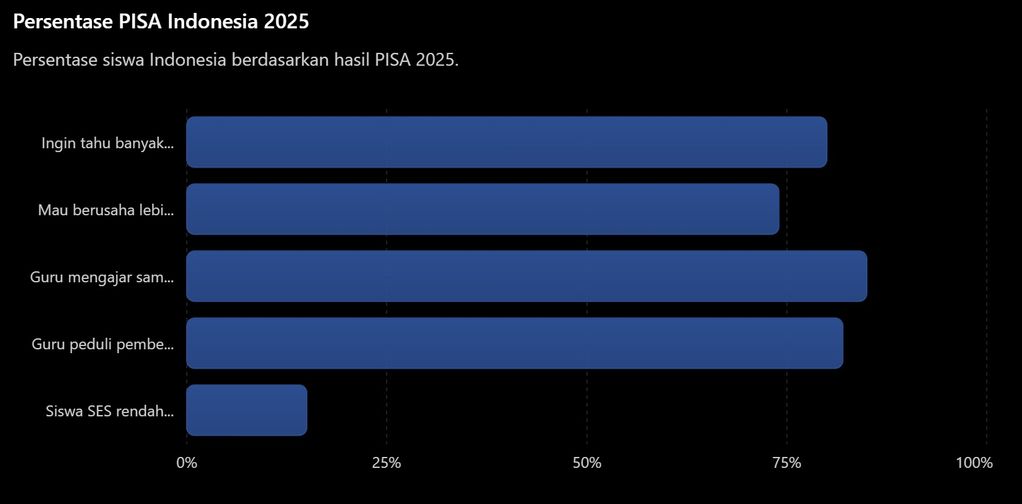
Secondly, schools must leverage assessment data to provide differentiated support. The "one-size-fits-all" approach to teaching is no longer viable. Students falling below the baseline require intensive, structured tutoring and remedial programs, while high-potential students require enrichment, project-based learning, and challenges that push them beyond the standard curriculum. The success of the 15% of students from lower socio-economic backgrounds who reached the top performance quartiles proves that socio-economic status is not a destiny, provided that appropriate support systems are in place.
Furthermore, the professional development of educators must move away from sporadic, one-day seminars toward continuous, collaborative learning environments. Schools should foster a culture where teachers can review student work, share pedagogical successes, and refine their approaches based on empirical evidence. Technology providers and private educational entities, such as Ruangguru and its Brain Academy centers, are increasingly positioning themselves as strategic partners in this endeavor. By offering personalized learning paths, diagnostic testing, and teacher training programs, these organizations aim to act as a bridge between high-level policy and daily classroom practice.
However, the responsibility cannot rest on any single entity. A cohesive strategy requires the alignment of government policy, school-level implementation, and support from civil society. The PISA results of 2025 should be treated as an actionable blueprint for reform. The focus must shift from the vanity of global rankings to the substance of student competency.

If Indonesia is to leverage its demographic potential, it must ensure that the "alarm" sounded by PISA is translated into concrete, measurable goals. This includes defining clear performance indicators for every academic level and holding the system accountable for progress. The goal is to build an educational ecosystem that values the "why" and "how" of knowledge over the "what." It requires moving toward a system where every student is not just a recipient of information, but a critical thinker capable of adapting to a rapidly changing global economy.
In the final analysis, the PISA 2025 report is a call to maturity for the Indonesian education system. It is an acknowledgment that the country has reached a stage where simple expansion is no longer sufficient. The path forward requires a rigorous commitment to quality, a willingness to overhaul outdated instructional practices, and a persistent focus on developing the unique talents of every student. The time for debate over international rankings is over; the time for decisive, structural, and sustainable action has begun. The future of Indonesia’s economic and social development rests on the ability to turn these lessons into a reality where every child has the foundation to succeed and the tools to innovate.