
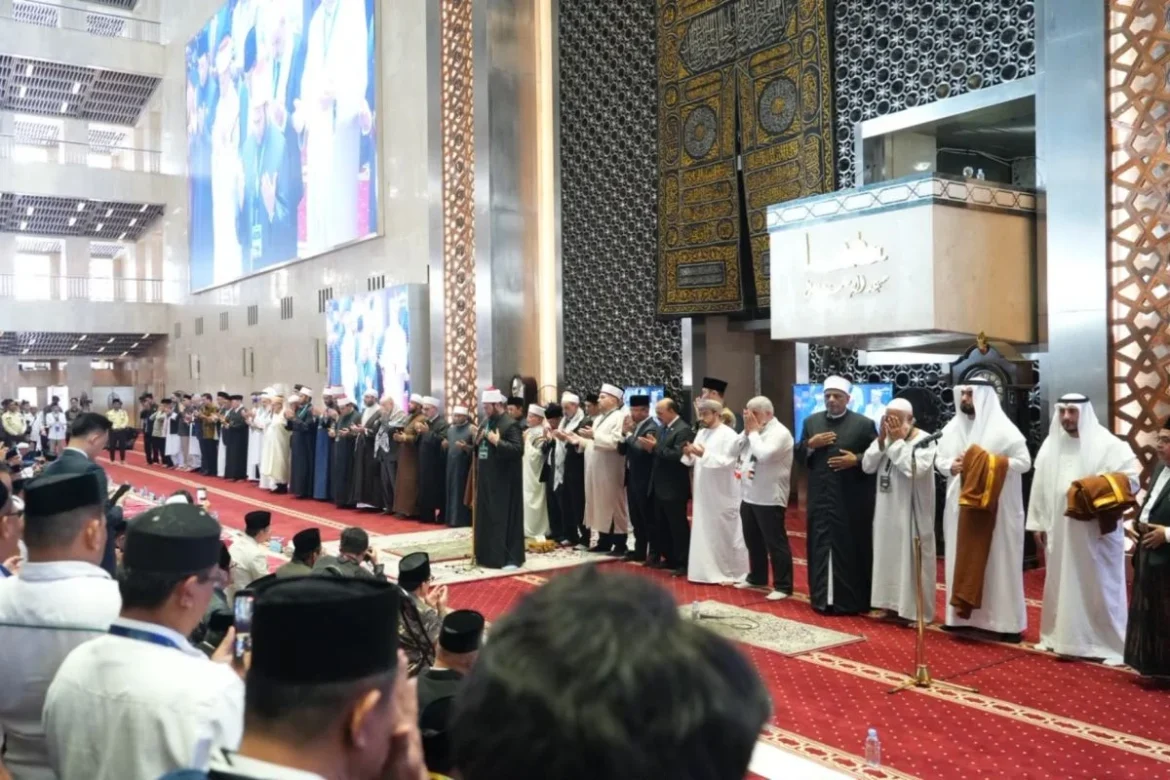
In a profound demonstration of global Islamic solidarity, more than 40 grand imams from across the world converged at the Istiqlal Mosque in Jakarta to lead a collective prayer for the unity of the Muslim community and the protection of the Al Aqsa Mosque. This spiritual gathering, held immediately following Friday prayers, served as a poignant centerpiece of the International Grand Imam Conference (IGIC) 2026, an assembly dedicated to addressing the most pressing issues of global peace, humanitarian crises, and the role of religious leadership in fostering international harmony.
Led by Ahmad Al Showi, a distinguished lecturer from Egypt’s Al-Azhar University, the congregation reverberated with a unified plea for strength, guidance, and reconciliation. The prayer specifically invoked divine intervention to bridge the ideological and political divides that have fragmented the global Muslim population, emphasizing a return to common values and collective resilience.
The Context of the International Grand Imam Conference 2026
The IGIC 2026 represents a landmark moment in modern interfaith and intra-faith diplomacy. Hosted in Jakarta, the capital of the world’s most populous Muslim-majority nation, the conference serves as a strategic platform for religious scholars and leaders to deliberate on the challenges of the 21st century. The event, which has drawn participants from diverse geopolitical landscapes, focuses on three primary pillars: social cohesion, the mitigation of humanitarian crises, and the advocacy for the sanctity of holy sites.
The selection of Jakarta as the host city is symbolic. Indonesia, known for its constitutional commitment to an independent and active foreign policy, has consistently positioned itself as a mediator in global conflicts, particularly regarding the rights of the Palestinian people. The presence of international grand imams at the Istiqlal Mosque—a symbol of national pride and religious tolerance—underscores the importance of Indonesia’s moral influence on the global stage.
A Chronology of the Gathering and Collective Prayer
The proceedings on Friday followed a structured agenda that began with the Friday congregational prayer (Jumu’ah), which saw a massive turnout of both delegates and local worshipers. Upon the conclusion of the prayer, the assembly of grand imams took the pulpit to lead the special invocation.
The prayer, delivered by Ahmad Al Showi, was marked by its intensity and focus on three distinct areas:
- Unity of the Ummah: A request for divine guidance to mend the fractures within the Muslim world and to strengthen the collective resolve of its people.
- Leadership and Accountability: A plea for the leaders of Muslim-majority nations to be granted the wisdom to govern with justice and to be surrounded by advisors who champion truth and human welfare.
- The Sovereignty of Al Aqsa: A central petition for the protection and restoration of the Al Aqsa Mosque, asking for the facilitation of peaceful access for all believers to practice their faith in the sacred site.
The session was not merely a ritual but a deliberate act of public diplomacy. By recording these prayers in the presence of international media and government officials, the participants aimed to bring the issue of Al Aqsa back to the forefront of the global human rights discourse.
Official Statements and Diplomatic Stance
The spiritual proceedings were bolstered by firm political statements from the Indonesian government. Minister of Religious Affairs Nasaruddin Umar, speaking to the media alongside high-ranking Palestinian representatives, reiterated the nation’s unwavering commitment to the Palestinian cause.
"Indonesia will always and forever stand with Palestine," Minister Umar declared. His statement came during a high-level bilateral meeting with the Grand Mufti of Al Quds and Imam of the Al Aqsa Mosque, Syekh Muhammad Hussein, and the Advisor to the President of the Palestinian Authority, Mahmoud Al-Habbash.
This diplomatic exchange highlights the "soft power" strategy employed by the Indonesian government. By hosting such influential figures, Jakarta reinforces its status as a reliable ally to the Palestinian people, utilizing the moral authority of religious leaders to amplify their political grievances on a global platform. The dialogue between Minister Umar and the Palestinian delegates touched upon the necessity of utilizing religious rhetoric to promote environmental stewardship and social harmony—two additional themes highlighted throughout the IGIC 2026.
Data and Implications: The Role of Mosques in Peacebuilding
The focus on Al Aqsa is not coincidental. Data from various international monitoring bodies suggest that the status of holy sites in occupied territories remains a primary flashpoint for regional instability. By centering the discussion on the "freedom of worship," the IGIC 2026 aims to reframe the conflict in a language that transcends purely political or territorial disputes, appealing instead to the universal human right of religious freedom.
The conference also serves as a workshop for "moderate religious discourse." In an era where extremist narratives often dominate the digital landscape, the collective voice of 40-plus grand imams acts as a counterweight. The conference organizers emphasized that mosques must function as centers of harmony, education, and community support, rather than being repurposed for political radicalization.
The Generational Dimension of the Appeal
One of the most notable aspects of the Friday prayer was its focus on intergenerational legacy. The invocation included a specific request that if the current generation is unable to see the restoration of peace and freedom in Al Aqsa, the hope for such a resolution should be passed down to the youth. This acknowledgment of the "long game" in diplomacy reflects a realistic understanding of the geopolitical obstacles in the Middle East. It serves to sustain the momentum of the movement, ensuring that the advocacy for justice is not a fleeting trend but a core pillar of the faith for future generations.
Analyzing the Impact of the Jakarta Declaration
The IGIC 2026 is expected to conclude with a "Jakarta Declaration," a document that will likely codify the principles discussed during the assembly. While the declaration is not legally binding in an international court, its political weight is significant.
- Global Legitimacy: By garnering the consensus of religious scholars from disparate schools of thought, the declaration provides a unified moral framework that governments can cite when advocating for Palestinian rights in forums like the United Nations or the Organization of Islamic Cooperation (OIC).
- Harmonizing Religious Law with Modern Governance: The conference has provided a rare venue for scholars to discuss how traditional Islamic jurisprudence can address modern crises, such as the humanitarian impacts of warfare and the displacement of civilian populations.
- Counter-Radicalization: By promoting a collective identity that prioritizes peace and justice, the conference undermines the messaging of extremist groups that often attempt to exploit the despair of displaced populations.
Broader Implications for Global Stability
The gathering at Istiqlal Mosque signifies a shift in how religious institutions engage with global politics. Rather than remaining isolated within the confines of theology, the grand imams are actively utilizing their positions to demand accountability and justice for systemic injustices.
The implications of this summit are twofold. First, it places renewed pressure on international actors to address the status of Jerusalem and the surrounding holy sites, as the issue is now being championed by a unified, global coalition of religious leaders. Second, it reaffirms Indonesia’s leadership role in the global Muslim community. By successfully hosting an event of this scale and sensitivity, Jakarta has demonstrated its ability to facilitate complex diplomatic dialogues, bridging the gap between spiritual ideals and political realities.
As the IGIC 2026 draws to a close, the resonance of the prayers recited by Ahmad Al Showi continues to linger. The call for unity, the protection of sacred sites, and the plea for divine guidance for world leaders serve as a reminder that even in the face of deep-seated conflict, the pursuit of justice remains a binding force that transcends borders and cultures. Whether these prayers will lead to tangible shifts in international policy remains to be seen, but the event itself has undeniably strengthened the narrative of solidarity that characterizes the current Indonesian approach to global affairs.
Through the careful orchestration of this conference, the organizers have succeeded in elevating the discourse surrounding the Al Aqsa Mosque from a regional conflict to a matter of global moral concern, ensuring that the plight of those in the region remains at the forefront of the international consciousness. The legacy of this assembly will likely be measured by the continued efforts of these 40 leaders to implement the principles of peace and harmony within their own respective nations, creating a ripple effect that could influence the trajectory of global religious discourse for years to come.
