
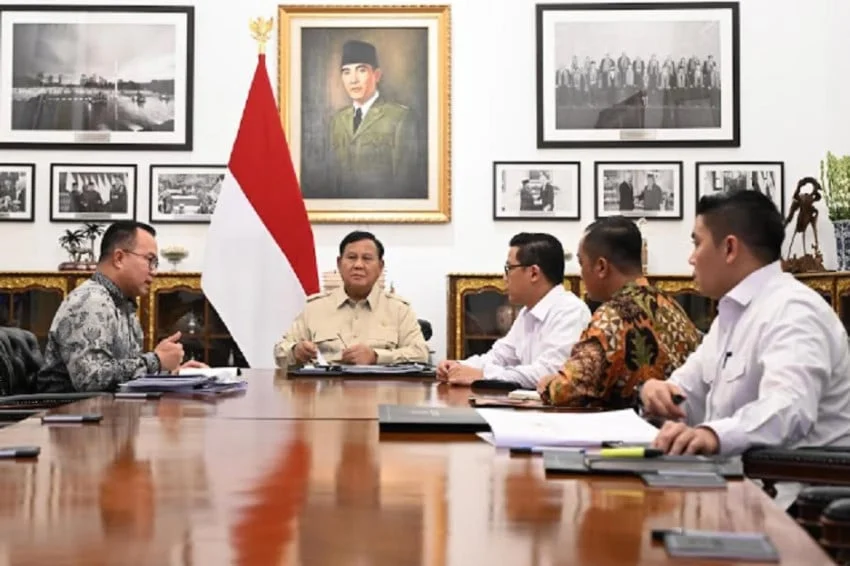
In a high-level meeting held at the Merdeka Palace in Jakarta on Tuesday, October 27, 2026, President Prabowo Subianto engaged in a comprehensive dialogue with the Head of the National Research and Innovation Agency (BRIN), Arif Satria. The consultation served as a pivotal platform for the government to align national research agendas with the current administration’s pressing socio-economic and environmental mandates. As Indonesia navigates complex challenges ranging from climate-induced disasters to the pursuit of energy sovereignty, the meeting underscored the government’s pivot toward science-based policymaking as a cornerstone of its governance strategy.
Strategic Agenda: From Environmental Resilience to Energy Innovation
The discussion between President Prabowo and the BRIN leadership spanned several critical sectors, reflecting the government’s intent to utilize scientific advancement as a practical tool for national development. Central to the dialogue were four key pillars: the mitigation of forest and land fires (karhutla), the development of alternative energy sources derived from palm oil waste, the acceleration of national vaccine and herbal medicine research, and the deployment of advanced technology to address the escalating urban waste management crisis.
For the administration, these topics represent more than mere scientific inquiries; they are existential issues that directly impact the Indonesian economy and the welfare of its citizens. The focus on palm oil waste, in particular, signals a strategic shift toward circular economy models, aiming to maximize the utility of Indonesia’s largest commodity while reducing environmental footprints and creating new revenue streams in the bio-energy sector.
Addressing the Karhutla Crisis: A Multidisciplinary Approach
Forest and land fires remain one of the most significant environmental threats to Indonesia, causing transboundary haze, biodiversity loss, and immense economic disruption. During the meeting, President Prabowo emphasized the need for a tiered approach to the crisis, moving beyond reactive emergency measures toward a proactive, science-driven prevention strategy.
BRIN’s current efforts, as reported by Arif Satria, involve a multi-agency synergy. The agency has been working in close coordination with the Meteorology, Climatology, and Geophysics Agency (BMKG), the National Disaster Management Agency (BNPB), the Ministry of Forestry, and the Indonesian Air Force. This coalition is tasked with the execution of Weather Modification Operations (WMO), which have increasingly utilized innovative techniques such as dry ice seeding to induce rainfall in critical areas.
However, the President’s directive goes deeper. He urged BRIN to focus on long-term predictive capabilities, specifically requesting the development of sophisticated models to map fire propagation. By understanding the dynamics of how fires spread across different types of peatland and forest topography, the government aims to deploy early-warning systems that can neutralize fire threats before they reach critical proportions.
Chronology of Collaborative Research Efforts
The collaboration between BRIN and the executive branch has intensified over the past eighteen months. Following the transition in government, the administration prioritized the integration of BRIN’s research output into the national budget planning process.
- Q1 2026: Initial policy reviews conducted by the Cabinet Secretariat to identify gaps in national disaster preparedness.
- May 2026: President Prabowo issues a mandate for BRIN to prioritize the "Food and Energy Security" research cluster, specifically focusing on non-food applications of palm oil.
- August 2026: Successful pilot of advanced drone-based monitoring for fire hotspots in Kalimantan, demonstrating the efficacy of BRIN’s sensor technologies.
- October 27, 2026: The meeting at Merdeka Palace, where the President demanded a clear roadmap for the commercialization of herbal medicine research and the scaling of waste-to-energy technologies.
Scientific Implications and Data-Driven Governance
The reliance on BRIN reflects a broader transition in Indonesian governance: the shift from anecdotal decision-making to data-driven policy. In the context of vaccine research and herbal medicine, the President’s focus is on reducing Indonesia’s dependence on imported pharmaceuticals. With a vast biodiversity profile, Indonesia holds significant untapped potential in the development of standardized herbal medicines (fitofarmaka). BRIN is currently tasked with accelerating the clinical trials and regulatory approval processes for these products, potentially creating a new export sector for the nation.
Furthermore, the waste-to-energy initiative is a response to the mounting pressure on Indonesia’s landfills, particularly in Java. By applying thermal and chemical technologies to convert organic and non-organic waste into electricity or biofuels, the government intends to solve two problems simultaneously: the sanitation crisis and the demand for decentralized renewable energy.
Official Responses and Institutional Expectations
Following the meeting, Arif Satria reaffirmed the agency’s commitment to the President’s vision. "Bapak President continues to monitor the situation regarding forest fires and emphasizes that research results must be actionable—providing solutions for short, medium, and long-term challenges," Satria stated. He acknowledged that the institutional weight of BRIN is being leveraged to provide the empirical backbone for the government’s climate adaptation strategies.
Independent observers and academic partners have reacted positively to the explicit link between the Palace and the research agency. Experts note that for BRIN to be effective, it must maintain a delicate balance between academic independence and government alignment. The President’s direct engagement is viewed by many as a necessary catalyst to cut through the bureaucratic inertia that has historically plagued large-scale research initiatives in Indonesia.
Economic and Environmental Implications
The integration of research into the national economic agenda has significant implications. If successful, the projects discussed during the meeting could reshape the Indonesian energy landscape by 2030. The development of alternative energy from palm oil waste, for example, offers a path to stabilize energy prices while bolstering the agricultural sector.
Similarly, the focus on "fire propagation modeling" is expected to change the operational strategy of the Ministry of Forestry. By utilizing big data and artificial intelligence, the government can shift its limited resources toward "high-risk, high-probability" zones, significantly increasing the efficiency of disaster response teams.
The social impact of these initiatives is equally profound. By fostering an environment where research is treated as a strategic national asset, the government is incentivizing a new generation of scientists and engineers to address local problems. This contributes to the overarching goal of building a "Knowledge-Based Economy," a key pillar of Indonesia’s national development plan for the next decade.
Looking Ahead: The Path to 2027 and Beyond
As the meeting concluded, it was clear that the relationship between the Presidency and BRIN is entering a more operational phase. The President’s insistence on "long-term anticipation" suggests that the government is looking beyond the immediate fiscal year. Future directives are expected to include increased funding for research infrastructure, particularly in laboratory upgrades and high-performance computing clusters required for complex climate modeling.
For the scientific community, the challenge now lies in execution. The ability of BRIN to translate theoretical models into deployable technology will be the ultimate test of this partnership. With the President’s direct oversight, the agency is under intense pressure to deliver tangible results that move beyond the laboratory and into the field, whether that involves fire-suppression drones, new vaccine candidates, or waste-to-energy plants.
In conclusion, the meeting between President Prabowo Subianto and Arif Satria marks a significant milestone in Indonesia’s strategic planning. By prioritizing science as a primary driver of policy, the administration is signaling a modern, proactive approach to governance. As the nation faces increasing environmental and economic complexities, the synergy between the Presidential office and the national research apparatus will likely become the definitive factor in Indonesia’s ability to secure a sustainable and resilient future. The upcoming quarters will be critical in determining the scalability of these research initiatives and their ultimate impact on the Indonesian public.
