
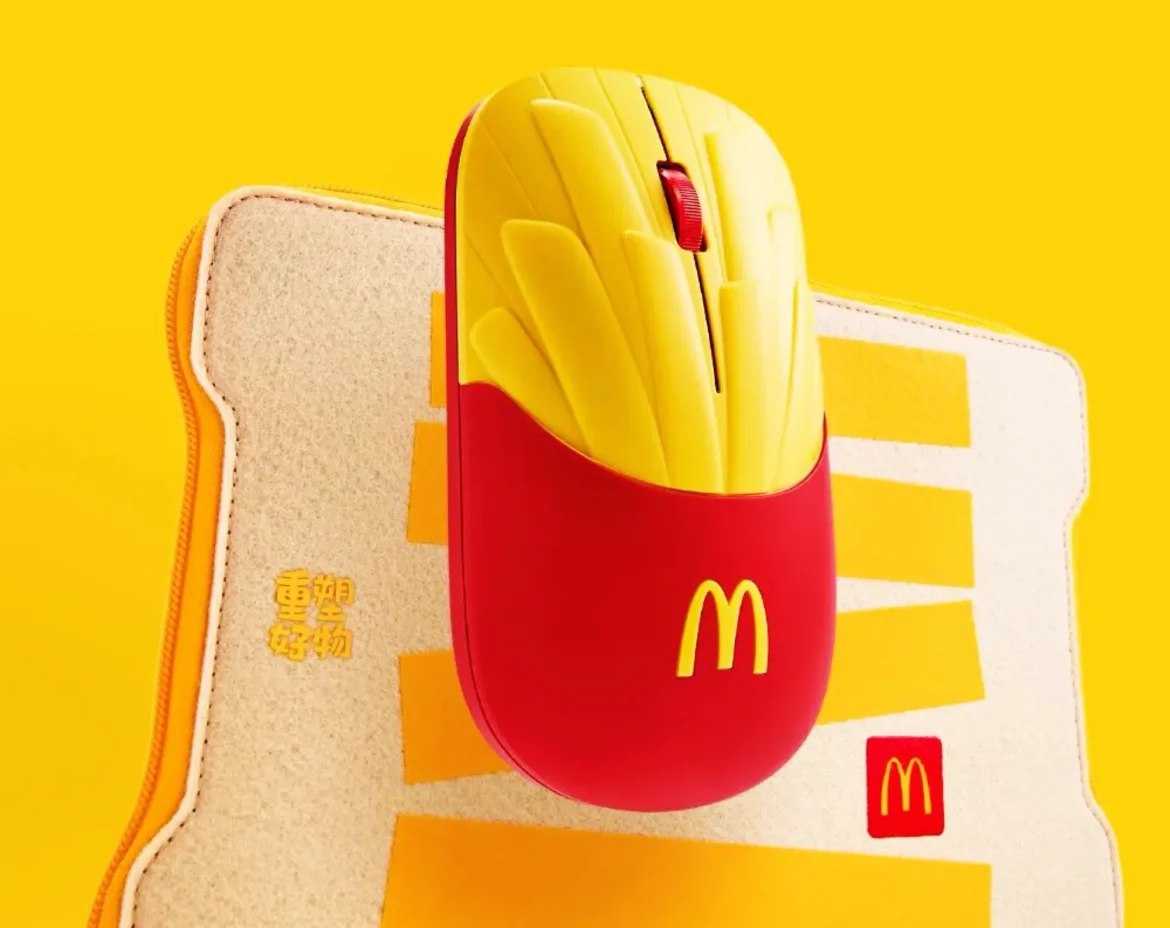
In an unexpected cross-industry collaboration that marries fast-food pop culture with consumer electronics, McDonald’s China has partnered with global tech giant Lenovo to introduce a distinctive wireless computer peripheral. Dubbed the "McDonald’s Fry Mark," the device breaks away from traditional ergonomic computer mouse designs by taking the unmistakable shape of McDonald’s iconic red French fry packaging. Beyond its quirky aesthetics, the peripheral carries a strong sustainability narrative: more than 60 percent of the plastic utilized in its external body is derived from recycled, post-consumer Happy Meal toys.
The announcement, which quickly captured the attention of tech enthusiasts, fast-food aficionados, and environmental advocates alike, highlights a growing trend among major corporations to repurpose legacy waste into functional, high-demand lifestyle products. With a strictly limited production run of just 4,000 units globally, the Fry Mark is positioned not only as a functional tool for everyday computing but also as a highly coveted collector’s item.
Design, Materials, and Environmental Initiatives
The core philosophy behind the McDonald’s Fry Mark centers on circular economy principles and waste reduction. For decades, fast-food chains have distributed billions of plastic toys alongside their children’s meals. While these items bring temporary joy to consumers, a significant portion inevitably ends up in landfills, contributing to the global plastic crisis. By establishing a recycling pipeline, McDonald’s China and Lenovo have engineered a method to collect, melt down, and re-pelletize these legacy plastic items to form the structural casing of a modern computer accessory.
The commitment to sustainability extends beyond the product itself. In a move to eliminate single-use plastics from the entire unboxing experience, McDonald’s has packaged the Fry Mark in minimalist, biodegradable cardboard boxes devoid of plastic windows or laminates. Furthermore, the retail bundle includes a versatile fabric storage pouch that doubles as an impromptu mouse pad, minimizing the need for additional synthetic accessories and emphasizing multi-functional utility.

Despite its unconventional, novelty-driven silhouette, Lenovo’s engineering division ensured that the Fry Mark does not compromise on core functionality. The mouse is engineered to support triple-mode connectivity, allowing users to pair it seamlessly with desktop computers, laptops, and tablets via Bluetooth, a standard 2.4 GHz wireless USB dongle, or a wired USB connection. Powering the device is a built-in 380mAh rechargeable battery, replenished efficiently through a modern USB Type-C port, ensuring compatibility with contemporary charging standards.
Chronology and Market Availability
The development and rollout of the McDonald’s Fry Mark reflect a carefully timed marketing strategy designed to coincide with broader corporate sustainability targets in the East Asian market. Planning for the cross-branded peripheral began covertly months prior, with engineers from Lenovo working alongside McDonald’s supply chain managers in China to test the structural integrity of recycled Happy Meal plastics. Traditional consumer plastics undergo rigorous stress testing to prevent degradation; ensuring that recycled toy plastics could withstand the physical demands of daily clicking, scrolling, and traveling required innovative material blending techniques.
Upon its official unveiling in late October 2026, the device was designated as an exclusive regional release tailored for the Chinese market. Priced accessibly at 99 yuan (approximately $14 USD or equivalent to around Rp230,000), the limited allocation of 4,000 units triggered immediate demand surges across digital storefronts. Because of its scarcity, the product crossed over from a standard corporate merchandise drop into the realm of secondary-market speculation, with collectors actively tracking availability.
Industry Implications and Corporate Strategy
The collaboration between McDonald’s and Lenovo is indicative of a wider strategic shift in how non-tech brands leverage technology to capture consumer mindshare. In recent years, fast-food chains have increasingly ventured into consumer electronics, apparel, and home goods to maintain cultural relevance among younger, tech-savvy demographics, particularly Generation Z and millennials. By partnering with a reputable hardware manufacturer like Lenovo, McDonald’s ensures that the product maintains a baseline level of electronic reliability rather than functioning merely as cheap plastic merchandise.
From Lenovo’s perspective, the partnership provides an opportunity to showcase its material science capabilities and commitment to corporate social responsibility (CSR). As regulatory scrutiny over electronic waste (e-waste) and corporate carbon footprints intensifies globally, hardware manufacturers are under mounting pressure to incorporate recycled post-consumer plastics (PCR) into their primary product lines. Collaborating on a high-visibility, lighthearted project allows Lenovo to experiment with recycled supply chains while generating positive brand goodwill and viral social media marketing.

Industry analysts note that while novelty items like the Fry Mark represent a relatively small percentage of total hardware manufacturing, they serve as powerful testbeds for sustainable material sourcing. The insights gained from breaking down and re-polymerizing mixed-plastic Happy Meal toys can theoretically be scaled up to inform the manufacturing processes of more traditional enterprise hardware, such as laptop chassis, keyboard housings, and standard office mice.
Consumer Reception and Broader Cultural Impact
Within the technology community, the reaction to the McDonald’s Fry Mark has been largely positive, praised for injecting a sense of humor and personality into an otherwise utilitarian peripheral market characterized by monotonous black and gray office supplies. Reviewers have highlighted the irony of using a device shaped like fast food to perform mundane spreadsheet tasks or creative digital work, noting that it invariably serves as an icebreaker in public workspaces, coffee shops, and university libraries.
At the same time, environmental watchdogs have offered measured praise, acknowledging the positive step of keeping legacy plastics out of landfills while reminding consumers that corporate sustainability must extend far beyond limited-edition promotional goods. True environmental impact in the fast-food and tech sectors requires systemic overhauls of core packaging and manufacturing lines rather than isolated, collectible novelty drops. Nevertheless, as a proof-of-concept for upcycling consumer goods into functional technology, the McDonald’s Fry Mark stands out as a memorable milestone in modern corporate collaboration.
As stocks deplete rapidly across China, consumers outside the region continue to voice demand for international availability, though neither McDonald’s nor Lenovo has announced plans to expand the production run beyond the initial 4,000 units. Whether the Fry Mark remains a rare collector’s artifact or paves the way for a broader wave of upcycled tech collaborations remains to be seen, but it has undoubtedly succeeded in transforming childhood nostalgia into a modern computing reality.
