
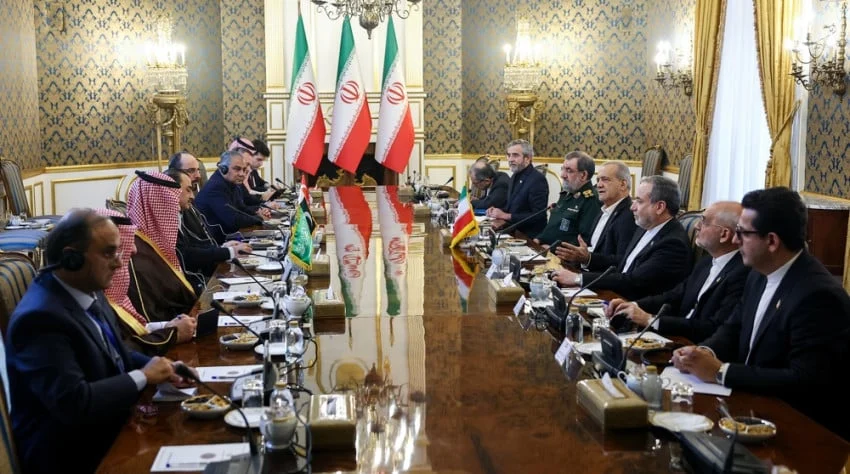
TEHRAN — In what senior officials in Tehran are describing as a profound geopolitical turning point, Iran has welcomed a high-level quadrilateral meeting in its capital involving representatives from Pakistan, Saudi Arabia, and Turkey. The summit, convened under the auspices of the Supreme National Security Council (SNSC), has been hailed by Iranian leadership as a direct vindication of the country’s long-standing doctrine of self-reliance and asymmetric resilience. According to Iranian state and security officials, the convergence of these influential Muslim-majority nations in Tehran underscores a shifting paradigm in Middle Eastern and South Asian security architecture—one that increasingly sidelines traditional Western hegemony in favor of indigenous, regional frameworks.
The high-stakes diplomatic encounter, led by SNSC Secretary Major General Mohsen Rezaei and detailed by Deputy SNSC Secretary Ali Bagheri Kani, brings to the forefront a complex web of shifting alliances, economic imperatives, and security recalculations. For decades, the geopolitical chessboard of the Middle East was defined by rigid polarities, often dictated by external superpowers. However, the Tehran summit suggests a growing consensus among regional heavyweights that long-term stability cannot be outsourced to Washington or other extra-regional capitals. Instead, the participating nations have signaled an appetite for inclusive multilateralism, even as underlying policy differences and historical rivalries persist.
Chronology of the Diplomatic Breakthrough
The path to the Tehran quadrilateral summit was neither immediate nor straightforward, reflecting years of nuanced back-channel diplomacy, shifting threat perceptions, and gradual normalization processes across the region.
The foundational groundwork for this regional alignment can be traced back to the easing of diplomatic tensions between Saudi Arabia and Iran, brokered in March 2023 in Beijing. That landmark détente broke a seven-year freeze in bilateral relations and opened channels for broader regional dialogue. Following the restoration of diplomatic ties, various sub-regional coalitions began testing the waters for broader security and economic cooperation.
In the months preceding the Tehran meeting, Pakistan, Saudi Arabia, and Turkey had engaged in a series of tripartite consultations aimed at addressing overlapping security concerns, ranging from counter-terrorism in South Asia and Central Asia to trade routes and border security. During these preliminary talks, the participating nations recognized that any comprehensive regional security framework would remain fundamentally incomplete without the active participation of Iran, given its pivotal geographic position connecting West Asia, Central Asia, and South Asia.
According to diplomatic sources, Pakistan played a crucial bridging role in facilitating the inclusion of Iran. During a recent state visit to Tehran, Pakistan’s Chief of Army Staff, Field Marshal Asim Munir, personally conveyed to Major General Mohsen Rezaei the collective desire of Riyadh, Ankara, and Islamabad to convene a joint summit. Significantly, while initial proposals had contemplated holding the meeting in a neutral venue, the three nations ultimately agreed to travel directly to Tehran, accepting terms that Iranian officials viewed as a diplomatic acknowledgment of the Islamic Republic’s standing.
The culminating summit took place on a Monday in Tehran, bringing together security chiefs and high-ranking diplomats to evaluate regional vulnerabilities, economic integration, and the shifting dynamics of global security partnerships.
Shifting Security Paradigms: The Demise of External Reliance
A central theme of the post-summit briefings delivered by Ali Bagheri Kani was the diminishing utility of relying on external security guarantees. For decades, various nations in the Middle East and South Asia operated under the strategic assumption that formal alliances with global superpowers—chiefly the United States—served as an impenetrable shield against regional threats.
Bagheri Kani bluntly challenged this historical assumption, stating that several regional states had previously invested heavily in the belief that alignment with Western military might would guarantee absolute protection. However, recent geopolitical crises have exposed the limitations of such pacts. From protracted conflicts in Yemen, Syria, and Afghanistan to shifting U.S. foreign policy priorities that favor strategic retrenchment over open-ended regional entanglement, allied nations have increasingly found themselves forced to manage local conflicts independently.
"Several countries in this region once imagined that by allying with great powers like the United States, they could protect themselves from any threat," Bagheri Kani remarked during his post-summit address. "However, in practice, they discovered that this notion does not correspond with reality. Consequently, these nations concluded that there is no alternative other than engaging in regional cooperation and building security based on synergy among the countries of the region."
This philosophical shift aligns with broader trends in international relations, where middle powers are increasingly asserting strategic autonomy. For Iran, which has endured decades of rigorous economic sanctions and diplomatic isolation orchestrated by the U.S. and its allies, this realization among its neighbors is interpreted as a vindication of its steadfast resistance economy and military self-sufficiency.
Strategic Implications and Regional Dynamics
The convergence of Iran, Pakistan, Saudi Arabia, and Turkey carries profound implications for the geopolitical landscape of the wider region. While these four nations represent diverse political systems, sectarian traditions, and foreign policy orientations, their willingness to sit at the same negotiating table points to a pragmatic recognition of shared vulnerabilities.
-
Economic Integration and Trade Corridors
Security and economic development are inextricably linked. The Tehran summit addressed the necessity of safeguarding regional trade routes, such as the Trans-Asian railway networks and maritime corridors connecting the Persian Gulf to the Arabian Sea and the Caspian region. Enhanced stability reduces insurance premiums on shipping, lowers transaction costs, and fosters cross-border investments. -
Counter-Terrorism and Border Security
Pakistan and Iran share a porous, strategically sensitive border plagued by cross-border militant activity. Similarly, Turkey and Iran maintain complex security dynamics regarding Kurdish separatist movements and regional spillover from the Syrian conflict. A collaborative security dialogue allows these states to share intelligence, coordinate border patrols, and neutralize non-state actors before they destabilize domestic stability. -
Managing the Palestine Question and Regional Flashpoints
The timing of the summit also coincides with heightened geopolitical volatility stemming from the ongoing conflict in Gaza and its broader ramifications across West Asia. The destabilization of the Israeli regime’s strategic calculus—referred to by Iranian officials as a core objective of regional resistance—has accelerated the urgency for Muslim-majority nations to present a unified diplomatic front. By engaging with both the Gulf monarchies and non-Arab regional powers like Turkey and Pakistan, Tehran seeks to consolidate a pan-regional consensus centered on Palestinian self-determination and opposition to unilateral Western interventions.
Official Responses and Domestic Reception in Iran
Within Iran, state media and political analysts have framed the quadrilateral meeting as a major triumph for the administration’s "neighborhood first" foreign policy. The doctrine, championed heavily by successive Iranian administrations, prioritizes deepening diplomatic, economic, and security ties with immediate neighbors over pursuit of agreements with distant Western powers.
Major General Mohsen Rezaei emphasized that the resilience of the Iranian armed forces, coupled with the steadfastness of the Iranian populace under severe economic pressure, created the structural conditions that compelled regional rivals to seek direct engagement. By weathering years of maximum pressure campaigns, Iran has demonstrated that it cannot be easily bypassed or isolated.
Independent analysts, however, offer a more measured assessment. While acknowledging the diplomatic significance of the gathering, foreign policy experts note that profound differences remain between Tehran and capitals such as Riyadh and Ankara, particularly regarding regional influence in Syria, Iraq, and the Caucasus. Nevertheless, the willingness to institutionalize dialogue indicates that these nations prefer diplomatic engagement over destructive proxy competition.
Broader Global Impact: The Rise of Multipolarity
The Tehran quadrilateral summit is part of a larger global trend toward multipolarity, characterized by the decline of unipolar American dominance and the rise of regional multilateral institutions. Organizations such as the Shanghai Cooperation Organisation (SCO) and BRICS—both of which count several of these nations as members or dialogue partners—have provided alternative platforms for diplomacy that bypass Western capitals.
By hosting Pakistan, Saudi Arabia, and Turkey, Iran has projected an image of diplomatic normalcy and regional leadership. For Saudi Arabia, participation in the summit reflects a pragmatic pivot toward economic diversification under Vision 2030, which requires a stable and secure regional environment. For Turkey, maintaining constructive ties with both Iran and its traditional Western allies reflects a balancing act designed to maximize Ankara’s leverage as a Eurasian transit and energy hub. For Pakistan, balancing relations with Saudi Arabia and Iran is an enduring geopolitical imperative dictated by domestic stability and regional equilibrium.
Conclusion
As the dust settles on the Tehran quadrilateral meeting, the diplomatic landscape of West and South Asia continues to evolve. Whether this specific coalition will institutionalize into a permanent security architecture remains to be seen. However, the mere fact of its occurrence marks a decisive departure from past paradigms of division and proxy warfare. For Iran, the summit represents tangible diplomatic dividends born from strategic patience and regional outreach. As Tehran and its regional counterparts navigate an uncertain global order, the emphasis on indigenous solutions, multilateral cooperation, and mutual economic interests is poised to redefine the future of regional security.
