
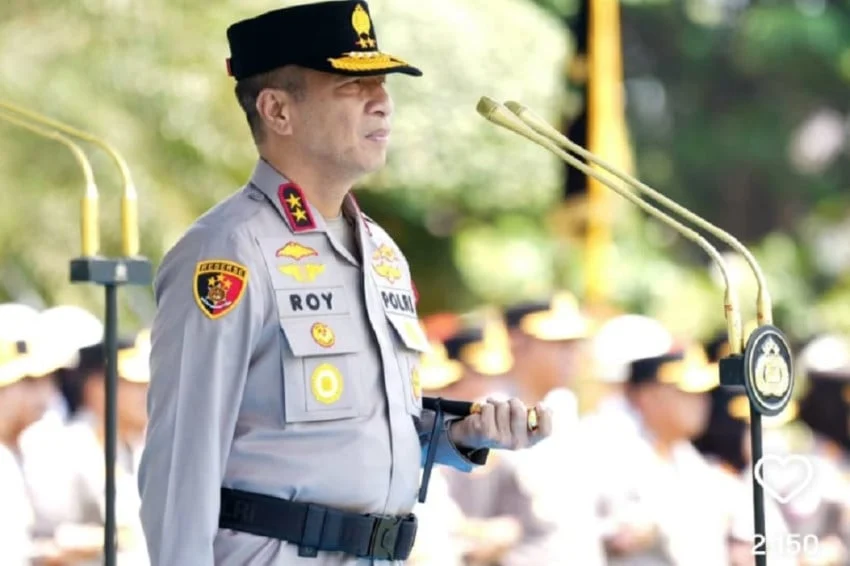
The Indonesian National Police has officially announced a major leadership reshuffle within its regional ranks, appointing Inspector General Roy Hardi Siahaan as the new Central Java Police Chief. The strategic transition sees him stepping into the role previously held by Inspector General Ribut Hari Wibowo, who has been reassigned to serve as the Vice Head of the Police Education and Training Institute (Wakalemdiklat Polri). This high-profile command change, formalized under the official Kapolri Telegram Letter Number ST/2205/X/KEP./2026 dated October 2, 2026, comes at a critically sensitive juncture for the regional police command.
While leadership transitions are a routine part of institutional refreshment and career progression within the National Police headquarters, Inspector General Roy Hardi Siahaan assumes his new responsibilities under an intense public spotlight. His ascension to the top regional post in Central Java coincides with ongoing controversies and institutional inquiries involving his predecessor and local law enforcement units. As the newly minted Central Java Police Chief, Roy Hardi Siahaan faces the immediate dual challenge of commanding one of the country’s most politically and socially significant regional jurisdictions while simultaneously steering the institution through a period of heightened public scrutiny regarding police accountability and procedural transparency.
Background Context of the Leadership Transition
The appointment of Inspector General Roy Hardi Siahaan is part of a broader periodic evaluation conducted by the National Police headquarters to optimize operational readiness across various provincial commands. Central Java remains a vital administrative and security stronghold in the national landscape, requiring meticulous oversight, particularly concerning public order, inter-faith relations, and community policing.
Roy Hardi Siahaan, born in Medan, North Sumatra, on February 16, 1970, brings an extensive operational background to his new assignment. A distinguished graduate of the Police Academy (Akpol) class of 1993, his career trajectory has been heavily defined by specialized work in the detective and criminal investigation sector. Throughout his decades-long service within the Bhayangkara Corps, he has developed a reputation as a seasoned investigator, with a significant portion of his career dedicated to narcotics eradication and high-level criminal enforcement. Notably, professional records indicate a deep operational history shared with current National Police Chief General Suyudi Ario Seto, with whom Roy previously served within the ranks of the National Narcotics Agency (BNN). This shared professional background underscores a high level of institutional trust from police leadership, even as external pressures mount.
The Catalyst Controversy: The Hamalatul Qur’an Raid
Despite his extensive investigative credentials, Inspector General Roy Hardi Siahaan’s recent prominence extends beyond his promotion, rooting itself in a deeply contentious enforcement action that sparked nationwide debate. Just weeks prior to his formal assumption of duties in Central Java, the high-ranking officer became the subject of a formal ethics complaint lodged with the internal Internal Professional and Security Division (Divisi Propam Polri).
The grievance stems from a controversial police operation conducted on Tuesday, October 27, 2026, involving the search and raid of a female student dormitory situated within the Hamalatul Qur’an Islamic Boarding School (Pondok Pesantren Hamalatul Qur’an). The enforcement action, which allegedly saw law enforcement personnel enter the private residential quarters of female students, immediately drew fierce condemnation from civil society organizations, religious leaders, and human rights advocates. Critics argued that the methods employed during the search breached standard operating procedures regarding privacy, institutional respect for educational and religious facilities, and the psychological well-being of the minor students residing at the dormitory.
Chronology of Events and Propam Filings
The sequence of events leading up to the current administrative and ethical crisis unfolded rapidly over a critical ten-day period in late October and early November 2026.
On October 27, 2026, units operating under regional jurisdiction executed the raid on the Hamalatul Qur’an Islamic Boarding School. The operation targeted the female dormitory under the pretext of an active criminal investigation, though initial disclosures regarding the precise legal justifications remained sparse, fueling immediate public speculation and outcry.
Within days of the incident, community outrage translated into formal legal and institutional challenges. On Tuesday, November 3, 2026, legal representatives and concerned community stakeholders formally registered a comprehensive complaint with Propam Polri. The petition explicitly named key regional law enforcement figures, including top regional commanders, holding them command-accountable for the alleged procedural overreach and ethical violations committed during the Sukoharjo-based raid.
The convergence of the high-level police reshuffle announced via Telegram on October 2 and the subsequent Propam filings in early November has created a complex political and operational landscape for the newly appointed Central Java Police Chief. Legal analysts and institutional watchdogs have closely monitored the timeline, noting that the leadership shift occurs precisely as the regional command must account for the actions taken during the October 27 operation.
Official Responses and Institutional Accountability
In the wake of the formal complaints lodged with Propam Polri, institutional stakeholders have faced mounting pressure to deliver transparent accounts of the Hamalatul Qur’an raid. The internal affairs division of the National Police is mandated under standard administrative protocols to conduct a thorough, impartial investigation into any ethical grievances or reports of professional misconduct filed against high-ranking officers and regional chiefs.
While the National Police headquarters has maintained that the issuance of Telegram Letter ST/2205/X/KEP./2026 was part of a scheduled administrative rotation, internal sources acknowledge that the timing necessitates a delicate balancing act. The leadership under Roy Hardi Siahaan is expected to cooperate fully with the ongoing Propam inquiries to ensure that institutional integrity is maintained. Legal experts point out that the principle of command responsibility dictates that senior regional officers must answer for operational breaches executed under their purview, regardless of whether they directly ordered the specific tactical maneuvers in question.
Community and Legal Reactions
The raid on the Hamalatul Qur’an boarding school has triggered profound reactions across Indonesia’s socio-religious spectrum. Islamic organizations, educational networks, and legal aid institutions have voiced deep apprehension regarding the safety and rights of students within religious educational institutions. Spokespersons for various community groups have emphasized that while law enforcement agencies retain the legal mandate to investigate criminal matters, such operations must be conducted with strict adherence to proportionality, cultural sensitivity, and human rights standards—particularly when operating within sensitive environments like Islamic boarding schools (pesantren).
Furthermore, legal observers have noted that the inclusion of both the regional police leadership and the local police chief in the Propam complaint signals a shift toward heightened accountability. Civil society watchdogs have demanded that the internal investigation be conducted openly, with findings made accessible to the public to restore trust between the regional constabulary and the communities they serve. The public demand for accountability places an immediate burden on Roy Hardi Siahaan to demonstrate a commitment to reform and transparent governance from the outset of his tenure.
Broader Impact and Strategic Implications for Central Java
The appointment of Inspector General Roy Hardi Siahaan, shadowed by the fallout of the Sukoharjo dormitory raid, carries significant implications for the future of policing in Central Java. As the province prepares for upcoming socio-political events and navigates complex regional dynamics, the stability and credibility of the regional police command remain paramount.
From an administrative perspective, Roy Hardi Siahaan’s extensive background in criminal investigation and narcotics enforcement equips him with the technical expertise required to manage complex criminal syndicates and maintain public order. However, technical proficiency alone may prove insufficient if the regional command fails to address the underlying trust deficit generated by the Hamalatul Qur’an incident. The success of his tenure will likely be measured not only by conventional crime-fighting metrics but also by his ability to rebuild constructive relationships with religious communities, educational institutions, and civil society organizations across Central Java.
Ultimately, the unfolding situation serves as a critical test for the Indonesian National Police’s internal oversight mechanisms. How Propam Polri handles the complaints against the regional leadership will set a vital precedent for institutional accountability. Meanwhile, Inspector General Roy Hardi Siahaan must navigate this turbulent transitional phase with political dexterity, administrative firmness, and an unwavering commitment to procedural justice to steer the Central Java Regional Police through its current challenges toward renewed public confidence.
