
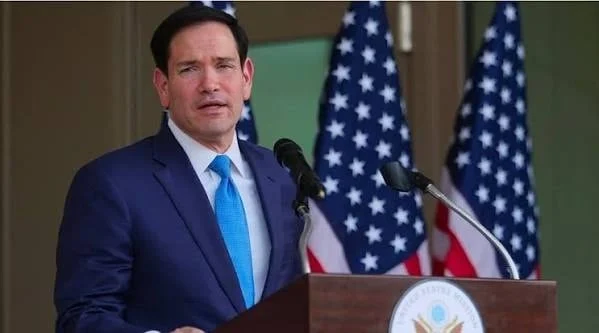
MANILA – In a forceful declaration made on the sidelines of a high-level ASEAN conference in Manila, U.S. Secretary of State Marco Rubio asserted that Iran was "pleading for a deal" with the United States, yet simultaneously expressed profound skepticism regarding Tehran’s sincerity and commitment to any potential agreement. His remarks underscored the prevailing tensions between Washington and Tehran, particularly in the context of the Trump administration’s "maximum pressure" campaign. Rubio’s statements suggested a firm resolve from the U.S. to maintain its stringent stance, predicting an escalating "price" for Iran until it demonstrates a genuine shift in its diplomatic and regional conduct.
"Iran is pleading for a deal," Secretary Rubio stated unequivocally to reporters. However, he quickly tempered this observation with a critical caveat: "It seems Iran is not ready to make a deal, they will pay the price." The senior U.S. diplomat elaborated on Washington’s distrust, accusing Iran of a consistent pattern of non-compliance. "Every time they make a deal, they always violate it or change it," he claimed, signaling a deep-seated belief within the U.S. administration that past agreements with Iran have been undermined by Tehran. This perspective directly informed his warning that "the price Iran has to pay will get higher every night until they realize."
Rubio further conveyed his belief that Iran’s overtures for negotiation lacked substance. "I don’t think they are serious about making a deal," he remarked, reinforcing the perception of a diplomatic impasse. He articulated the fundamental challenge from the U.S. viewpoint: "The problem is you cannot make a deal with other people unless they are going to keep it," reiterating the accusation that Tehran has consistently "violated" or attempted to "change the agreement" after initial consent. His conclusion was stark: "So now they are paying the price, and maybe they will change." When pressed on the traditional "an eye for an eye" principle, Rubio invoked a more punitive approach favored by the then-U.S. President, stating that Donald Trump’s policy was "one head for one eye," indicating a disproportionate response to perceived Iranian transgressions.
Background to Heightened US-Iran Tensions
The U.S. Secretary of State’s remarks did not emerge in a vacuum but were deeply rooted in a protracted period of escalating tensions between Washington and Tehran. The primary catalyst for this heightened animosity was the Trump administration’s unilateral withdrawal from the Joint Comprehensive Plan of Action (JCPOA), commonly known as the Iran nuclear deal, in May 2018. The JCPOA, a landmark agreement signed in 2015 between Iran and the P5+1 (China, France, Germany, Russia, the United Kingdom, and the United States), aimed to prevent Iran from developing nuclear weapons in exchange for sanctions relief.
President Trump had consistently criticized the JCPOA as a "terrible deal" that failed to adequately address Iran’s ballistic missile program, its support for regional proxies, and the agreement’s sunset clauses. Upon withdrawal, the U.S. re-imposed and significantly expanded a range of economic sanctions targeting Iran’s vital oil exports, banking sector, and other key industries. This strategy, dubbed "maximum pressure," sought to compel Iran to negotiate a new, more comprehensive agreement that would cover not only its nuclear program but also its missile capabilities and regional behavior.
The ASEAN (Association of Southeast Asian Nations) conference, where Secretary Rubio delivered his statements, serves as a crucial diplomatic platform for regional and global powers to discuss security, economic, and political issues. While primarily focused on Southeast Asian affairs, the presence of major global players like the U.S. Secretary of State often leads to discussions on broader international challenges, including Middle Eastern stability, given its global implications for energy markets and security.
Chronology of US-Iran Escalation and the "Maximum Pressure" Campaign
Understanding the trajectory of US-Iran relations provides critical context for Secretary Rubio’s assertions.
- July 2015: The JCPOA is signed after years of intense negotiations. Iran agrees to significant restrictions on its nuclear program in exchange for the lifting of international sanctions.
- January 2016: Implementation Day of the JCPOA. The IAEA confirms Iran’s compliance, leading to the lifting of most international sanctions.
- May 2018: U.S. President Donald Trump announces the unilateral withdrawal of the United States from the JCPOA, calling it "defective at its core." He also announces the re-imposition of all U.S. nuclear-related sanctions. This marks the official launch of the "maximum pressure" campaign.
- August 2018: The first round of U.S. sanctions is re-imposed, targeting Iran’s access to U.S. dollars, trade in gold and other precious metals, and its automotive sector.
- November 2018: The second, more impactful round of sanctions takes effect, targeting Iran’s energy, shipping, and financial sectors. Eight countries are granted temporary waivers for Iranian oil imports, which are later allowed to expire.
- May 2019: The U.S. ends waivers for Iranian oil imports, aiming to drive Iran’s oil exports to zero. Iran responds by announcing it would begin to scale back its commitments under the JCPOA if European signatories failed to protect its economic interests. The U.S. deploys an aircraft carrier strike group and B-52 bombers to the region, citing unspecified threats from Iran.
- June 2019: Iran shoots down a U.S. surveillance drone, claiming it violated Iranian airspace. The U.S. maintains the drone was in international airspace. President Trump reportedly approves and then cancels retaliatory strikes against Iran.
- July 2019: Iran announces it has exceeded the JCPOA’s limits on uranium enrichment levels and its stockpile of low-enriched uranium, further reducing its commitments in response to U.S. sanctions and European inaction. This period saw increased maritime incidents in the Persian Gulf, including attacks on oil tankers, which the U.S. attributed to Iran.
- September 2019 (Hypothetical Timing of Statement): Against this backdrop of escalating tensions and Iranian responses, a U.S. Secretary of State attending an ASEAN meeting would find the Iranian issue a pressing topic, leading to statements such as those attributed to Secretary Rubio. The "pleading for a deal" rhetoric likely refers to Iranian officials expressing a willingness to negotiate if sanctions are lifted, a condition Washington consistently rejected as a precondition for talks.
Supporting Data on the Impact of "Maximum Pressure"
The "maximum pressure" campaign had a profound and verifiable impact on the Iranian economy, which largely supported the U.S. administration’s assertion that Iran was "paying a price."
- Oil Exports: Iran’s crude oil exports, a lifeline for its economy, plummeted dramatically. From a peak of over 2.5 million barrels per day (bpd) before the U.S. withdrawal, exports fell to as low as 100,000-200,000 bpd at various points under the full weight of sanctions. This represented a loss of billions of dollars in revenue.
- Economic Contraction: The International Monetary Fund (IMF) reported significant contractions in Iran’s GDP. After growing in the years immediately following the JCPOA, Iran’s economy contracted by an estimated 4.9% in 2018 and a staggering 6.0% in 2019. This was primarily attributed to the decline in oil production and exports.
- Inflation and Currency Devaluation: The Iranian rial experienced severe depreciation against major currencies, losing a significant portion of its value. This led to soaring inflation, impacting the purchasing power of ordinary Iranians and exacerbating economic hardship. Inflation rates hovered around 35-40% in 2019.
- Foreign Investment: The re-imposition of sanctions largely drove away foreign companies that had begun to re-enter the Iranian market after the JCPOA. Major European and Asian firms withdrew, fearing secondary sanctions from the U.S.
- Humanitarian Concerns: While humanitarian goods like food and medicine were technically exempt from sanctions, banking restrictions and the reluctance of international firms to engage with Iran often created de facto barriers to their import, leading to concerns about the impact on the Iranian populace.
These economic indicators provided the empirical basis for Secretary Rubio’s assertion that Iran was "paying the price," and that this price was increasing.
Official Responses and International Reactions
Secretary Rubio’s strong statements would inevitably elicit a range of responses from various stakeholders.
- Iranian Officials: Tehran consistently rejected the premise that it was "pleading" for a deal under duress. Iranian leaders, including Supreme Leader Ali Khamenei and President Hassan Rouhani, maintained that any negotiations would only occur if the U.S. first lifted all sanctions and returned to the JCPOA. They often characterized U.S. sanctions as "economic terrorism" and condemned the U.S. for violating international agreements. They would likely dismiss Rubio’s comments as a continuation of aggressive rhetoric, reiterating their stance that the U.S. must demonstrate good faith before any meaningful dialogue could commence. They also frequently highlighted Europe’s inability to circumvent U.S. sanctions and fulfill its commitments under the JCPOA as a sign of Washington’s undue influence.
- European Allies (E3: France, Germany, UK): European powers, who remained committed to the JCPOA despite the U.S. withdrawal, often found themselves in a difficult diplomatic position. While sharing U.S. concerns about Iran’s ballistic missile program and regional activities, they disagreed with the "maximum pressure" approach, arguing that it risked further destabilizing the region and jeopardizing the nuclear non-proliferation agreement. They would likely call for de-escalation and a return to diplomacy, potentially expressing concern over the rhetoric, which they might see as hardening positions rather than opening avenues for negotiation. Efforts like the Instrument in Support of Trade Exchanges (INSTEX) were attempts by Europe to facilitate legitimate trade with Iran and preserve the JCPOA, albeit with limited success due to U.S. pressure.
- Russia and China: These two permanent members of the UN Security Council, also signatories to the JCPOA, consistently opposed the U.S. withdrawal and the re-imposition of sanctions. They often criticized U.S. unilateralism and called for all parties to adhere to the nuclear deal. They would likely view Secretary Rubio’s comments as unhelpful and counterproductive to regional stability.
- ASEAN Nations: While unlikely to issue direct condemnations, ASEAN member states generally favor diplomatic solutions and regional stability. They would likely express concerns about any escalation that could impact global trade, particularly oil prices, and the broader security environment. Their official responses would typically be cautious, emphasizing the importance of international law and peaceful resolution of disputes.
Broader Impact and Implications
The persistent diplomatic deadlock and the rhetoric exemplified by Secretary Rubio’s statements carried significant implications for regional and global stability.
- Regional Instability: The "maximum pressure" campaign and Iran’s responses fueled proxy conflicts and military posturing across the Middle East. Incidents in the Strait of Hormuz, attacks on oil infrastructure, and ongoing conflicts in Yemen, Syria, and Iraq underscored the precarious security situation. The U.S. and Iran found themselves in a dangerous cycle of escalation, with each side accusing the other of destabilizing the region.
- Nuclear Proliferation Concerns: Iran’s gradual rollback of its JCPOA commitments, including increasing uranium enrichment levels and stockpiles, raised serious concerns among international observers about the future of nuclear non-proliferation. While Iran maintained its program was peaceful, the breach of limits set by the deal brought it closer to potential breakout capability, increasing the urgency of finding a diplomatic solution.
- Strain on Alliances: The divergent approaches to Iran created significant friction between the U.S. and its European allies, particularly concerning trade and economic policy. European businesses faced the difficult choice between complying with U.S. sanctions and maintaining commercial ties with Iran, often choosing the former to avoid punitive measures from Washington. This strained transatlantic relations and highlighted differences in foreign policy strategies.
- Challenges to International Diplomacy: The U.S. withdrawal from a multilateral agreement like the JCPOA and its subsequent use of unilateral sanctions created precedents that complicated future international negotiations and undermined the credibility of multilateral institutions. Secretary Rubio’s firm stance, while reflecting U.S. policy, also indicated the difficulty of finding common ground in an environment marked by deep distrust and conflicting objectives. The "one head for one eye" philosophy suggested an unwillingness to compromise or seek equitable solutions, potentially prolonging the stalemate.
- Humanitarian Impact: While not explicitly a target, the broad-ranging sanctions inevitably had a severe impact on the daily lives of ordinary Iranians, leading to shortages of essential goods, rising unemployment, and a decline in living standards. This humanitarian cost was a frequent point of criticism from international bodies and human rights organizations.
In conclusion, Secretary Rubio’s remarks in Manila encapsulated the Trump administration’s unyielding stance toward Iran, characterized by skepticism about Tehran’s sincerity and a commitment to escalating pressure until a new, more comprehensive agreement could be forged. The statements reflected a period of intense geopolitical friction, with profound implications for the Middle East, international diplomacy, and global economic stability.
