
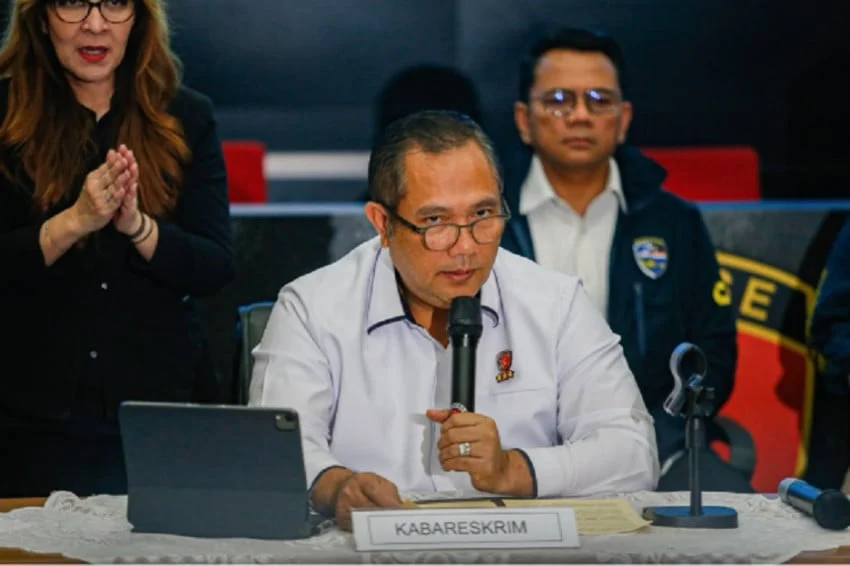
JAKARTA — In an unprecedented development that has sent shockwaves through Indonesia’s political and security establishments, the Indonesian National Police (Polri) Criminal Investigation Agency (Bareskrim) officially announced the designation of three high-ranking police officers as suspects in a sprawling criminal investigation involving illegal wiretapping, unauthorized electronic data deletion, and illegal access. Among the accused is former National Police Chief and current Chief of Staff to the President, Listyo Sigit Prabowo.
The announcement was made by the Head of Bareskrim Polri, Commissioner General Asep Safrudin, during a high-stakes press conference held at the Bareskrim headquarters in Jakarta. The scandal has immediately escalated into one of the most sensitive and destabilizing legal crises in the country’s recent history, implicating top-tier security officials in the covert surveillance of the highest echelons of the Indonesian government, including President Prabowo Subianto himself.
Alongside Listyo Sigit Prabowo—identified by investigators using the initial LSP—Bareskrim has named two other high-ranking active duty officers as suspects: Inspector General Ahrie Sonta, who serves as the Head of the Legal Division (Kadivkum Polri) and is designated by the initial ASN, and Inspector General Eko Hadi Santoso, referred to by the initial EH. Furthermore, investigators have confirmed that another high-profile individual, identified by the initial SU, is currently undergoing intensive interrogation in the capacity of a witness as authorities work to unravel the full operational scope of the conspiracy.
Comprehensive Scope of Surveillance Targets
According to findings presented by Commissioner General Asep Safrudin, the illicit surveillance operation was remarkably broad, extending far beyond routine security monitoring. The suspects are accused of systematically intercepting communications and tapping the telephone numbers of an extensive roster of high-profile targets.
The compromised communications network reportedly included President Prabowo Subianto, various cabinet ministers and state officials, prominent political figures, media organizations, leaders of mass social organizations (ormas), non-governmental organizations (NGOs), and influential business leaders. The sheer breadth of the targeted individuals highlights a sophisticated, large-scale intelligence-gathering operation conducted outside the bounds of legal authorization and democratic oversight.
The methodical nature of the wiretapping operation has prompted severe institutional concern. Legal experts and constitutional scholars have noted that compromising the private communications of a sitting head of state and key national stakeholders constitutes a direct threat to national security and the integrity of democratic governance.
Scientific Crime Investigation and Modus Operandi
The formal naming of the suspects was the culmination of an intensive investigation conducted under strict protocols of scientific crime investigation and rigorous case management procedures. Bareskrim investigators utilized advanced digital forensics, cyber audits, and telecommunication data analysis to trace the unauthorized interception activities back to the accused officers.
Detailing the modus operandi of the syndicate, Commissioner General Asep explained that the illegal activities were primarily executed between 2025 and 2026. During this period, the suspects allegedly issued internal directives and oversaw wiretapping operations without any formal, legally mandated application procedures. Under Indonesian law, lawful interception of communications must be accompanied by explicit warrants, formal investigative requests, and verifiable police reports (Laporan Polisi) tied directly to active criminal investigations.
Investigators discovered that the wiretapping operations carried out by LSP, ASN, and EH had zero legal nexus to legitimate law enforcement duties. Instead, the intercepted data was funneled through unauthorized channels. To obstruct justice and prevent detection, the perpetrators allegedly engaged in a systematic cover-up, executing digital purges in October 2026 to wipe clean access logs, server histories, and digital footprints associated with the illegal surveillance.
Legal Framework and Potential Penalties
The severity of the charges reflects the gravity of undermining state security and violating digital privacy rights. Bareskrim has laid out multiple criminal charges under the Indonesian Penal Code, specifically incorporating provisions from Law Number 1 of 2023 regarding the Criminal Code (KUHP), which governs modern offenses related to information technology and electronic transactions.
The primary charge brought against the three suspects is rooted in Article 258 of Law Number 1 of 2023. This statute criminalizes the unlawful act of intercepting, listening to, recording, diverting, altering, obstructing, and/or logging transmissions of non-public electronic information without legal authorization.
"Against these three suspects, we as investigators have applied charges under Article 258 of Law Number 1 of 2023 concerning the Criminal Code. The provision explicitly penalizes anyone who unlawfully listens to, records, diverts, alters, obstructs, and/or logs electronic information transmissions that are not of a public nature," Commissioner General Asep stated during the briefing.
Conviction under this primary article carries a maximum statutory penalty of 10 years of imprisonment. In addition to wiretapping charges, the suspects face supplementary indictments under Article 332, paragraph (1) or paragraph (2), of the same law. These provisions target individuals who intentionally and without legal right access computers or electronic systems belonging to other parties—a charge directly addressing the unauthorized data breaches and digital intrusions executed during the covert operation.
Chronology of the Investigation
The public revelation on November 3, 2026, represents the climax of a tightly guarded internal investigation that has rattled the Indonesian National Police. While Bareskrim has maintained strict confidentiality regarding the initial whistleblowing or digital anomaly that triggered the probe, intelligence and cybercrime units reportedly began noticing unauthorized signal routing and data extraction anomalies in mid-2026.
As forensic accountants and cyber specialists peeled back the layers of the digital infrastructure, they uncovered systematic log deletions occurring in October 2026. This frantic attempt to destroy evidence ultimately backfired, as forensic teams were able to recover shadow copies and metadata that exposed the command chain responsible for the unauthorized access. By late October and early November, the evidentiary threshold required for suspect designation was fully satisfied, leading to the high-profile announcement at the Mabes Polri.
Reactions and Broader Political Implications
The involvement of Listyo Sigit Prabowo—a towering figure in modern Indonesian law enforcement who previously commanded the entire national police apparatus before transitioning to the presidential administration as Chief of Staff to the President—has sent shockwaves through the political landscape.
Reacting to the developments, senior political figures and legal analysts have characterized the scandal as an unprecedented stress test for Indonesia’s democratic institutions. Prominent constitutional law expert and former minister Yusril Ihza Mahendra voiced deep concern over the implications of the case, describing the wiretapping of a sitting president as a monumental security failure and a grave institutional crisis.
"This is not merely a technical breach of telecommunications regulations; this is a severe systemic problem for a sovereign state," Yusril noted in early commentary following the news. The ability of high-ranking security officials to establish parallel, unauthorized intelligence-gathering operations targeting the nation’s leadership underscores deep vulnerabilities within state apparatuses and highlights the urgent need for enhanced institutional checks and balances.
Civil society organizations, transparency advocates, and legal watchdogs have similarly called for a transparent, uncompromised judicial process. They emphasize that the prosecution must proceed without political interference to restore public trust in the country’s law enforcement and legal systems.
Next Steps in the Judicial Process
With the formal announcement of the suspect status for LSP, ASN, and EH, Bareskrim Polri is moving swiftly into the dossier-completion phase. Investigators are continuing to examine the witness identified as SU to determine the exact extent of secondary complicity, logistical support, and data dissemination channels utilized during the two-year operation.
Legal teams representing the accused have yet to issue comprehensive formal defenses, though the unfolding legal battle promises to be complex, given the high-ranking status of the defendants and the intricate digital evidence compiled by the state. As the case advances toward the Attorney General’s Office and subsequent trial proceedings, the Indonesian public and international observers will be watching closely to see how the justice system navigates a scandal that touches the very pinnacle of state power.
