
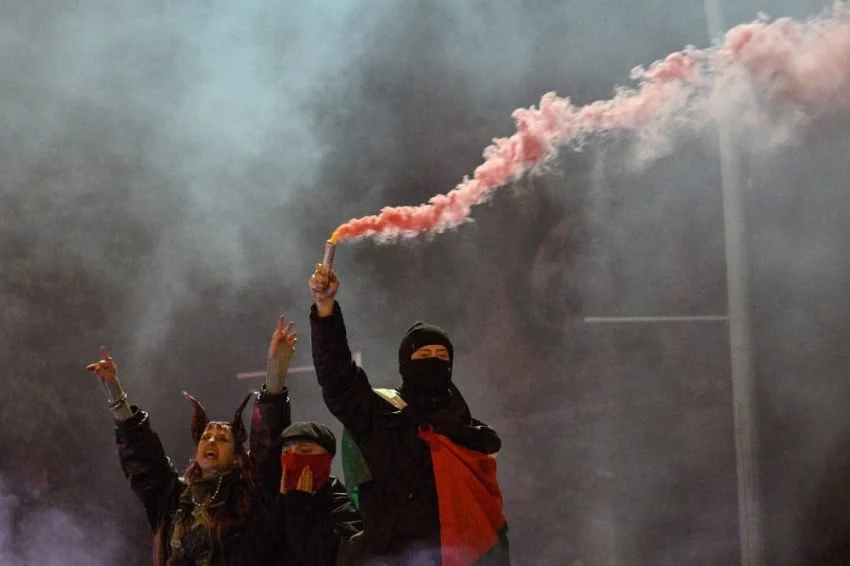
Germany recently faced one of its most volatile weekends in recent history as nationwide protests over the soaring cost of living, inadequate public school funding, budget austerity measures, and military conscription debates spiraled into widespread violence, looting, and civil unrest. What began as organized demonstrations by youth-led advocacy groups quickly deteriorated after nightfall, forcing law enforcement agencies in major metropolitan areas to deploy water cannons, tear gas, and tactical units. The convergence of economic anxiety, generational frustration, and opportunistic criminality has triggered intense political debate across Europe regarding the limits of public dissent, police response strategies, and the socioeconomic pressures facing post-pandemic generations.
The epicenter of the nighttime violence was Frankfurt, Germany’s financial capital, where bands of rioters targeted high-end retail districts, looting shops and clashing violently with police officers. Similar scenes of urban chaos erupted concurrently in Berlin, Cologne, and Hamburg. According to preliminary police reports, emergency responders were ambushed with volleys of commercial-grade fireworks, heavy stones, and glass bottles as they attempted to secure commercial corridors and disperse aggressive crowds. The escalation of violence led to dozens of immediate arrests, massive property damage, and the temporary closure of major shopping thoroughfares as municipal authorities struggled to regain control of the streets.
Chronology of the Unrest: From Peaceful Daytime Marches to Nocturnal Chaos
The sequence of events unfolded across multiple phases, transforming peaceful daytime assemblies into nocturnal battlegrounds. The demonstrations were originally coordinated by "Gen Z regelt," a rapidly growing youth-oriented activist collective whose slogan translates to "Gen Z takes over." The group successfully mobilized tens of thousands of participants across Germany on Saturday afternoon. Organizers had utilized social media platforms to channel widespread grievances over the skyrocketing cost of living, deteriorating school infrastructure, sweeping public sector spending cuts, and polarizing political discussions surrounding the potential reinstatement or expansion of mandatory military service.
By afternoon, official estimates placed the aggregate number of participants at approximately 18,000 across key urban centers including Frankfurt, Munich, and Berlin—roughly half of the turnout anticipated by organizers on their digital registration portals. German media outlets, however, estimated the broader nationwide participation in the tens of thousands, reflecting a deeply resonant public discontent.
The turning point occurred as dusk settled. As the official demonstrations concluded, splinter groups—composed of radicalized elements, opportunistic criminals, and disgruntled individuals—detached from the main bodies of protesters. These groups moved into commercial districts, particularly in Frankfurt, where they smashed storefront windows and engaged in coordinated looting, reportedly including the theft of firearms. Police interventions escalated rapidly as officers faced direct physical assaults. By late Saturday night, municipal police forces, bolstered by federal reinforcements, instituted emergency lockdowns in central Frankfurt, deploying water cannons and making sweeping arrests to clear the streets.
Core Grievances: Why Gen Z Regelt Mobilized Thousands
To understand the scale of the unrest, it is essential to examine the underlying socio-economic catalysts that drove thousands of young Germans into the streets. The primary driver of the protests is the relentless cost-of-living crisis, which has severely compressed household budgets amid persistently high inflation, rising energy costs, and escalating housing rentals. For younger demographics, entry into the independent housing market and the securing of stable, living-wage employment have become increasingly elusive.
Compounding these economic anxieties is the state of public infrastructure. Activists from Gen Z regelt highlighted severe underfunding in the educational sector, pointing to decaying school buildings, outdated technological resources, and a shortage of teaching staff. These structural deficiencies are perceived by the younger generation as systemic neglect by policymakers who prioritize macroeconomic austerity and fiscal debt brakes over human capital development.
Furthermore, the implementation of public spending cuts has disproportionately affected youth services, public transportation subsidies, and mental health resources. The inclusion of military service debates—against the backdrop of heightened geopolitical tensions in Eastern Europe—served as an additional flashpoint. Many young citizens expressed profound apprehension regarding proposals to reintroduce forms of compulsory military service, viewing it as an intrusion into their futures and career trajectories.
Transnational Parallels and Political Reactions
The German unrest did not occur in a vacuum; it closely mirrored concurrent events in neighboring France, where more than 320,000 individuals participated in massive anti-government and cost-of-living protests on the same Saturday. The synchronization of youth-led protests across Western Europe underscores a shared continental malaise driven by post-pandemic economic fallout, inflationary pressures, and a perceived disconnect between traditional political institutions and the younger electorate.
By Sunday morning, senior German political figures stepped forward to address the crisis. Federal Interior Minister Alexander Dobrindt addressed the public via the Bild newspaper, asserting that German law enforcement agencies had successfully prevented the catastrophic level of structural destruction and systemic violence seen in Paris over preceding weeks. Dobrindt commended the resilience and tactical execution of the police forces while issuing a stern warning to those who participated in the rioting and looting. He called upon the judiciary to deliver "severe punishments" to the perpetrators, emphasizing that civil disobedience must not be permitted to mutate into domestic terrorism and opportunistic theft.
Municipal leaders in Frankfurt, Berlin, and Cologne echoed these sentiments, stressing that while the constitutional right to peaceful assembly remains inviolable, the state holds a zero-tolerance policy for violence against emergency personnel and property destruction. Police unions have similarly demanded increased legal protections and advanced riot gear, noting the unprecedented hostility directed at frontline officers during Saturday’s clashes.
Broader Implications for German Society and Governance
The events of this weekend have exposed profound vulnerabilities within Germany’s social fabric and security apparatus. Sociologists and political analysts point out that the integration of legitimate socio-economic grievances with violent opportunism presents a complex challenge for democratic governance.
First, the unrest signals a deepening generational rift. Younger populations feel structurally disenfranchised by economic policies that fail to protect them from inflation and housing shortages. When institutional channels of political expression are perceived as unresponsive, the propensity for street-level mobilization increases significantly.
Second, the involvement of criminal elements in what began as political demonstrations highlights the tactical difficulties police face in managing decentralized, social media-coordinated movements. The rapid morphing of a political protest into commercial looting suggests that criminal networks and extremist factions are increasingly exploiting public demonstrations as cover for illegal activities, including the alarming reports of weapons looting.
Finally, the political fallout is likely to influence upcoming legislative agendas. Policymakers in Berlin are now under intense pressure to balance fiscal responsibility with targeted relief measures for young adults, educational funding reforms, and transparent communication regarding national defense policies. Failure to address these structural concerns risks cementing a cycle of recurring civil unrest, threatening the stability and safety of Germany’s major urban centers for the foreseeable future.
