
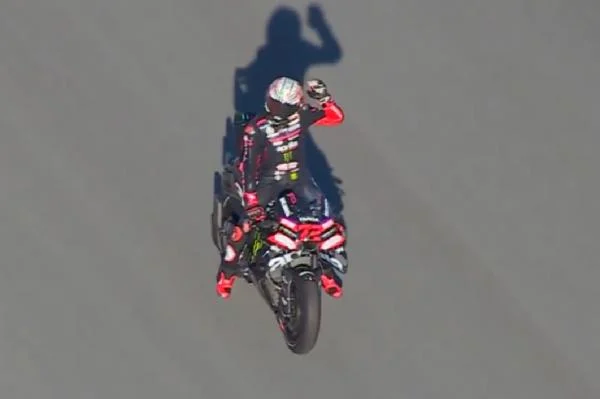
The 2026 MotoGP season reached a fever pitch at the Circuit Ricardo Tormo in Cheste on Saturday, November 28, as Marco Bezzecchi delivered a masterclass performance to secure a commanding victory in the Sprint Race. While Bezzecchi’s triumph solidified his standing as a force to be reckoned with, the narrative of the evening was undeniably stolen by a series of dramatic mechanical failures and procedural delays involving the legendary Marc Marquez. The event, which served as a penultimate showcase before the final Grand Prix, highlighted both the technical volatility of modern MotoGP machinery and the relentless pressure of championship racing.
The Sprint Race, originally scheduled for 13 laps, was ultimately shortened to 12 laps following a chaotic pre-start sequence that tested the patience of both the teams and the spectators at the Valencia circuit. The atmosphere in the paddock was tense from the onset, but the situation escalated when the starting lights failed to trigger correctly, leaving the grid in a state of suspended animation for nearly thirty minutes.
A Fiery Pre-Race Incident
The most significant disruption occurred while the field waited for the race to commence. As the bikes sat idling on the grid, smoke began to billow from the belly of Marc Marquez’s Ducati. Within moments, the smoke transformed into visible flames, forcing the Spanish icon to abandon his machine. In a display of composure under duress, Marquez retreated to the pit lane, leaving his primary motorcycle engulfed in smoke and fire.
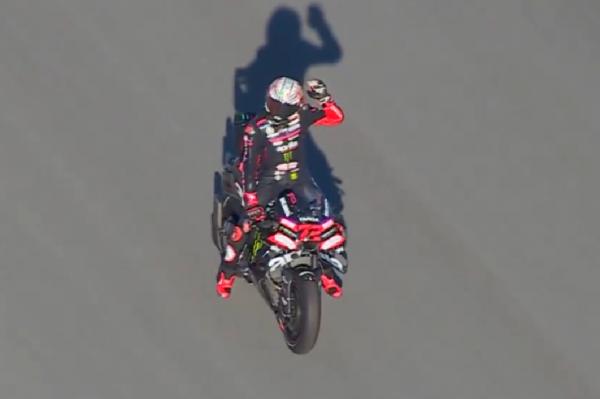
The incident triggered an immediate scramble within his garage. Because the race had not officially begun, regulations permitted Marquez to switch to his reserve machine. However, the sequence of events—leaving the grid in a non-standard manner—drew the attention of the FIM MotoGP Stewards. Despite being allowed to rejoin the race from his original second-place starting position, Marquez was handed a double long-lap penalty. This sanction, deemed necessary by officials to maintain the integrity of the start procedure, would ultimately serve as the catalyst for his slide down the field.
Race Chronology and Tactical Execution
When the lights finally went out to initiate the shortened 12-lap sprint, Marco Bezzecchi showcased exceptional race craft. Starting from pole position, he executed a clean launch, effectively neutralizing any threat from the chasing pack at the notoriously tight first corner. Behind him, the Aprilia contingent displayed remarkable speed. Jorge Martin, who began the race from the fifth spot on the grid, navigated the early chaos with surgical precision, climbing to second place and effectively securing a 1-2 finish for the Aprilia manufacturer.
For Marquez, the race became an exercise in damage limitation. After starting from the front row, he was forced to serve his first long-lap penalty early in the proceedings, which saw him plummet to eighth place. The tactical challenge was further compounded when he was required to take his second long-lap penalty. By the time he rejoined the racing line after fulfilling these mandates, he had dropped to 14th position. Despite a determined effort to recover, the deficit proved too great to bridge, and Marquez crossed the finish line in 13th place, a far cry from the podium finish he had likely envisioned at his home circuit.
The intensity of the race claimed other victims as well. Fermin Aldeguer, who had been running strongly in fifth place, suffered a technical or handling error at Turn 8, resulting in a slide that ended his bid for points. Raul Fernandez, another competitor in the fray, experienced a separate incident that saw him drop down the order, though he managed to recover and continue his race.

Supporting Data and Technical Context
The 2026 season has been characterized by extreme technical parity, and the Valencia Sprint highlighted how thin the margin is between success and failure. Bezzecchi’s victory was built on the momentum he established during qualifying, where he shattered the standing circuit record. Data from the telemetry of the top-performing bikes indicates that the grip levels at the Ricardo Tormo circuit were lower than anticipated, necessitating a delicate balance between aggressive throttle application and tire preservation.
The fire that sidelined Marquez’s primary bike is currently under investigation by Ducati engineers. Early reports suggest a potential fuel line leak or an electrical short within the engine bay, a rare occurrence in modern MotoGP. Such failures are statistically infrequent but highlight the extreme thermal loads under which these prototypes operate, especially in the stop-and-go nature of the Valencia track.
The Human Element: Perspectives and Stakes
While no official press release has been issued by the Gresini or Ducati camps regarding the specific cause of the fire, the implication for the championship is clear. Marquez, having recently announced his retirement from full-time MotoGP competition, is looking to conclude his storied career on a high note. His frustration was evident, yet his commitment to finishing the race—despite the insurmountable penalty—was noted by competitors and fans alike as a testament to his enduring professional spirit.
Conversely, Bezzecchi’s performance has been described by pundits as one of the most clinical of his career. By managing his pace and maintaining focus despite the half-hour delay, he demonstrated the psychological maturity required to compete at the absolute pinnacle of the sport. Aprilia’s 1-2 finish also serves as a significant boost for the manufacturer, proving that their chassis development has reached a competitive peak just as the season draws to a close.
Broader Implications and Championship Outlook
The events at Valencia carry significant weight for the final championship standings. With the Sprint Race points distributed, the gaps in the top-five hierarchy have tightened. The race served as a reminder that in MotoGP, a championship can be won or lost not just on the track, but in the seconds before the start. The procedural delays, while frustrating, are part of the complex machinery that governs the sport, and the ability of teams to adapt to sudden changes—or the lack thereof—remains a defining characteristic of the 2026 grid.
Furthermore, the retirement of a figure as influential as Marc Marquez adds an emotional weight to these final rounds. Every session, every qualifying lap, and every sprint race is now part of a closing chapter. The fact that he was forced to battle from 14th after a mechanical failure only serves to emphasize the unpredictability of his final campaign.
As the paddock prepares for the main event on Sunday, the focus shifts to tire degradation and the physical toll of the Valencia track. The temperatures are expected to remain consistent, but the technical gremlins that struck Marquez on Saturday will likely trigger a thorough technical review across all teams tonight. The race for the 2026 title is effectively a two-front war: one against the rivals on the track, and one against the mechanical reliability of the prototypes themselves.
The victory for Bezzecchi is not merely a stat in a ledger; it is a signal of the next generation’s readiness to seize the mantle of leadership in the sport. As the sun sets on the Ricardo Tormo circuit, the narrative of the 2026 season continues to evolve, proving once again that in MotoGP, the only certainty is that the unexpected is always just one corner away. Whether it is a podium finish, a heartbreaking mechanical fire, or a tactical masterclass, the sport continues to provide the high-stakes theater that defines the modern era of grand prix motorcycle racing.
