

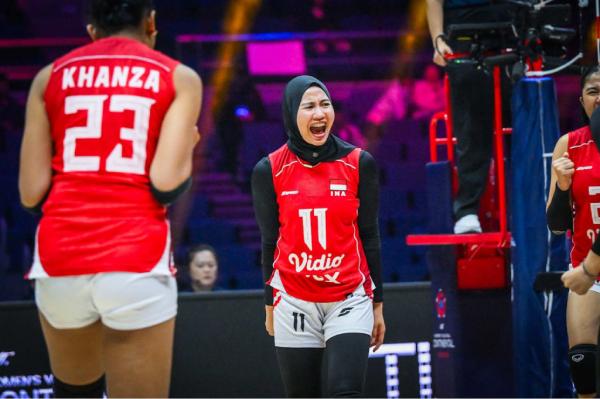
The Indonesian women’s national volleyball team commenced their campaign at the 2026 Asian Games in Aichi-Nagoya, Japan, with a clinical performance on Thursday, September 17, 2026. Facing off against Nepal at the Park Arena Komaki, the Indonesian squad secured a dominant 3-0 victory, setting a positive tone for their aspirations in Pool A. The match concluded with set scores of 25-12, 25-21, and 25-20, reflecting both the team’s technical superiority and their ability to navigate moments of increased pressure during the second and third sets.
This victory is a significant morale booster for the Indonesian delegation, which has faced mounting pressure to deliver results in regional multi-sport events. By securing the win in straight sets, the team not only claimed maximum points but also preserved their energy for the more challenging fixtures that lie ahead in the group stage.
Match Chronology and Tactical Breakdown
The encounter began with a clear disparity in technical proficiency and tactical discipline. From the opening serve, the Indonesian side asserted control, forcing errors from the Nepalese side through a combination of aggressive serving and well-coordinated blocking at the net. The first set served as a statement of intent, with Indonesia dismantling the opposition’s defense to close the frame at 25-12.
However, the dynamics of the game shifted in the second set. Nepal, having adjusted to the intensity of the opening frame, found a rhythm that allowed them to challenge the Indonesian defensive structure. The mid-set period saw Nepal capitalize on a slight lapse in concentration from the Indonesian side, establishing a 15-12 lead. This juncture tested the leadership and composure of the Indonesian coaching staff and team captain.
Responding to the deficit, Indonesia implemented a tactical pivot, utilizing tactical timeouts to reorganize their rotation and heighten the focus on their transition game. The team clawed their way back, relying on consistent side-out efficiency to neutralize the Nepalese momentum. By restoring defensive stability, Indonesia managed to overturn the deficit and secure the second set 25-21.
The third set proved to be the most competitive, as both sides fought for every point. Nepal refused to concede, staying within reach for the majority of the set. Nevertheless, the depth of the Indonesian roster and their experience in high-pressure scenarios ultimately proved decisive. Indonesia maintained their composure to finish the set 25-20, officially closing the match and confirming their first victory of the tournament.
Contextualizing the 2026 Asian Games Volleyball Tournament
The Asian Games in Aichi-Nagoya represent the pinnacle of regional volleyball competition, featuring a rigorous qualification process and a field of high-caliber teams. Volleyball, as a sport, continues to see rapid development across Southeast Asia, and this tournament serves as a benchmark for the progress of the Indonesian team under current management.
The tournament format requires teams to navigate a challenging group stage before progressing to the knockout rounds. Being placed in Pool A, Indonesia faces the daunting task of sustaining performance levels across multiple matches against regional powerhouses. The victory against Nepal is statistically essential, as it provides a buffer for the team as they look toward subsequent matches. Historically, opening-game victories correlate highly with successful tournament runs, providing players with the necessary confidence to face higher-ranked opponents.
Performance Analysis and Statistical Implications
Statistically, the victory demonstrates an effective offensive-defensive balance. While the 25-12 scoreline in the first set suggests a lopsided affair, the tightening of the game in the following sets provides valuable data for the coaching staff. Analyzing the points conceded in the second and third sets will be a priority for the technical team to ensure that defensive lapses are corrected before the next round of fixtures.
The efficiency of the team’s service game was particularly notable. By putting consistent pressure on the Nepalese serve-receive, Indonesia limited the opposition’s ability to run complex offensive sets. Furthermore, the efficiency of Indonesia’s wing spikers and middle blockers in exploiting gaps in the Nepalese wall was a recurring theme throughout the match.
Official Perspectives and Team Preparedness
While official post-match press conferences are ongoing, sources within the Indonesian Volleyball Association (PBVSI) have emphasized the importance of this win. The preparation for the 2026 Asian Games has been extensive, involving months of specialized training camps and participation in regional exhibition matches.
The leadership within the team has expressed that the primary objective for the group stage is to maintain focus on individual match preparation rather than looking too far ahead to the medal rounds. This disciplined approach is designed to prevent the complacency that often follows an easy opening victory. The players have been instructed to treat every opponent with equal respect, acknowledging that in the fast-paced nature of international volleyball, momentum can shift rapidly.
Broader Implications for Indonesian Sport
The success of the women’s volleyball team is viewed as a vital component of Indonesia’s overall performance target for the 2026 Asian Games. Beyond the immediate joy of victory, this performance reflects the ongoing investment in women’s sports across the nation. The growth of the professional league in Indonesia has translated into a more seasoned national squad, capable of adapting to international-level competition.

The match against Nepal also serves as a reminder of the rising parity in Asian volleyball. Countries that were previously considered lower-tier are showing significant improvement, necessitating a higher level of preparation from traditional contenders. This development is healthy for the sport, as it pushes the entire region to elevate its standards of play, coaching, and athlete development.
Looking Ahead: The Road to the Medal Rounds
Following this successful outing, the Indonesian team will turn their attention to their next opponents in Pool A. The schedule for the remainder of the group stage is demanding, and the team will need to manage player fatigue and potential injuries carefully. Recovery protocols, including physiotherapy and nutritional management, are being prioritized to ensure that the starting lineup remains at peak physical condition.
The upcoming matches will be critical in determining the final standings of the pool, which will dictate the path through the quarterfinals and beyond. The team’s ability to maintain the level of aggression shown in the first set, while mitigating the defensive vulnerabilities identified in the second, will be the key factor in their success.
Conclusion
The 3-0 victory against Nepal is more than just a notch in the win column; it is a signal that the Indonesian women’s volleyball team has arrived in Aichi-Nagoya with a clear mission. By overcoming both a weaker opponent and their own moments of hesitation during the match, the team has proven their resilience. As the tournament progresses, the eyes of the nation will remain fixed on this squad, hoping that this strong start serves as the foundation for a historic achievement on the international stage.
The focus now shifts to the preparation for the next encounter, where consistency and tactical discipline will once again be tested. In the high-stakes environment of the Asian Games, every set and every point counts, and with this opening win, Indonesia has successfully positioned itself in the race for a deep tournament run. The commitment shown by the players and the strategic oversight by the coaching staff suggest a team that is well-prepared, focused, and ready to face the challenges of the coming week.
