
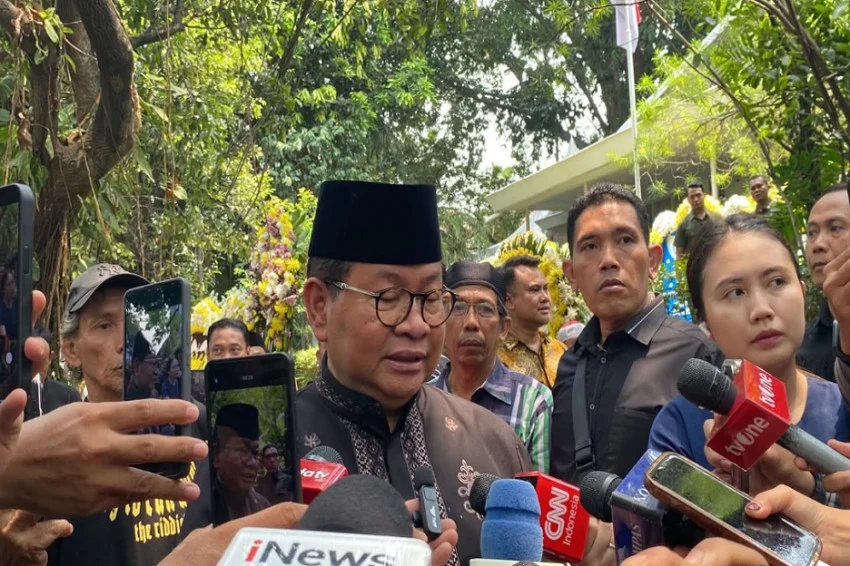
The capital city of Indonesia plunged into mourning following the departure of one of its most illustrious cultural luminaries, Guruh Soekarnoputra, whose death on Saturday, September 26, 2026, reverberated across the nation’s political, artistic, and social landscapes. Prominent figures from various sectors immediately extended their condolences, chief among them Jakarta Governor Pramono Anung, who paid a personal tribute at the late statesman and artist’s residence in the Kebayoran Baru district of South Jakarta. The loss marks the final chapter in the life of a multifaceted personality who bridged the worlds of high art and national politics, leaving an indelible imprint on the collective identity of Indonesia.
Governor Pramono Anung, reflecting on a long-standing personal and professional relationship with the deceased, emphasized that Guruh defied simple categorization. Speaking to the press outside the grieving family home, the governor underscored that Guruh was much more than a conventional artist or cultural preservationist. He was a dynamic creator, a dedicated politician, and a visionary whose contributions transcended partisan divides. The Governor’s remarks captured the sentiment of a nation grappling with the absence of a cultural titan who seamlessly carried the heavy legacy of the nation’s founding family while carving out a distinct, contemporary artistic identity.
A Multifaceted Legacy: Artist, Politician, and Nationalist Creator
Guruh Soekarnoputra, the youngest son of Indonesia’s first president, Sukarno, and First Lady Fatmawati, lived a life defined by an unwavering commitment to Indonesian arts and national pride. Born in Jakarta on January 13, 1953, he grew up immersed in the ideological fervor of the nation’s nascent independence era. Rather than relying solely on his formidable political lineage, Guruh forged a path as an avant-garde choreographer, musician, songwriter, and cultural diplomat.
Throughout the 1970s, 1980s, and beyond, Guruh revolutionized the Indonesian performing arts scene. He founded legendary cultural troupes such as Swara Mahardika, which redefined modern Indonesian musical theater by fusing traditional regional dances and gamelan motifs with Western pop arrangements, orchestrations, and stagecraft. Productions like Badai Pasti Berlalu (The Storm Will Surely Pass) transformed the Indonesian music industry, yielding timeless soundtracks that remain cornerstones of the nation’s popular culture. His artistic endeavors were invariably tied to a deep, resonant sense of nationalism. For Guruh, art was not merely for aesthetic consumption; it was a vital instrument for nation-building, cultural self-sufficiency, and the preservation of Indonesia’s vast ancestral heritage against the tides of Westernization.
In parallel with his artistic pursuits, Guruh stepped into the political arena, carrying forward the ideological banner of his father’s nationalist movement. As a long-serving member of the House of Representatives (DPR RI) representing the Indonesian Democratic Party of Struggle (PDI-P), he consistently championed policies related to cultural preservation, creative economy development, and educational reform. His presence in parliament served as a bridge between the legislative halls of power and the creative communities of the archipelago, ensuring that the voice of Indonesian artists resonated in national policy debates.
Chronology of Events and Final Tributes
The news of Guruh Soekarnoputra’s passing broke early Saturday morning, prompting an immediate outpouring of grief from across the political and cultural spectrum. Family members, political colleagues, artists, and citizens began gathering at his South Jakarta residence to pay their final respects.
Governor Pramono Anung arrived at the Kebayoran Baru home in the afternoon to offer condolences directly to the bereaved family. Addressing reporters stationed outside the residence, Pramono shared personal memories of his interactions with the late cultural icon.
"I have known Mas Guruh for a very long time, and Mas Guruh is not only an artist, a cultural figure, a musician, but also a politician, and also a creator," Pramono stated, capturing the essence of the multifaceted life that had just concluded.
The governor elaborated on the profound sense of loss felt not only by those who knew him personally, but by the broader Indonesian public. He offered explicit prayers for the departed soul, expressing hope that Guruh’s journey would be met with ease and that his extensive body of work would endure as a unifying force. "We all feel a deep sense of loss, and I personally pray that Mas Guruh’s path is smoothed, and that what Mas Guruh has left behind will hopefully remain a binding force in our hearts, not only for Mas Guruh’s admirers," Pramono added.
Emphasizing the core driver of Guruh’s life and career, the governor highlighted his exceptional patriotism. "But also for the people who experience it, because Mas Guruh’s spirit of nationalism was exceptionally high."
Broader Impact and Cultural Implications
The passing of Guruh Soekarnoputra arrives at a critical juncture for Indonesian cultural policy and national identity. As the nation navigates the complexities of globalization and digital transformation, the loss of figures who actively maintained the synthesis between traditional heritage and modern creativity is acutely felt. Guruh represented a generation of cultural architects who viewed the preservation of indigenous arts as a matter of national security and sovereignty.
Sociopolitical analysts note that Guruh’s unique positioning allowed him to advocate for the creative sector with a moral authority that few contemporary politicians could replicate. His absence leaves a noticeable void in parliamentary advocacy for the arts and culture sector—an area that frequently struggles for adequate budgetary support and institutional protection amidst rapid economic modernization.
Furthermore, Guruh’s career serves as a case study in soft power. Long before cultural diplomacy became a standard buzzword in international relations, Guruh was utilizing music and dance to project a vibrant, sophisticated image of Indonesia to the world. His artistic creations demonstrated that modern Indonesian identity is not a rejection of tradition, but an evolutionary synthesis that honors ancestral roots while embracing contemporary global standards.
Reactions from the Cultural and Political Communities
Tributes continued to pour in throughout Saturday from various institutional bodies, political figures, and artistic associations. The Indonesian Ministry of Education, Culture, Research, and Technology issued a formal statement acknowledging Guruh’s monumental contributions to the national canon. Representatives from the Indonesian Musicians Union and various dance academies praised his rigorous dedication to discipline, innovation, and authenticity.
Colleagues within the PDI-P party remembered him as a steadfast ideological loyalist who remained true to the teachings of Sukarno throughout his public life. Despite the often turbulent nature of Indonesian politics, Guruh maintained a reputation for personal integrity, artistic passion, and intellectual rigor.
As preparations for the funeral arrangements progressed under the watchful eye of family, government officials, and security personnel, the public discourse shifted toward ensuring the preservation of his extensive archives, musical scores, choreographic notes, and personal artifacts. Cultural preservationists have already begun calling for the establishment of a dedicated foundation or museum space to house Guruh’s vast collection, ensuring that future generations of Indonesian artists can study and draw inspiration from his pioneering work.
The legacy of Guruh Soekarnoputra thus remains anchored in the foundational structures of modern Indonesian culture. From the concert halls that echo his timeless compositions to the legislative chambers where he fought for cultural recognition, his influence persists. As Governor Pramono Anung aptly observed, the true measure of Guruh’s life lies not merely in the accolades he accumulated during his lifetime, but in the enduring capacity of his work to bind the hearts and minds of a diverse nation in shared national pride and artistic appreciation.
