
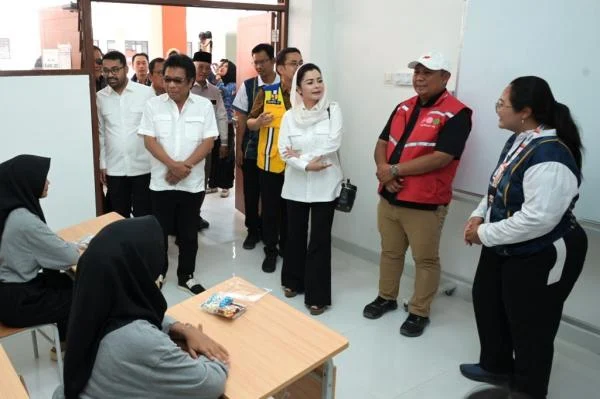
In an effort to modernize educational infrastructure and ensure a secure learning environment for underprivileged students, Novita Wijayanti, a prominent member of Commission V of the House of Representatives (DPR), has formally called for the installation of closed-circuit television (CCTV) systems across all Sekolah Rakyat (People’s Schools) facilities. During a high-profile visit to a Sekolah Rakyat located on Jalan Kedungsari Raya, Rowosari, in the Tembalang District of Semarang, Central Java, the legislator emphasized that technological surveillance is no longer a luxury but a fundamental necessity for maintaining discipline and protecting students from negative social influences. According to Wijayanti, the integration of monitoring technology is a strategic move to ensure that these educational institutions remain focused on their core mission of academic and character development.
The urgency of this proposal stems from the unique role that Sekolah Rakyat play in the Indonesian educational landscape. These institutions often cater to children from lower-income families, providing an essential pathway for social mobility. However, because they frequently operate with limited resources in densely populated or marginalized areas, they can be vulnerable to external influences. Wijayanti noted that the presence of CCTV cameras would serve as a vital deterrent against "pergaulan bebas"—a term encompassing various forms of juvenile delinquency and social misconduct—and would assist administrators in monitoring student behavior to prevent disciplinary infractions before they escalate.
Strategic Oversight and the Role of Surveillance in Education
The proposal presented by Novita Wijayanti aligns with a broader national trend toward the digitalization of school security. In her address to school administrators and local officials in Semarang, she clarified that the primary objective of the CCTV installation is not to create an environment of constant suspicion, but rather to provide a safety net for the students. "The importance of CCTV is to monitor the children so that they do not engage in activities that are contrary to our expectations. Their purpose here is strictly for school and education," Wijayanti stated in a press release following her visit.
Beyond the prevention of delinquency, surveillance technology in schools is increasingly viewed as a tool for accountability. By having a digital record of daily activities, school boards can ensure that both students and staff adhere to the highest standards of conduct. In the context of Sekolah Rakyat, where the ratio of students to supervisors can sometimes be imbalanced, CCTV acts as an "extra set of eyes" that helps maintain order during breaks, entry and exit times, and in secluded areas of the campus.

Human Supervision and Character Building
While advocating for technological solutions, Wijayanti was careful to note that hardware alone cannot solve the complexities of student discipline. She urged school principals to optimize the placement and roles of teachers to ensure comprehensive supervision. The legislator argued that technology should complement, not replace, the mentorship provided by educators. "I ask the school heads to position teachers strategically to monitor the children, ensuring that undesirable incidents do not occur. This school must truly become a safe haven for education and character building," she added.
This dual approach—combining modern surveillance with active human involvement—is intended to address various potential disruptions to the educational process. Educators are encouraged to engage more deeply with students’ psychological and social needs, using the data or observations from surveillance to identify students who may be struggling or heading toward disciplinary trouble. This proactive stance is seen as essential for fostering an environment where students feel both watched over and cared for.
The Vision of Sekolah Rakyat: Breaking the Cycle of Poverty
The push for better facilities in Sekolah Rakyat is part of a larger political and social movement in Indonesia aimed at using education as a primary tool for poverty alleviation. This vision has been championed by several national figures, including Prabowo Subianto, who has frequently spoken about the need for graduates of Sekolah Rakyat to pursue higher education. The ultimate goal is to empower children from impoverished backgrounds to break the cycle of generational poverty and contribute to the nation’s economic growth.
The Sekolah Rakyat initiative is often seen as a grassroots response to the limitations of the formal state school system, providing flexible and accessible learning for those who might otherwise fall through the cracks. By improving the infrastructure of these schools—starting with security measures like CCTV—the government and legislative bodies aim to elevate the status of these institutions, making them comparable in quality and safety to premium private or state-operated schools.
Comparative Infrastructure Development and Regional Expansion
The demand for improved facilities is not limited to Central Java. Recent reports indicate a growing momentum for the Sekolah Rakyat model across the archipelago. In Jakarta, for instance, political figures such as Pramono Anung have announced plans to establish large-scale Sekolah Rakyat facilities capable of accommodating up to 1,000 students. These planned institutions are expected to serve as blueprints for modern "People’s Schools," featuring state-of-the-art classrooms, digital laboratories, and, as suggested by Wijayanti, comprehensive security systems.

The involvement of DPR Commission V is particularly significant in this regard. As the commission responsible for infrastructure, transportation, and regional development, its members hold the keys to budget allocations that can transform educational facilities. Wijayanti’s advocacy suggests that school safety and digital infrastructure are becoming priorities in the national budget discussions for the upcoming fiscal years.
Data on School Safety and Surveillance Trends
The move to install CCTV in Indonesian schools mirrors global trends where school safety has become a paramount concern. Data from various international educational NGOs suggest that schools equipped with visible surveillance systems see a significant reduction in bullying and vandalism. In Southeast Asia, countries like Singapore and Malaysia have already integrated extensive CCTV networks into their public school systems to manage student safety and monitor external threats.
In Indonesia, the Ministry of Education, Culture, Research, and Technology has been encouraging schools to adopt "Safe School" (Sekolah Aman) protocols. While the primary focus has been on disaster resilience—such as earthquake and flood preparedness—the definition of "safety" is expanding to include protection from social threats and physical violence. The integration of CCTV in Sekolah Rakyat would represent a milestone in bringing these high-standard safety protocols to the most vulnerable segments of the student population.
Implementation Challenges and Privacy Considerations
Despite the clear benefits, the widespread installation of CCTV in Sekolah Rakyat faces several hurdles. The first is financial; many of these schools operate on thin margins and rely on donations or limited government subsidies. Funding the procurement, installation, and maintenance of high-definition camera systems requires a sustainable financial commitment from the government or private sector partners.
Furthermore, there are ongoing discussions regarding the privacy of students and teachers. Legal experts suggest that any implementation of surveillance must be accompanied by strict guidelines on data storage and access. To address these concerns, Novita Wijayanti and her colleagues in the DPR are expected to deliberate on frameworks that ensure cameras are placed only in public areas—such as hallways, playgrounds, and entrances—rather than in private spaces, thereby balancing safety needs with the right to privacy.

Timeline and Future Implications
The visit to the Rowosari Sekolah Rakyat serves as a starting point for a broader legislative push. It is expected that Commission V will conduct further inspections of similar facilities across Java and other islands to assess the current state of educational infrastructure. By late 2026, there may be a formal proposal to include "Security and Digital Monitoring Grants" in the national education budget, specifically targeted at community-based and "People’s" schools.
The long-term implications of this policy are twofold. Firstly, it sets a new standard for what constitutes a "basic" educational facility in Indonesia, moving the bar from just "classrooms and books" to "safe, monitored, and digitally-integrated environments." Secondly, it reinforces the role of the state in overseeing non-traditional educational institutions, ensuring that even the most grassroots schools meet national safety standards.
Conclusion
The advocacy by Novita Wijayanti for CCTV in Sekolah Rakyat highlights a critical intersection between technology, security, and social welfare. By calling for these upgrades, the DPR is signaling a commitment to protecting the nation’s most vulnerable students while fostering an atmosphere of discipline and academic rigour. As Indonesia moves toward its "Golden Indonesia 2045" vision, the transformation of Sekolah Rakyat into high-quality, secure learning centers will be a vital component of its strategy to develop a competitive and disciplined future workforce. The success of this initiative will depend on the effective collaboration between legislative bodies, school administrators, and local communities to ensure that every child, regardless of their economic background, can study in an environment that is both safe and conducive to growth.
