
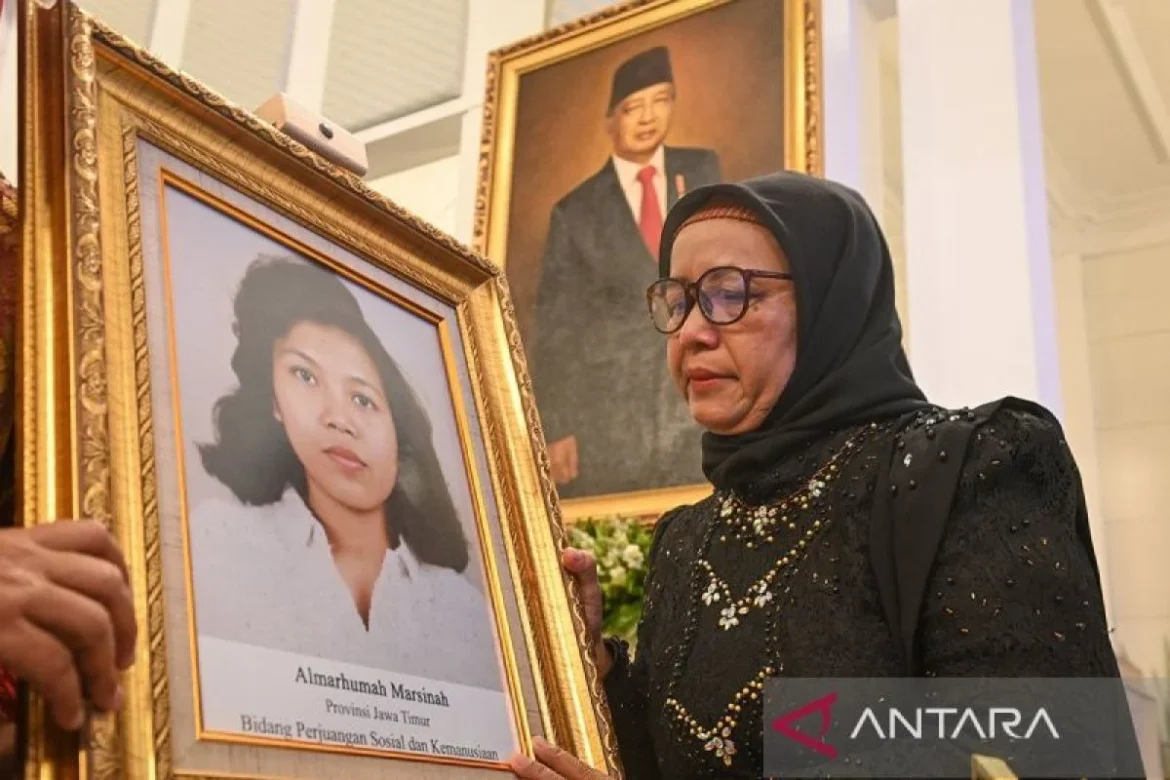
President Prabowo Subianto officially conferred the title of National Hero upon Marsinah, a legendary labor activist whose life and tragic death became a catalyst for the Indonesian workers’ rights movement, during a solemn ceremony at the State Palace in Jakarta on Monday, November 10, 2025. The ceremony, held in conjunction with National Heroes’ Day, marks a historic milestone in the Indonesian government’s recognition of grassroots activism and the struggle for social justice. Marsinah is among ten distinguished figures honored this year under Presidential Decree (Keppres) Number 116/TK/Year 2025, signaling a shift in the national narrative to include those who fought not only for independence from foreign powers but also for the fundamental rights of citizens within the industrial landscape.
The decision to elevate Marsinah to the status of National Hero is seen by political analysts and human rights advocates as a profound acknowledgment of the labor movement’s role in the nation’s democratic journey. For decades, Marsinah’s name has been whispered in factory halls and shouted at protest rallies, serving as a symbol of defiance against the repressive labor practices that characterized the New Order era. By granting her this title, President Prabowo has institutionalized her legacy, moving her story from the fringes of activist lore into the heart of Indonesia’s official national history.
The Life and Formative Years of a Grassroots Leader
Marsinah was born on April 10, 1969, in the village of Nglundo, Sukomoro District, Nganjuk, East Java. Her upbringing was marked by the modest and often difficult realities of rural life in Indonesia. Raised primarily by her grandmother and aunt following the early loss of maternal guidance, she learned the values of independence and resilience from a young age. As the second of three children born to Mastin and Sumini, Marsinah contributed to her family’s meager income by selling snacks, a testament to her early industriousness.
Despite her family’s financial constraints, Marsinah was a dedicated student. She completed her primary education at SD Negeri Karangasem 189 and attended SMP Negeri 5 Nganjuk. Her intellectual curiosity led her to seek further education at the Muhammadiyah Islamic Boarding School. However, the systemic barriers of poverty eventually halted her formal academic ambitions. Unable to afford the costs of higher education, Marsinah made the difficult decision to leave her hometown in search of employment, a path taken by millions of young Indonesians during the country’s rapid industrialization in the late 20th century.
In 1989, she moved to the provincial capital of Surabaya, residing with her sister, Marsini. After a brief stint at a plastics factory in the Rungkut industrial zone, she joined PT Catur Putra Surya (CPS) in 1990. PT CPS was a watch manufacturing plant located in Porong, Sidoarjo. It was within the walls of this factory that Marsinah’s political consciousness was forged. She witnessed firsthand the vast disparity between the company’s productivity and the welfare of its workers, as well as the lack of genuine representation for the labor force.
The 1993 Strike and the Struggle for Fair Wages
The catalyst for the events that would lead to Marsinah’s martyrdom was the issuance of East Java Governor’s Circular No. 50/Th.1992. The directive urged private companies to increase the basic minimum wage of workers by 20 percent. While intended to alleviate the economic pressures on the working class, many industries, including PT CPS, were reluctant to implement the raise.
In early May 1993, the frustration of the workers reached a breaking point. Marsinah, known for her articulateness and unwavering courage, emerged as a central figure in the organized protest. On May 3 and 4, 1993, she led a massive strike involving hundreds of her colleagues. The workers presented a list of 12 demands to the management of PT CPS. These demands were not merely about the 20 percent wage hike; they included calls for the dissolution of the local branch of the All-Indonesia Workers Union (SPSI), which the workers viewed as a tool of the management rather than a protector of labor interests. They also demanded better transport allowances and healthcare benefits.
The negotiations were tense, but the sheer unity of the workers forced the management to concede to 11 of the 12 demands. It appeared to be a significant victory for the laborers. However, in the socio-political climate of the early 1990s, such acts of organized defiance were often met with swift and severe intervention by the state security apparatus.
Military Intervention and the Disappearance of Marsinah
The aftermath of the strike took an ominous turn on May 5, 1993. Thirteen of Marsinah’s fellow strike leaders were summoned to the District Military Command (Kodim) in Sidoarjo. There, they were subjected to intense pressure and intimidation, eventually being forced to sign letters of resignation. When Marsinah learned of this development, she did not retreat in fear. Instead, she went to the Kodim headquarters to demand an explanation and to obtain copies of the resignation letters, intending to use them as evidence to challenge the legality of the forced terminations.
That evening was the last time Marsinah was seen alive. Her sudden disappearance sent shockwaves through the labor community in Sidoarjo. For three days, her whereabouts remained a mystery until May 8, 1993, when her lifeless body was discovered in a remote hut in Jegong Village, Wilangan District, Nganjuk—nearly 200 kilometers from where she had last been seen.
The autopsy reports revealed a harrowing reality. Marsinah had been subjected to extreme physical torture before her death. The brutality of the crime suggested that her killers intended not only to silence her but also to send a chilling message to any other worker who dared to challenge the status quo. The "Marsinah Case" quickly became a national and international scandal, drawing condemnation from human rights organizations worldwide and exposing the dark underbelly of Indonesia’s industrial growth.
The Quest for Justice and Historical Significance
The legal proceedings that followed Marsinah’s death were widely criticized as a "show trial" designed to protect the true perpetrators. Several employees and directors of PT CPS, along with a few military personnel, were initially arrested and convicted. However, in a stunning reversal in 1995, the Supreme Court of Indonesia acquitted all the defendants, citing a lack of credible evidence and procedural irregularities. To this day, the actual killers of Marsinah have never been brought to justice, leaving her case as one of the most prominent "dark notes" in Indonesia’s human rights record.
The decision by the Prabowo administration to grant her the title of National Hero is, therefore, more than a ceremonial gesture; it is a form of "historical justice." By recognizing her as a hero, the state acknowledges that her death was a consequence of her fight for the constitutional rights of Indonesian citizens. It reframes her not as a victim of a cold case, but as a martyr for the labor movement.
Reactions from Labor Unions and Civil Society
The conferment has been met with widespread acclaim from labor organizations. The Confederation of Indonesian Trade Unions (KSPI) hailed the move as a long-overdue recognition of the working class’s contribution to the nation. Said Iqbal, President of KSPI, noted that Marsinah’s elevation to heroism provides a moral boost to millions of workers currently navigating the complexities of modern labor laws and economic shifts.
"Marsinah is the mother of the Indonesian labor movement," a KSPI representative stated. "This recognition by President Prabowo proves that the state finally sees the struggle of the worker as a heroic endeavor. It is a reminder that the rights we enjoy today were bought with the courage and, in Marsinah’s case, the life of those who came before us."
Furthermore, the Ministry of Human Rights recently immortalized her name by dedicating a Human Rights Service Room in her honor. These collective actions suggest a concerted effort by the current government to address past grievances and integrate human rights advocacy into the national identity.
Broader Implications and the Path Forward
The inclusion of Marsinah in the pantheon of National Heroes carries significant implications for Indonesia’s future. First, it serves as a deterrent against the repetition of such state-sponsored or industrial violence. By honoring a victim of repression, the government sets a precedent that the protection of labor rights is a national priority.
Second, the move strengthens Indonesia’s standing in the international community regarding its commitment to human rights. For years, the Marsinah case was cited by international bodies as evidence of Indonesia’s failure to protect activists. This official recognition goes a long way in healing those diplomatic and moral wounds.
Finally, for the youth of Indonesia, Marsinah’s story serves as a powerful educational tool. It shifts the definition of a "hero" from someone who only carries a weapon on a battlefield to someone who carries a list of demands for fair wages and dignity in a factory. As Indonesia strives to become one of the world’s top economies by 2045, the legacy of Marsinah ensures that this growth is not achieved at the expense of the people’s fundamental rights.
In his address at the State Palace, President Prabowo Subianto emphasized that the spirit of heroism must be found in every sector of society. The recognition of Marsinah ensures that her voice, which was once silenced in a remote hut in Nganjuk, will now echo forever in the halls of Indonesian history as a beacon of courage, justice, and the eternal struggle for human dignity.
