
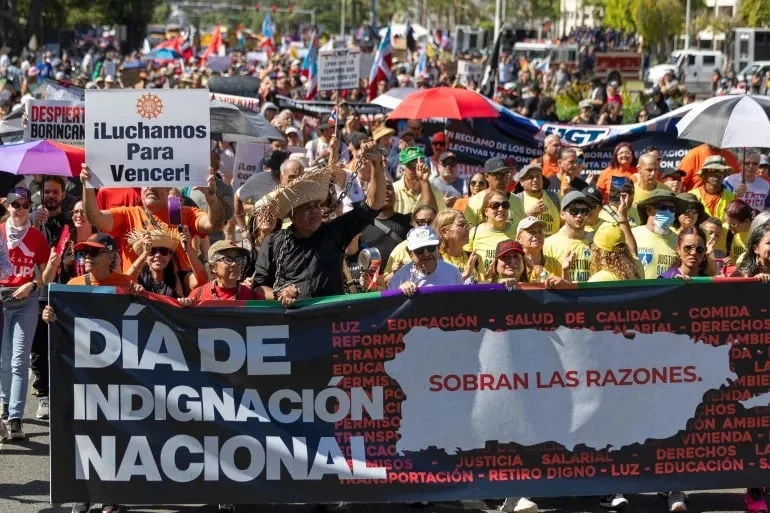
The streets of San Juan reverberated with chants of dissent and the waving of historical flags as an estimated 8,000 demonstrators converged on the Puerto Rican capital for what organizers termed the "Day of National Outrage." The mass mobilization, held on Friday, November 27, 2026, brought together roughly 30 distinct organizations, spanning powerful labor unions, grassroots community groups, and religious institutions. Protesters gathered to voice their collective fury over a compounding crisis characterized by exorbitant electricity tariffs, a relentless surge in the cost of living, and a severe deterioration of essential public services across the Caribbean territory.
The demonstration stands as one of the largest civil uprisings in the U.S. territory since the inauguration of Governor Jenniffer Gonzalez in January 2025. For a populace already grappling with systemic economic instability, aging infrastructure, and recurring fiscal crises, the latest utility rate hikes proved to be a breaking point, drawing citizens from dozens of municipalities across the island via organized bus caravans to confront the government head-on.
The Anatomy of the Outrage: Escalating Utility Costs and Deteriorating Services
At the core of the widespread civil unrest is the crippling financial burden placed on households by the island’s beleaguered power grid. According to data compiled by the U.S. Energy Information Administration (EIA), the average monthly electricity bill for residential customers in Puerto Rico experienced a dramatic and sudden surge of approximately 18 percent, climbing from USD 229 to USD 271. More critically, the effective rate per kilowatt-hour (kWh) charged to island residents now dwarfs the average rates paid by consumers in the U.S. mainland, creating a severe economic anomaly where a territory with lower average household incomes faces some of the highest utility costs under the American flag.
For ordinary citizens, these figures translate into impossible choices between keeping the lights on, purchasing necessary medication, and putting food on the table. Radames Garcia Badillo, a 74-year-old retired resident participating in the march, captured the sentiment of the crowd when speaking to international media. "Mulai dari mana? Kemarahan ini sudah mutlak," or translated to the broader sentiment of the movement, the indignation has reached an absolute and undeniable threshold where silence is no longer an option.
The anger, however, extends far beyond the electric meter. Demonstrators highlighted a broader collapse in the quality of public infrastructure. Chronic blackouts, unreliable water supply, underfunded public education systems, and crumbling roadways have compounded the daily struggles of Puerto Ricans, fostering a pervasive sense of abandonment by both local authorities and federal oversight boards.
Chronology of the Mobilization: From Grassroots Organizing to Capital Confrontation
The path to the November 27 protests was paved over several months of mounting frustration. The chronology of the crisis highlights a systemic failure to address public grievances prior to the boiling point:
- January 2025: Governor Jenniffer Gonzalez assumes office, inheriting a legacy of chronic fiscal mismanagement and a deeply unpopular energy privatization model. Early policy announcements fail to reassure citizens regarding promised relief for utility consumers.
- Mid-2026: Successive regulatory approvals permit incremental rate adjustments for private operators managing the island’s transmission and distribution networks, despite widespread public opposition and documented failures in service reliability.
- September – October 2026: Independent energy data underscores a widening gap between mainland and island utility costs, with average residential bills breaching the USD 250 threshold and eventually reaching USD 271 by late autumn.
- Early November 2026: Approximately 30 labor federations, community coalitions, and religious groups formalize an alliance under the banner of the "Day of National Outrage," planning a synchronized, island-wide mobilization.
- November 27, 2026: Thousands of citizens board buses across dozens of municipalities, converging on San Juan. The protest swells to an estimated 8,000 participants, who successfully occupy and shut down a major metropolitan thoroughfare near a prominent commercial center, waving both modern and pre-1952 Puerto Rican flags as symbols of cultural resilience and political defiance.
Symbolism and Solidarity in the Face of Systemic Pressure
The visual elements of the San Juan protest carried profound historical and political weight. Demonstrators prominently displayed the official Puerto Rican flag alongside older historical banners, most notably the version utilizing a lighter shade of blue from the era preceding 1952. Sociologists and political analysts note that the deliberate use of pre-1952 iconography serves as a potent reminder of the island’s complex political status and a rejection of contemporary governance models that many locals view as subservient to external corporate and federal interests.
The coalition of 30 groups organizing the event demonstrated a rare level of cross-sector solidarity. Labor unions representing electrical workers, teachers, and public sector employees marched side-by-side with neighborhood associations and faith leaders. This unity diluted attempts by political figures to frame the unrest as a localized or partisan dispute, presenting instead a unified front of a working class demanding systemic reform.
Economic and Political Implications
The implications of the November 27 protests extend deep into the political stability of Governor Gonzalez’s administration and the broader framework of U.S.–Puerto Rico relations. Economically, the reliance on high-cost imported fossil fuels combined with a fragile distribution grid creates a structural trap that traditional subsidies fail to resolve. Independent policy analysts warn that unless sweeping structural reforms are implemented to diversify energy sources, upgrade physical assets, and rein in privatization excesses, civil unrest will likely become a recurring feature of the island’s sociopolitical landscape.
Politically, the administration faces an uphill battle to restore public trust. The inability to guarantee affordable basic utilities in a U.S. territory undermines confidence in local governance and intensifies debates surrounding the effectiveness of federal oversight mechanisms, such as the Financial Oversight and Management Board for Puerto Rico (PROMESA board). As international media attention focuses on the resilience and grievances of the Puerto Rican populace, pressure mounts on regional and federal leaders to move beyond temporary relief measures and address the root causes of the island’s deepening socioeconomic crisis.
