
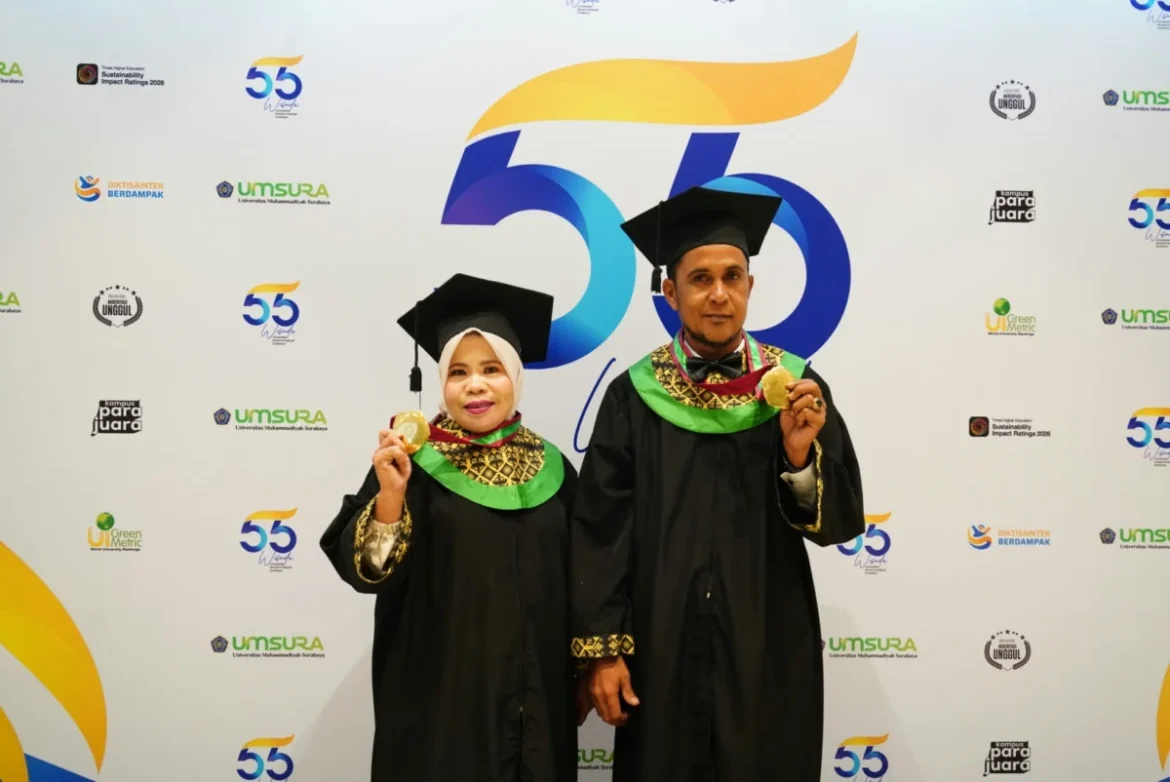
The pursuit of academic excellence often demands extraordinary resilience, but few stories match the determination demonstrated by Idris Yakub and Wahyuni Adam. Hailing from South Halmahera Regency in North Maluku, this married couple has defied formidable geographical and infrastructural challenges to earn their Bachelor of Education degrees from Universitas Muhammadiyah Surabaya (UM Surabaya). Their simultaneous graduation not only marks a personal milestone for the couple but also highlights a broader, transformative educational initiative empowering veteran educators in Indonesia’s remote archipelagic regions.
The journey to graduation was far from conventional. Both Idris and Wahyuni enrolled in the Primary School Teacher Education (Pendidikan Guru Sekolah Dasar – PGSD) study program at UM Surabaya. Despite being separated by thousands of kilometers from the campus based in East Java, the couple completed their coursework entirely through online learning systems. Their academic success was made possible by the Teacher Qualification Scholarship program initiated by the Regional Government of South Halmahera, facilitated through the Recognition of Prior Learning (RPL – Rekognisi Pembelajaran Lampau) pathway. This specialized academic route acknowledges professional experience and prior informal learning, allowing long-serving educators to fast-track their degrees and meet national teacher qualification standards.
A Journey Marked by Geographic and Logistical Hardships
The triumph of Idris and Wahyuni is contextualized by the harsh realities of remote island living in eastern Indonesia. Residing in South Halmahera—an expansive regency comprising hundreds of islands—the couple faced severe infrastructural deficits, most notably unreliable electricity and a near-total absence of stable internet connectivity.
Participating in mandatory online lectures required daily physical exertion and strategic planning. In a statement released to the media, Idris recounted the grueling routine required to attend virtual classes. "During our studies, the main obstacle was connectivity. We had to hike up a nearby hill for about 30 minutes just to find a cellular signal. Compounding that challenge was the lack of a reliable electricity grid in our area," Idris explained.
Despite these setbacks, the couple persevered, driven by a mutual commitment to self-improvement and professional development. They credited the unwavering support, patience, and academic guidance of the faculty members at UM Surabaya with helping them navigate the digital curriculum, manage coursework deadlines, and ultimately complete their undergraduate theses.
The Seven-Day Voyage to the Graduation Stage
The culmination of their multi-year academic endeavor required yet another monumental physical journey: traveling from the remote islands of North Maluku to the bustling metropolitan city of Surabaya in East Java. Rather than opting for costly commercial flights, which can be financially prohibitive for regional educators, Idris and Wahyuni joined hundreds of fellow scholarship recipients from South Halmahera in a massive logistical undertaking.
Wahyuni shared the camaraderie and thriftiness that characterized the journey for the cohort of remote graduates. "To keep costs manageable, hundreds of us graduates made the collective decision to travel by sea. We boarded a passenger ship together for a grueling voyage that lasted approximately seven days," Wahyuni noted. Despite the length and physical toll of the maritime transit, the arrival at the UM Surabaya campus offered an overwhelming sense of validation and joy. "Seeing the campus and finally participating in the official commencement ceremony made every single hardship completely worthwhile," she added.
Background and Context: The Teacher Qualification Imperative in Indonesia
To fully understand the significance of Idris and Wahyuni’s achievement, it is necessary to examine the broader educational landscape of Indonesia. Under national regulations, specifically the 2005 Teachers and Lecturers Law, all formal educators in Indonesia are required to hold a minimum of a bachelor’s (Sarjana) degree and a professional educator certificate. While this policy was designed to elevate the overall quality of instruction nationwide, its implementation exposed stark disparities between Java and the outer islands.
For decades, many remote regions, including South Halmahera, relied heavily on passionate educators who lacked formal four-year degrees due to a historical scarcity of higher education institutions in their localities. These teachers often served marginalized communities for years without official certification, limiting their professional mobility and financial compensation.
Recognizing this systemic gap, forward-thinking local administrations, such as the South Halmahera Regency government, partnered with reputable institutions like UM Surabaya. By utilizing the RPL framework, these programs evaluate the decades of practical teaching experience accumulated by veteran educators, translating professional service into academic credits. This reduces the time and financial burden required to secure a formal degree.
The Identification and Selection Process
The initiative that changed the trajectory of Idris and Wahyuni’s lives began well before their virtual lectures commenced. The program was rolled out through a meticulous screening and identification process conducted directly across various schools in South Halmahera.
Local education authorities, in collaboration with university representatives, conducted field audits to identify veteran teachers who met specific criteria of tenure, dedication, and professional readiness. Idris and Wahyuni were identified during this rigorous evaluation phase. Upon selection, they were awarded full scholarships that covered their tuition and administrative fees, effectively removing the financial barrier that had previously kept higher education out of reach.
Institutional Support and the Role of Private Higher Education
Universitas Muhammadiyah Surabaya, a prominent private Islamic higher education institution affiliated with the Muhammadiyah movement—Indonesia’s second-largest Islamic organization—has increasingly positioned itself as a pioneer in accessible, flexible learning. Through distance education models and tailored scholarship partnerships with local governments, Umsura has opened its virtual doors to students residing in Indonesia’s 3T regions (Tertinggal, Terdepan, dan Terluar — Disadvantaged, Frontier, and Outermost regions).
Educational experts note that the success of online learning for students in remote areas depends heavily on institutional empathy and adaptive pedagogy. Umsura’s faculty members implemented flexible consultation hours, asynchronous lecture materials to accommodate intermittent power supplies, and dedicated peer-support systems. This ensured that geographical isolation did not translate into academic exclusion.
Implications and Broader Economic-Educational Impacts
The graduation of Idris, Wahyuni, and their hundreds of peers from South Halmahera carries profound implications for regional development and educational equity in Indonesia.
First, the formalization of teacher credentials directly elevates the quality of primary education in isolated communities. Teachers who undergo formal degree programs are exposed to modern pedagogical theories, curriculum development strategies, and child psychology frameworks, which they can immediately apply in their local classrooms.
Second, the success of the RPL scholarship scheme serves as a viable policy blueprint for other regional governments. By investing in the upskilling of existing local workforces rather than relying entirely on importing educators from major urban centers, regency governments can foster sustainable human capital development that respects local cultural roots and ensures teacher retention. Educators rooted in their communities are statistically far more likely to remain in their posts long-term, reducing chronic teacher shortages in rural schools.
Looking Ahead: Ambitions for Advanced Studies
For Idris and Wahyuni, the acquisition of their bachelor’s degrees is not a final destination, but rather a catalyst for ongoing intellectual growth. Despite the formidable challenges they overcame during their undergraduate studies, both educators maintain an unyielding enthusiasm for lifelong learning.
In their post-graduation interviews, the couple expressed a strong desire to continue their academic journey. Should the opportunity for a scholarship arise again, both Idris and Wahyuni hope to pursue master’s (S2) degrees, ideally continuing their relationship with UM Surabaya. Their forward-looking ambition underscores a profound truth: education, once tasted, fuels a deeper hunger for knowledge.
A Timeless Lesson in Perseverance
The story of Idris Yakub and Wahyuni Adam transcends a simple university graduation report. It stands as an inspiring testament to human resilience, the democratization of education through digital innovation, and the vital role of strategic government-university partnerships.
By scaling hills to catch cellular signals, weathering week-long ocean voyages, and balancing decades of teaching responsibilities with rigorous academic demands, this South Halmahera couple has delivered a powerful message to future generations. Their journey powerfully demonstrates that no matter how distant the classroom, and no matter how severe the infrastructural limitations, geography is no match for genuine dedication to the pursuit of knowledge.
