

Social interaction constitutes the fundamental building block of human society, representing the reciprocal relationship between individuals and groups that shapes cultural, economic, and political structures. In the field of sociology, these interactions are categorized based on their functional outcomes, primarily divided into associative, disassociative, and accommodative processes. As human populations become increasingly interconnected through digital and physical platforms, the study of these interaction patterns has become essential for understanding how communities maintain cohesion or experience fragmentation.

The Foundations of Sociological Interaction
At its core, social interaction is defined as the dynamic sequence of social actions between individuals or groups who modify their actions and reactions due to the presence of others. These interactions are not merely random occurrences; they follow established social norms, cultural values, and institutional frameworks. Sociologists argue that these interactions create the "fabric" of society, determining how resources are shared, how conflicts are mediated, and how cultural identities are formed.
Historically, social interaction has evolved from localized, face-to-face engagements to complex, globalized networks. While the environment—be it a classroom, a workplace, or a digital social network—may change, the underlying mechanisms of human connection remain consistent. When individuals engage in collaborative tasks, such as group academic projects or professional team-building exercises, they participate in associative processes that reinforce group stability. Conversely, when competitive interests collide, they engage in disassociative processes that challenge existing social orders, necessitating accommodative interventions to restore equilibrium.

Associative Interactions: Building Social Cohesion
Associative interaction refers to social processes that promote unity, cooperation, and the integration of disparate elements into a cohesive whole. These interactions are vital for the sustainability of complex societies.
-
Cooperation: This represents the most basic form of associative interaction, where individuals or groups work together to achieve shared goals. Modern empirical research suggests that high levels of cooperation within organizations lead to increased productivity and higher morale. Whether through traditional practices like community-led "gotong royong" (communal work) or modern corporate project management, cooperation minimizes the friction caused by individualistic pursuits.

-
Asimilation: As societies become more diverse, assimilation serves as the process where different cultural groups gradually adopt the traits of another, eventually merging to form a new, unified culture. A prominent example is the evolution of musical genres. The development of dangdut music in Indonesia serves as a sociological case study, illustrating how the integration of Malay, Arabic, and Indian musical influences resulted in a unique cultural product that transcended its origins, effectively creating a new national identity.
-
Acculturation: Distinct from assimilation, acculturation involves the blending of two or more cultures while preserving the core identities of the original traditions. The architecture of the Great Mosque of Kudus provides a tangible example of this; the structure features elements of Hindu, Javanese, and Islamic design, reflecting a historical period of religious and cultural synthesis that did not necessitate the erasure of existing belief systems.

Disassociative Interactions: The Drivers of Conflict
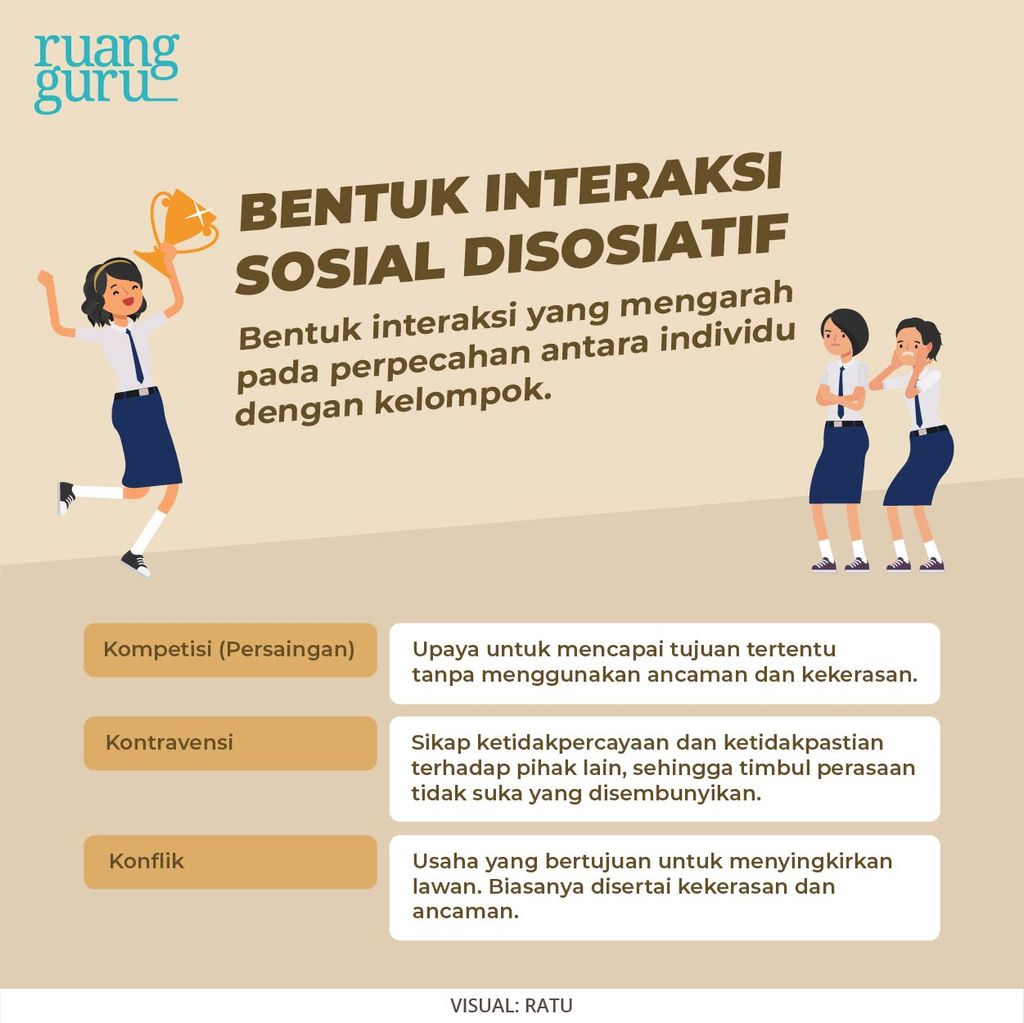
While cohesion is necessary for stability, conflict and competition are inherent to the human experience and often drive social change. Disassociative interactions involve processes that lead to division or opposition.
-
Competition: Competition is defined as a struggle for limited resources—such as wealth, power, or status—conducted within a framework of established rules. Unlike conflict, competition is generally governed by social norms and excludes the use of direct violence. Global economic markets and academic ranking systems are primary examples where competition functions as a mechanism for meritocratic advancement.

-
Contravence: This is a more subtle form of social friction, often characterized by hidden animosity or suppressed dissent. In professional and social environments, contravence manifests as passive-aggressive behavior. Sociologists note that while it does not always lead to immediate breakdown, persistent contravence can erode trust and lower organizational efficiency over time.
-
Conflict: The most intense form of disassociative interaction, conflict involves direct opposition where one party seeks to defeat or neutralize another, often through force or coercion. Conflict typically arises from incompatible interests, resource scarcity, or deep-seated ideological differences. While destructive in nature, conflict historically acts as a catalyst for institutional reform, forcing societies to address long-standing grievances.

Acommodative Processes: Restoring Social Balance
Acommodation is the process of resolving conflict or reducing tension between parties to restore social order. This process is essential for the management of modern societies, where the diversity of interests makes perpetual harmony difficult to achieve.
- Coercion: This involves the use of force or the threat of violence to end a dispute. While effective in the short term, sociologists warn that reliance on coercion often breeds resentment, potentially leading to future, more severe conflicts.
- Compromise: This is a voluntary adjustment of positions where both parties reduce their demands to reach a mutually acceptable middle ground. It is the most common form of conflict resolution in democratic societies and daily interpersonal relationships.
- Arbitration and Mediation: These mechanisms involve third-party intervention. In arbitration, a third party with higher authority—such as a legal judge or a school administrator—makes a binding decision. In contrast, mediation involves a neutral third party who facilitates dialogue, allowing the involved parties to arrive at their own resolution.
- Conciliation: This process aims to harmonize the divergent interests of the conflicting parties by creating a new framework for interaction. Unlike mediation, which focuses on the current dispute, conciliation attempts to address the root causes of the friction.
- Adjudication: This refers to the formal, institutionalized process of resolving conflicts through the legal system. It provides a standardized, objective pathway for addressing disputes that cannot be settled through informal negotiation.
Implications for Modern Society
The study of these interaction forms is not merely academic; it has profound implications for public policy and organizational management. In an era of increasing polarization, understanding the distinction between healthy competition and destructive conflict is crucial.
Data from recent sociological studies indicate that societies with robust, non-coercive accommodation mechanisms—such as strong legal institutions and active community mediation programs—experience lower rates of social instability. Conversely, when the channels for associative interaction (such as open dialogue and community cooperation) are restricted, societies are more prone to prolonged, cycles of disassociative conflict.
Furthermore, the influence of digital communication on these interactions cannot be overlooked. The anonymity and speed of the internet have introduced new variables into how people compete and resolve conflicts. While digital platforms can facilitate rapid cooperation on a global scale, they also provide environments where contravence and conflict can escalate rapidly due to the absence of face-to-face social cues.

In conclusion, social interaction is a fluid and multifaceted phenomenon. By recognizing the patterns of association, dissociation, and accommodation, individuals and institutions can better navigate the complexities of contemporary life. Whether in the classroom, the marketplace, or the halls of government, the ability to manage these interactions effectively remains the primary indicator of a resilient and functional society. Continued research into these processes will remain a priority for sociologists as they seek to map the shifting landscapes of human behavior in the 21st century.
