
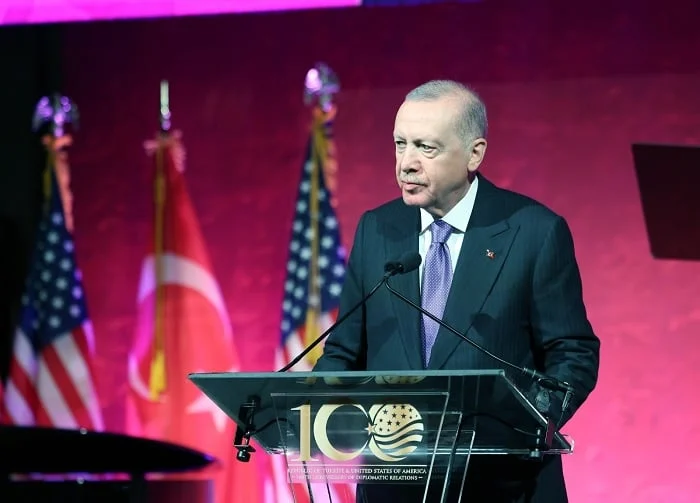
Turkish President Recep Tayyip Erdogan has reignited a fierce global debate regarding the architectural framework of the United Nations, issuing a direct and impassioned call for the complete abolition of the veto power held by the five permanent members of the UN Security Council (UNSC). Speaking to journalists in New York on the sidelines of high-level diplomatic engagements, Erdogan characterized the current decision-making apparatus as fundamentally unjust, outdated, and profoundly detrimental to global peace and stability. His remarks come at a time of profound geopolitical friction, where paralysis within the Security Council has repeatedly hindered international intervention in major global conflicts, including the devastating wars in Gaza and Ukraine, as well as rising maritime tensions in the Strategic Strait of Hormuz.
The longstanding debate over the structure of the UN Security Council highlights a deep institutional crisis. While the council is mandated with the primary responsibility of maintaining international peace and security, its internal mechanisms have increasingly rendered it incapable of executing its core mandate. Critics, led increasingly by middle-power nations like Turkey, argue that the privileges afforded to the five permanent members—commonly known as the P5—create an insurmountable barrier to effective multilateral diplomacy, leaving the broader international community helpless in the face of humanitarian catastrophes and sovereign aggressions.
Understanding the Anatomy of the UN Security Council Veto Power
To comprehend the gravity of President Erdogan’s proposals, one must examine the mechanics of the United Nations Security Council as established in the aftermath of World War II. The council is composed of 15 member states: five permanent members with veto authority (the United States, the United Kingdom, France, Russia, and China) and 10 non-permanent members elected by the UN General Assembly for staggered two-year terms.
The veto power, enshrined in Article 27 of the UN Charter, grants any of the P5 nations the unilateral ability to block the adoption of any substantive resolution, regardless of how overwhelming the support from other members might be. This means that even if 14 out of the 15 council members vote in favor of a resolution, a single negative vote—a veto—from a single permanent member entirely nullifies the measure.
Historically conceived to prevent the major powers from taking enforcement actions against one another and to ensure their continued participation in the fledgling international organization, the veto has instead evolved into an instrument of obstruction. In contemporary geopolitics, it is frequently deployed to shield allies from international accountability, block consensus on critical humanitarian interventions, and project narrow national interests over collective global welfare.
A Legacy of Paralysis: Recent Gridlock in the UNSC
The failure of the UN Security Council to act decisively in recent global conflicts serves as the primary empirical basis for Erdogan’s critique. Over the past three years, the council has found itself systematically deadlocked on several pivotal issues that define contemporary international relations.
In the context of the protracted Israeli-Palestinian conflict, the United States has repeatedly utilized its veto power to shield Israel from international resolutions. Within a span of three years, Washington has cast vetoes on multiple resolutions related to the conflict, including at least five specific texts that demanded an immediate, unconditional, and permanent ceasefire in Gaza. These vetoes occurred against the backdrop of catastrophic civilian casualties, widespread destruction of infrastructure, and severe humanitarian shortages, drawing sharp condemnation from human rights organizations and the majority of UN member states.
Simultaneously, the war in Ukraine has paralyzed the Security Council from an opposing ideological and geopolitical axis. Russia, as a permanent member, has exercised its veto power to block any substantive or legally binding resolutions condemning its military operations or demanding the withdrawal of its forces from Ukrainian territory. This stalemate has effectively neutralized the council’s ability to enforce international law or broker a viable peace framework, reducing the UN’s highest security body to a forum for rhetorical confrontation rather than practical conflict resolution.
Beyond Gaza and Ukraine, brewing flashpoints such as the security situation in the Strait of Hormuz—a vital global energy transit chokepoint—and ongoing conflicts in Sudan, Syria, and Yemen continue to suffer from the lack of a unified international response. The structural inability of the UNSC to address these crises has fueled widespread disillusionment with the post-WWII multilateral architecture.
Erdogan’s Blueprint for Comprehensive UN Reform
In his recent policy paper published in Bloomberg on September 22, alongside his address to the UN General Assembly, President Erdogan detailed a comprehensive four-pillar framework designed to restructure the global governance system. His proposals aim to transition the United Nations from an organization dominated by a select few to a truly inclusive global forum.
First, Erdogan advocates for the total elimination of the veto mechanism. He argues that the world of the twenty-first century cannot be safely navigated by relying on the political will of five individual capitals. By abolishing the veto, no single nation could single-handedly override the collective consensus of the international community.
Second, the Turkish leader calls for a structural overhaul of the Security Council itself, which includes ending the permanent status of the current P5 members. Erdogan contends that a system designed eight decades ago to reflect the balance of power immediately following World War II is fundamentally incapable of addressing contemporary global realities. He has emphasized that the distribution of global power has shifted dramatically, with emerging economies and developing regions deserving a permanent voice at the highest levels of international security decision-making.
Third, Erdogan proposes empowering the UN General Assembly (UNGA) to play a central role in global governance. Under his vision, the General Assembly should be granted the authority to elect all members of the Security Council for defined terms. This democratic mechanism would ensure that any nation sitting on the council must continually earn and maintain the trust of the broader international community through transparent electoral processes, rather than relying on historical privileges.
Fourth, the Turkish administration has actively sought to galvanize international coalitions in support of these reforms. During his remarks in New York, Erdogan directly appealed to the broader membership of the United Nations, noting that a system where the collective will of more than 190 sovereign nations is subjugated to the geopolitical calculations of just five countries is inherently unstable and unsustainable.
The Procedural Reality: How Difficult is UN Charter Amendment?
While the moral and political arguments for reforming the UN Security Council are widely acknowledged by many member states, the practical realization of such changes faces monumental legal and procedural hurdles.
Formally ending the veto power or restructuring the permanent membership of the UN Security Council requires a formal amendment to the UN Charter. According to Article 108 of the Charter, any amendment must be adopted by a vote of two-thirds of the members of the General Assembly and must be ratified by two-thirds of the Members of the United Nations, including all five permanent members of the Security Council.
This requirement creates a self-referential paradox: the very nations that benefit from the veto power—the P5—must voluntarily vote to relinquish their own extraordinary privileges. Consequently, historical attempts to reform the Security Council, whether through the expansion of permanent seats or the curtailment of veto rights, have consistently stalled due to opposition from the incumbent powers, who fiercely guard their geopolitical leverage.
Broader Implications and the Future of Multilateralism
The persistent gridlock within the UN Security Council and the growing chorus of high-level criticisms from leaders like President Erdogan carry profound implications for the future of the international order.
As formal multilateral institutions become increasingly incapacitated by partisan stalemates, there is a measurable trend toward alternative diplomatic frameworks. Middle powers and developing nations are increasingly turning to regional organizations, ad-hoc coalitions, and alternative economic forums—such as the expanded BRICS bloc or informal diplomatic groupings—to address transnational security and economic challenges. While these platforms offer alternative avenues for dialogue, they lack the universal legitimacy and enforcement mechanisms traditionally associated with the United Nations.
Furthermore, the continuous erosion of the Security Council’s authority risks deepening cynicism regarding the efficacy of international law. When populations suffering from conflict observe that the highest global authority is structurally unable to provide protection or justice due to the veto of a single state, confidence in the rules-based international order diminishes rapidly.
Ultimately, while the immediate abolition of the UN Security Council veto remains an uphill diplomatic battle constrained by the rigid architecture of the UN Charter, Erdogan’s persistent advocacy serves as a barometer of mounting global frustration. As geopolitical divisions widen and new transnational threats emerge, the debate over UN reform is no longer a peripheral diplomatic discussion but a central fault line determining whether the global governance architecture can adapt to survive the twenty-first century.
