
The trajectory of the Communist Party of Indonesia (Partai Komunis Indonesia, or PKI) stands as one of the most complex, volatile, and heavily scrutinized chapters in modern Southeast Asian political history. Once functioning as a formidable force within the archipelago’s turbulent political landscape—boasting millions of adherents, extensive mass organizations, and significant parliamentary clout—the party’s existence was violently uprooted in the mid-1960s. Its formal dissolution and proscription in 1966 marked not only the eradication of organized domestic communism in Indonesia but also catalyzed a fundamental restructuring of the nation’s political architecture, paving the way for the authoritarian New Order regime under General Suharto.
The history of the PKI cannot be understood through a singular, isolated event. Rather, it unfolded across distinct historical phases: the early incubation of leftist ideology during the late Dutch colonial era, armed uprisings and ideological fracturing during the national revolution, a dramatic parliamentary resurgence under Guided Democracy in the 1950s and early 1960s, and a catastrophic collapse following the events of September 30, 1965. Decades after these watershed moments, the historiography of the PKI continues to evolve, drawing on declassified international archives, official state documents, and human rights investigations that continually refine how scholars, policymakers, and the public interpret the legacy of Indonesian communism.
Genesis of the Left: From Colonial Resistance to the Madiun Affair
The ideological roots of Indonesian communism trace back to the twilight years of the Dutch East Indies. In May 1914, European socialists and anti-colonial activists established the Indische Sociaal-Democratische Vereeniging (ISDV), or the Indies Social Democratic Association, under the leadership of figures like Henk Sneevliet. The ISDV initially sought to introduce Marxist-Leninist thought to the Dutch colony, infiltrating local nationalist movements such as Sarekat Islam to build a broader anti-colonial base.
By 1920, the organization underwent a metamorphosis, shedding its European-centric framing to become the Perserikatan Komunis di Hindia (PKH), later officially renamed the Partai Komunis Indonesia (PKI) in 1924. This made it the earliest communist party established outside of Europe and the Soviet Union. As the party matured, it increasingly clashed with the colonial administration. In 1926, emboldened by radical factions, the PKI launched a series of premature uprisings against Dutch colonial authorities in West Java and West Sumatra. The rebellions were poorly coordinated and quickly suppressed by the colonial security apparatus. The aftermath was devastating for the party: thousands of members and suspected sympathizers were arrested, exiled to the notorious Boven Digoel concentration camp in Papua, or driven deep underground, severely curtailing communist activity for the remainder of the Dutch colonial era and the subsequent Japanese occupation.
Following Indonesia’s declaration of independence in 1945, the PKI resurfaced rapidly, seeking to position itself at the vanguard of the anti-imperialist struggle. However, ideological and strategic fissures within the nascent republic soon erupted into open conflict. The most severe crisis of this early period occurred in September 1948 in Madiun, East Java. Amidst severe economic hardship, diplomatic concessions to the Dutch, and intense political polarization, leftist groups—including the PKI, the Socialist Party, and labor organizations operating under the umbrella of the People’s Democratic Front (FDR)—engaged in armed resistance against the republican government led by President Sukarno and Vice President Mohammad Hatta.
On September 18, 1948, leaders of the leftist coalition proclaimed the "Soviet Republic of Indonesia" in Madiun. The republican government, viewing the revolt as a treacherous stab in the back while the nation was fighting to secure its independence from the Netherlands, launched a swift and decisive military campaign. Within months, the rebellion was crushed. Key communist leaders, including Musso, were killed, and thousands of cadres were imprisoned. The Madiun Affair left deep, generational scars on the national consciousness, cementing an adversarial relationship between the Indonesian military, religious groups, and the domestic communist movement.
Parliamentary Resurgence and the 1955 General Election
Despite the catastrophic setback of the Madiun Affair, the PKI demonstrated remarkable organizational resilience. By the early 1950s, under the dynamic and pragmatic leadership of Dipa Nusantara (D.N.) Aidit, along with co-leaders Njoto, M.H. Lukman, and Sudisman, the party embarked on a massive internal restructuring. Abandoning the adventurist tactics that had doomed the Madiun uprising, the "Aidit leadership" pivoted toward legal, mass-based political mobilization.
The PKI systematically expanded its influence by organizing trade unions (such as SOBSI), peasant fronts (BTI), women’s organizations (Perwari/Gerwani), and youth groups. It championed popular agrarian reforms, land redistribution for impoverished tenant farmers, and anti-corruption campaigns, which struck a powerful chord among Indonesia’s rural and urban working classes.
This methodical grassroots organizing culminated in the watershed Indonesian legislative election of 1955—the nation’s first democratic parliamentary vote. According to official data from the General Elections Commission (KPU), the PKI secured an astonishing 6,179,914 votes, translating to 16.36 percent of the national vote share and yielding 39 seats in the People’s Representative Council (DPR). This placed the party fourth overall, trailing only the Indonesian National Party (PNI), Masyumi, and Nahdlatul Ulama (NU). In the subsequent elections for the Constituent Assembly, the party expanded its footprint further, capturing roughly 6.23 million votes and 80 seats. The election results irrefutably demonstrated that the PKI had successfully rehabilitated its image and transformed itself into an institutionalized, major political power within Indonesia’s parliamentary democracy.
The Guided Democracy Era and Nasakom
The mid-to-late 1950s witnessed chronic political instability, regional rebellions, and frequent cabinet collapses under the parliamentary system. Seizing upon this friction, President Sukarno issued a decree on July 5, 1959, dismantling the constitutional democracy and ushering in the era of "Guided Democracy." This political pivot concentrated executive authority within the presidency, backed by an uneasy alliance between Sukarno, the military, and the rapidly expanding leftist movement.
During this period, the PKI adeptly aligned itself with President Sukarno’s nationalist agenda. The party threw its full rhetorical and political weight behind Nasakom—an acronym coined by Sukarno representing the union of Nasionalisme (Nationalism), Agama (Religion), and Komunisme (Communism). By championing Nasakom, the PKI sought to legitimize its presence as an indispensable pillar of the Indonesian state, neutralizing ideological attacks from religious parties like Masyumi (which was subsequently banned in 1960).
By the early 1960s, the PKI’s influence within the corridors of power reached unprecedented heights. Its membership reportedly swelled into the millions, making it the largest communist party outside of the Soviet bloc and China. However, this unchecked expansion triggered severe anxieties among rival political forces, most notably the Indonesian Army (Angkatan Darat) and conservative Islamic organizations. The political climate grew increasingly toxic. Tensions escalated along multiple fronts: ideological debates over the direction of the state, intense land reform disputes in rural Java and Bali (known as aksi sepihak or unilateral actions), and foreign policy alignments, particularly Sukarno’s confrontational stance against Malaysia (Konfrontasi) and the PKI’s controversial proposal to arm a "Fifth Force" composed of peasants and workers alongside the official branches of the armed forces.
The 1965 Crisis and the Fall of the Left
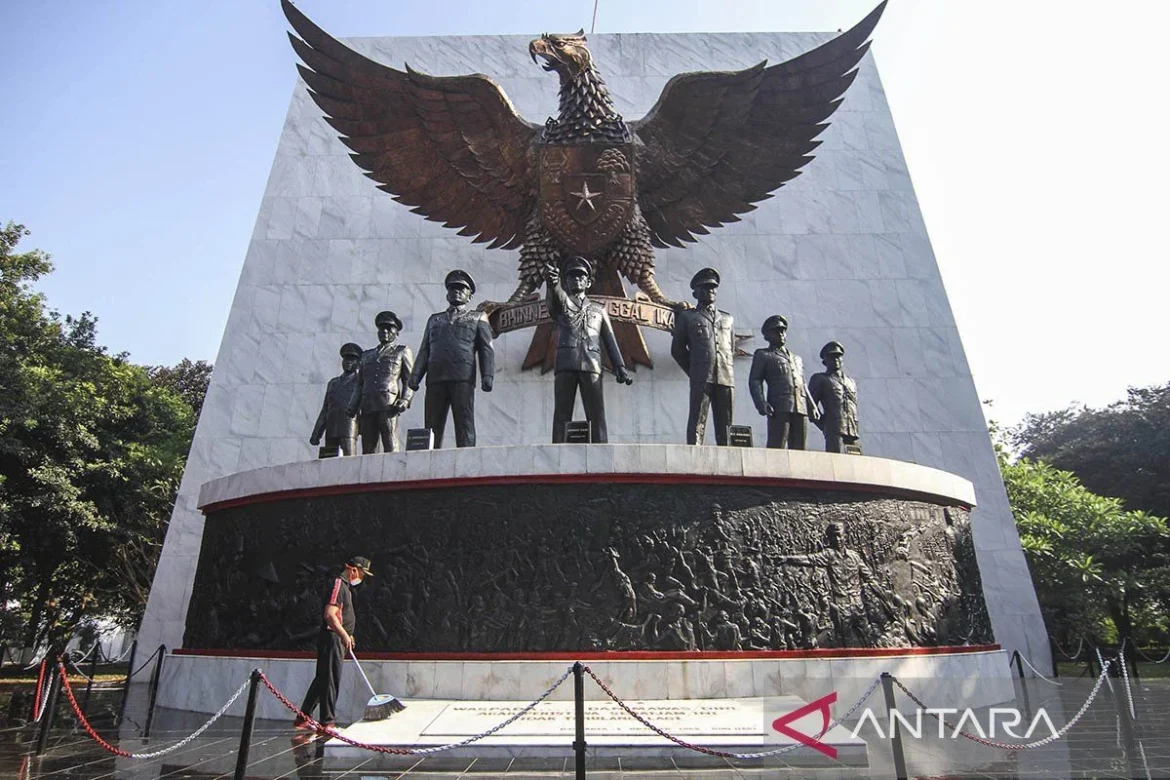
The fragile political equilibrium shattered irrevocably on the night of September 30 and the early hours of October 1, 1965. A faction within the military, calling itself the September 30 Movement (Gerakan 30 September, or G30S) and led by Lieutenant Colonel Untung Syamsuri of the Tjakrabirawa presidential bodyguard, launched a coordinated operation in Jakarta. They abducted and subsequently murdered six high-ranking Army generals and one officer, dumping their bodies at a well in the Lubang Buaya area on the southern outskirts of the capital.
The immediate objective and true orchestration of G30S remain subjects of intense scholarly debate and historiographical divergence. The official narrative constructed by the subsequent New Order regime consistently maintained that the PKI was the singular mastermind behind the coup attempt, portraying it as a treacherous conspiracy to overthrow the legal government and establish a communist state. Conversely, alternative historical analyses—drawing on later declassified intelligence documents, academic studies, and international archives from the United States, Japan, and Western Europe—suggest a much more complex web of motivations, pointing to internal military factionalism, intelligence manipulations, and opportunistic maneuvering by various domestic and foreign actors.
Regardless of the precise culpability of the party apparatus as a whole, the political fallout for the left was swift and catastrophic. Major General Suharto, who quickly assumed operational control of the Army in the wake of the assassinations, moved decisively to crush the movement. The military initiated a nationwide crackdown against the PKI, its affiliated mass organizations, and anyone suspected of leftist sympathies.
What followed was one of the worst mass atrocities of the 20th century. Between late 1965 and 1966, an estimated 500,000 to over one million individuals were killed, while hundreds of thousands more were subjected to arbitrary mass detentions, systematic torture, sexual violence, forced labor, and lifelong internal exile without formal trial. Investigations by the Indonesian National Commission on Human Rights (Komnas HAM) have formally classified these sweeping atrocities as gross violations of human rights. The violence did not merely decapitate the PKI leadership; it devastated entire families and communities, leaving an enduring trauma that continues to cast a long shadow over Indonesian social and political life.
Legal Proscription and the Birth of the New Order
The political collapse of the PKI culminated in formal state actions that permanently altered Indonesia’s legal and constitutional landscape. On March 12, 1966, General Suharto—acting under the controversial executive powers conferred by the Supersemar (Surat Perintah Sebelas Maret)—issued a presidential decree formally banning the PKI and all of its associated mass organizations, declaring them illegal entities.
This executive decision was institutionalized at the legislative level a few months later through Decree of the Provisional People’s Consultative Assembly (TAP MPRS) No. XXV/MPRS/1966, enacted on July 5, 1966. The decree explicitly banned the PKI throughout the entire territory of the Republic of Indonesia and outlawed any activities aimed at propagating or developing the teachings of communism, Marxism, and Leninism. To this day, TAP MPRS No. XXV/1966 remains a foundational element of Indonesian statutory law, though contemporary legal scholars and human rights advocates frequently debate its implementation in relation to modern constitutional principles, democratic freedoms, and universal human rights standards.
The destruction of the PKI served as the death knell for Sukarno’s Guided Democracy. As the left was eradicated and Sukarno’s executive powers were systematically stripped away, Suharto consolidated his control. In March 1968, the MPRS formally appointed Suharto as the second President of the Republic of Indonesia, inaugurating the centralized, military-backed authoritarian regime known as the New Order (Orde Baru), which would govern the nation for over three decades until its collapse in 1998.
Contemporary Historiography and Legacy
More than half a century after the trauma of 1965, the history of the PKI remains a potent and sensitive touchstone in Indonesian public discourse. The narrative of the events is no longer monolithic; historians and archivists continually advocate for a more nuanced, multi-sourced approach to understanding the era.
Highlighting this ongoing process of historical inquiry, institutions such as the National Archives of Republic Indonesia (ANRI) have emphasized the necessity of examining diverse archival collections—spanning domestic repositories as well as declassified documents from the United States, Japan, and European nations—to construct a comprehensive, evidence-based account of the past. In doing so, modern historiography seeks to carefully delineate between documented historical facts, official state decrees of the past, and the ongoing academic interpretations that continue to animate discussions among historians.
Ultimately, the history of the Communist Party of Indonesia transcends the single, bloody crucible of October 1965. It represents a sweeping historical arc that began with the idealistic anti-colonial organizing of the early 20th century, survived severe repression and near-annihilation after the Madiun revolt in 1948, achieved remarkable democratic legitimacy through grassroots mobilization in the 1950s, and ended in catastrophic structural collapse under the pressures of the Cold War. For Indonesia, the legacy of the PKI and the tragedy of 1965 remains an essential, deeply complex cornerstone of national historical reflection—a reminder of the high costs of intense ideological polarization and the enduring imperative of safeguarding human rights, democracy, and the rule of law.
