
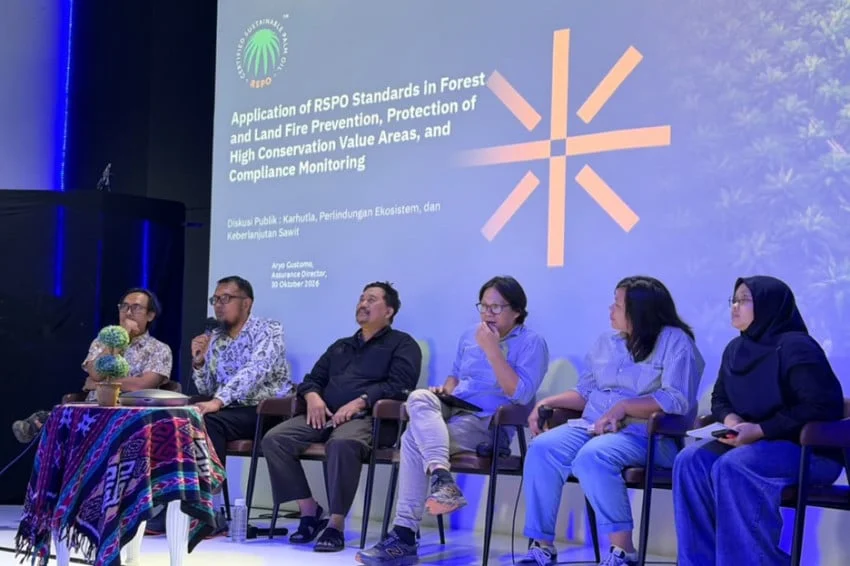
JAKARTA — The Roundtable on Sustainable Palm Oil (RSPO) has reiterated its uncompromising zero-tolerance stance regarding the use of fire in agricultural and land-clearing practices. This definitive declaration was made during a high-profile side meeting held on Friday, October 30, 2026, as part of the lead-up to the annual Roundtable (RT) RSPO conference in Jakarta. The convening brought together a diverse group of stakeholders, including representatives from civil society organizations, academia, media outlets, and prominent environmental watchdogs such as Sawit Watch, Greenpeace Indonesia, the Yayasan Ekosistem Lestari (YEL), Satya Bumi, and Bogor Agricultural University (IPB).
The renewed emphasis on strict fire prevention comes in response to recurring forest and land fires—locally known as kebakaran hutan dan lahan (karhutla)—that continue to plague parts of Indonesia and reignite regional concerns regarding transboundary haze pollution across Southeast Asia. As international scrutiny intensifies over environmental accountability, the RSPO’s recent statements highlight the organization’s ongoing efforts to reinforce proactive prevention measures, stringent auditing standards, and evidence-based accountability across the certified sustainable palm oil supply chain.
Background Context and the Road to RT RSPO 2026
The annual Roundtable on Sustainable Palm Oil serves as a critical global platform for dialogue, innovation, and progress within the sustainable palm oil sector. Ahead of the main conference, a series of side meetings are organized to address some of the most pressing environmental and socio-economic challenges facing the industry. The Jakarta session, co-hosted by SawitWatch, YEL, and Satya Bumi under the thematic banner “Karhutla, Ecosystem Protection, and Palm Oil Sustainability,” provided a transparent forum for rigorous debate.
Forest and land fires in Indonesia have historically been a complex environmental crisis, carrying severe ecological, economic, and diplomatic consequences. When severe haze episodes occur, they frequently strain diplomatic relations between Indonesia and its neighboring countries, such as Singapore and Malaysia, due to the cross-border drift of smoke and particulate matter. Recent regional developments have further underscored the urgency of this issue; notably, high-ranking officials in neighboring nations have intensified calls for corporate accountability, summoning executives of companies linked to regional land-clearing activities to address the crisis collaboratively rather than through finger-pointing.
Against this backdrop, the RSPO’s presence at the Jakarta side meeting was designed to address systemic vulnerabilities head-on, reassuring the public, civil society groups, and international markets that certified sustainable palm oil producers are held to the highest standards of environmental stewardship.
The RSPO’s Unyielding Stance on Fire Use
Addressing the assembled panel and audience, RSPO Director of Assurance Aryo Gustomo delivered a resolute message regarding the organization’s foundational principles. He emphasized that the utilization of fire for land preparation or any other operational purpose within certified concessions remains strictly forbidden under all circumstances.
“Forest and land fires represent a severe threat to ecosystems, biodiversity, and local communities. The RSPO treats every single risk with the utmost seriousness,” Gustomo stated during the session.
He further elaborated on how the RSPO certification framework is structured to mitigate these environmental hazards. By enforcing rigorous standard requirements, comprehensive auditing systems, and continuous monitoring processes, the organization aims to safeguard the integrity of the entire sustainable supply chain. According to Gustomo, the core responsibility of the RSPO is to guarantee that certified sustainable palm oil (CSPO) operates strictly within clear, enforceable boundaries that prioritize zero-burning practices.
When environmental infractions, community grievances, or allegations of non-compliance arise, Gustomo stressed that the RSPO does not rely on ad-hoc reactions. Instead, the organization deploys a structured, transparent, and credible grievance mechanism. This system is engineered to evaluate facts rigorously, respect established due process, and deliver decisive accountability measures—ranging from suspension to certification withdrawal—whenever breaches of the RSPO Standards are definitively proven.
Examining the Data: Contextualizing Palm Oil’s Role in Karhutla
A significant and contentious focal point of the panel discussion centered on the empirical data surrounding the origin and primary drivers of recent forest and land fires. For decades, the palm oil industry has frequently borne the brunt of international criticism, often being labeled as the primary culprit behind Indonesia’s recurring karhutla crises. However, recent scientific tracking and satellite-verified mapping present a markedly different empirical reality.
During the session, Gustomo drew attention to comprehensive geographic data that challenges prevailing narratives. According to findings verified by Nusantara Atlas, an independent monitoring platform, nearly 90 percent of the approximately 1.9 million hectares of land burned across Indonesia between January and September 2026 occurred entirely outside of officially recognized and managed palm oil concessions.
This statistical breakdown indicates that while land fires remain a catastrophic environmental issue driven by various socio-economic factors—including smallholder agricultural clearing, land speculation, and weak law enforcement in unmanaged public lands—large-scale, RSPO-certified palm oil plantations are statistically distinct from the vast majority of current burn zones.
Environmental experts and academic panelists at the Jakarta meeting analyzed these figures to underscore the necessity of targeted interventions. While certified producers are held to rigorous zero-burn standards and subjected to continuous satellite monitoring, a massive proportion of fires continue to ignite in non-certified areas, degraded peatlands, and abandoned tracts of land lacking active management or regulatory oversight. Consequently, participants agreed that addressing regional haze requires a multi-sectoral approach that extends far beyond the boundaries of the palm oil sector alone.
Stakeholder Perspectives and Civil Society Engagement
The inclusion of prominent civil society organizations such as Greenpeace Indonesia, Sawit Watch, YEL, and Satya Bumi alongside academic representatives from IPB ensured that the discussions were multifaceted and critically scrutinized. Environmental NGOs have historically played a vital watchdog role, holding certification bodies and corporate entities accountable for their environmental commitments.
During the panel exchanges, civil society representatives pressed the RSPO on the efficacy of its monitoring systems, the transparency of its grievance procedures, and the practical challenges of enforcing compliance among third-party suppliers and independent smallholders. While acknowledging the strictness of the RSPO’s official policies, NGO participants emphasized that policy on paper must seamlessly translate into operational reality on the ground.
The dialogue also underscored the unique vulnerabilities of independent smallholders who supply fresh fruit bunches to larger mills. Integrating smallholders into sustainable supply chains while providing them with the necessary technical and financial support to clear land without fire remains one of the most formidable hurdles in achieving total landscape-level sustainability. Panelists highlighted that proactive capacity-building, community fire-brigade initiatives, and early-warning systems are indispensable tools that must be scaled up to prevent fires before ignition occurs.
Broader Implications and Strategic Outlook for the Industry
The implications of the discussions held at the Road to RT RSPO side meeting extend far beyond domestic agricultural policy in Indonesia. As global consumer markets—most notably the European Union with its stringent Deforestation Regulation (EUDR)—demand absolute proof of deforestation-free and fire-free supply chains, the credibility of sustainability certification bodies like the RSPO is under unprecedented global scrutiny.
By publicly reaffirming its zero-tolerance policy backed by transparent, evidence-based accountability mechanisms, the RSPO aims to reinforce trust among international buyers, regulatory bodies, and environmental advocates. At the same time, the reliance on verified spatial data, such as the Nusantara Atlas statistics highlighting that the vast majority of recent fires occur outside palm oil concessions, provides the industry with a data-driven defense against generalized accusations.
However, industry analysts note that this data does not absolve the sector of its responsibilities. Instead, it places a heavier burden on certified producers, government agencies, and civil society to collaborate on landscape-level fire prevention. Because smoke and haze do not respect concession boundaries, true environmental security can only be achieved through regional cooperation, community empowerment, and strict enforcement of the law across all land-use sectors.
As the industry prepares for the main Roundtable conference, the message emerging from Jakarta is clear: while significant strides have been made in establishing robust certification standards, the eradication of forest fires and regional haze requires unyielding vigilance, cross-sectoral collaboration, and an unwavering commitment to accountability from all stakeholders involved in land management across Southeast Asia.
