
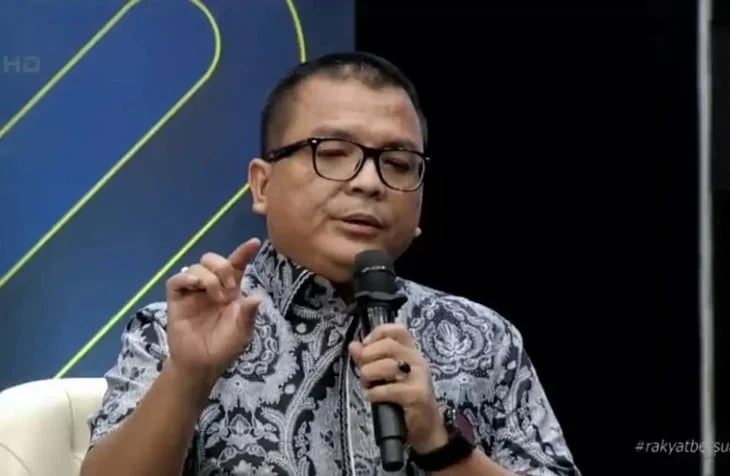
JAKARTA – The legal controversy surrounding the educational background of Indonesian Vice President Gibran Rakabuming Raka has escalated significantly, drawing sharp scrutiny from constitutional law experts and legal practitioners. Former Deputy Minister of Law and Human Rights, Denny Indrayana, has publicly challenged the legal representatives of Vice President Gibran Rakabuming Raka to present comprehensive academic records, specifically targeting the midterm examination (UTS) transcripts from Insearch, to clear up lingering discrepancies regarding his academic qualifications.
The challenge follows a recent court session where intervening defendants presented various educational documents intended to validate Gibran’s academic timeline and credentials. However, rather than resolving the public debate, the submission of these records has triggered deeper skepticism, with legal critics pointing out apparent inconsistencies within the submitted transcripts. As the judicial proceedings continue to unfold, the debate has transformed from a localized administrative dispute into a prominent national discussion concerning transparency, public accountability, and the verification of credentials held by high-ranking state officials.
Unpacking the Discrepancies in Educational Documents
The core of the current controversy centers on a series of academic records introduced by Gibran’s legal team during ongoing legal challenges regarding his educational background. Among the documents presented in court were a transcript of grades from Orchid Park Secondary School in Singapore and a certificate for an Advanced Diploma from the Management Development Institute of Singapore (MDIS).
Denny Indrayana, acting as a vocal critic of the presented evidence, argued that the documentation offered by the defense does not alleviate suspicions of information manipulation; instead, it deepens them. According to Denny, a meticulous examination of the academic credentials reveals peculiar grading marks and unusual academic progressions that warrant further clarification from independent educational authorities.
Of particular interest to legal observers is an English language grade marked as "E8" appearing on the documents from Singapore. In various British-system grading scales commonly utilized in Singaporean secondary institutions during that period, an E8 grade denotes a marginal pass, hovering just above outright failure. Denny highlighted this specific metric as a crucial puzzle piece in evaluating the academic trajectory of the Vice President, questioning how a student with such marginal foundational language scores managed to seamlessly transition into advanced tertiary programs without encountering institutional hurdles.
"Now it is being capitalized that Mr. Gibran’s diploma already exists. This was shown yesterday as part of the defense, the transcript of grades at Orchid Park Secondary School, Singapore. But interestingly, why is the English grade an E8? This is the key right here, why didn’t he pass the UTS Insearch?" Denny stated during a press briefing addressing the developments in the ongoing legal proceedings.
The reference to "UTS Insearch" points toward pathway programs often associated with the University of Technology Sydney (UTS) in Australia, where foundational English proficiency and rigorous midterm assessments serve as strict gatekeeping mechanisms for international students seeking entry into undergraduate degree tracks. Critics argue that securing an E8 in secondary-level English raises valid questions regarding whether standard institutional prerequisites were met or if alternative pathways were leveraged.
Chronology of the Educational Verification Dispute
The legal scrutiny surrounding Vice President Gibran Rakabuming Raka’s educational credentials is not an isolated event; it represents the latest chapter in a protracted administrative and judicial saga that has persisted through various political and electoral cycles.

The dispute initially gained traction during the lead-up to the national elections, where candidates’ foundational documentation—including high school equivalency certificates—faced rigorous scrutiny from political opponents, civil society organizations, and election watchdogs. Questions were raised regarding the exact nature of Gibran’s secondary and tertiary education obtained abroad, particularly concerning how foreign diplomas were converted, recognized, and equated by the Indonesian Ministry of Education, Culture, Research, and Technology.
The timeline of key developments highlights the escalation of the controversy:
- Pre-Election Phase: Civil society groups and legal activists begin filing preliminary inquiries regarding the exact nature of secondary schooling completed overseas by high-profile political candidates, demanding transparency from educational authorities.
- Administrative Filings: The Ministry of Education issues equalization letters (surat keterangan penyetaraan) for foreign-earned diplomas, which subsequently become the subject of administrative lawsuits filed by opposing legal coalitions.
- Judicial Review and Supreme Court Rulings: Legal challenges wind their way through the administrative court system, eventually reaching the Supreme Court (Mahkamah Agung). In recent rulings, the Supreme Court addressed the validity of specific equalization letters concerning high school credentials, delivering judgments that challengers claim delegitimize prior administrative clearances.
- Recent Court Proceedings: In the latest judicial sessions, intervening defendants representing Gibran introduce new documentation—including the Orchid Park Secondary School transcripts and MDIS advanced diplomas—to counter claims of academic deficiencies.
- The Current Challenge: Denny Indrayana publicly challenges the defense team to release the specific midterm examination (UTS) transcripts from Insearch to provide a complete and transparent narrative of the academic transition phases.
Legal Implications and the Role of the Supreme Court
The ongoing litigation touches upon fundamental administrative principles governing the validation of foreign academic credentials for individuals holding public office in Indonesia. Under national regulations, citizens—especially those occupying high-ranking executive positions—must possess verified educational credentials that meet national standards, with foreign degrees requiring formal equalization certificates issued by the authorized ministry.
Recent judicial maneuvers have brought the validity of these equalization certificates under intense legal review. Notably, rulings from the Supreme Court regarding the legal standing of secondary school equivalency documents (suket penyetaraan ijazah SMA) have introduced significant legal complexities. While the defense maintains that all documentation complies with regulatory standards and was lawfully acquired, plaintiffs and independent legal analysts argue that foundational gaps in the academic record undermine the integrity of the equalization process.
Legal experts note that transparency regarding academic records is essential for maintaining public trust in governance. When questions regarding educational qualifications persist without clear, verifiable documentary evidence, it invites prolonged litigation and fuels public skepticism. By demanding the release of the Insearch midterm transcripts, legal critics are attempting to shift the burden of proof onto the defense to provide an unbroken, verifiable chain of academic performance from secondary school through tertiary pathway programs.
Broader Socio-Political and Institutional Impact
Beyond the courtroom battles, the controversy surrounding Vice President Gibran’s educational credentials holds broader implications for Indonesia’s political landscape and institutional accountability. The debate intersects with wider public demands for transparency, meritocracy, and rigorous vetting processes for individuals ascending to the highest echelons of state power.
Civil society organizations, academic institutions, and governance watchdogs have closely monitored the proceedings, viewing the case as a litmus test for the judiciary’s ability to independently adjudicate administrative disputes involving powerful political figures. The willingness of legal practitioners like Denny Indrayana to publicly interrogate the authenticity and coherence of the presented documents underscores a persistent push for institutional transparency.
Furthermore, the controversy highlights the challenges faced by regulatory bodies in managing foreign educational verifications. As more Indonesian students and public figures pursue education abroad, the mechanisms for verifying foreign transcripts, evaluating pathway programs, and issuing equivalency certificates must remain robust, standardized, and immune to political interference.
As the legal proceedings continue to unfold, all eyes remain fixed on the courts to determine whether the defense will heed the challenge to release the requested Insearch midterm transcripts. Regardless of the immediate judicial outcome, the debate has established a precedent for heightened public scrutiny regarding the credentials of public officials, ensuring that the intersection of education, law, and politics will remain a focal point of national discourse in the foreseeable future.
