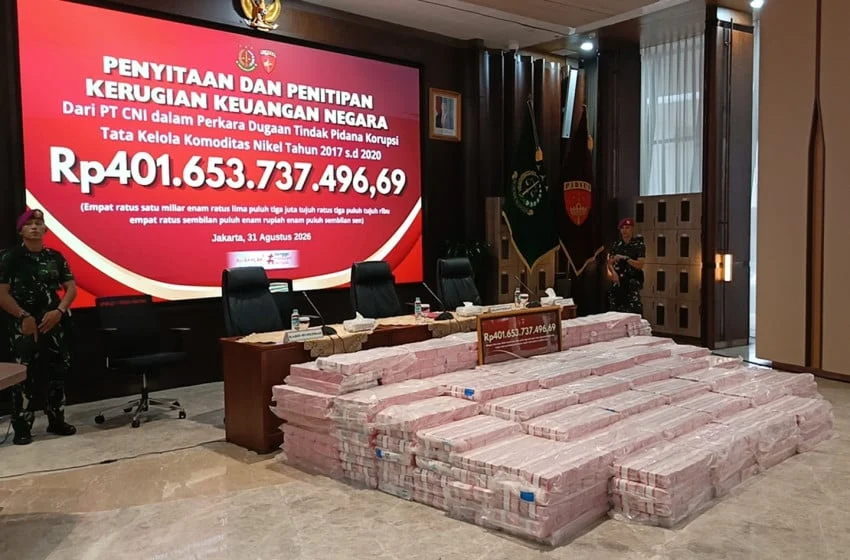
The Indonesian Attorney General’s Office (Kejagung) has dealt a significant blow to systemic white-collar crime within the country’s lucrative mining sector by displaying a staggering Rp401.65 billion in cash seized from PT Ceria Nugraha Indotama (CNI). The funds represent the quantified financial losses sustained by the state due to alleged corruption in the governance of nickel commodities spanning the 2017 through 2020 operational periods. Publicly exhibited during a high-profile press conference in Jakarta, the monumental pile of cash serves as a stark visual testament to the sheer scale of illicit financial flows plaguing Indonesia’s strategic mineral industries.
Legal experts and criminal law scholars have lauded the Attorney General’s aggressive investigative posture, particularly the decision to designate PT CNI as a corporate suspect. This legal maneuver is widely regarded as a watershed moment for Indonesian jurisprudence, challenging the traditional paradigm that limits criminal culpability to natural persons. By piercing the corporate veil, investigators aim to establish whether the sprawling web of illegal activities was merely the rogue enterprise of isolated individuals or a calculated, institutionalized strategy designed to maximize corporate profits at the expense of national sovereignty and environmental integrity.
The unfolding scandal touches upon the very core of Indonesia’s downstream nickel strategy—a cornerstone of the nation’s economic development plan aimed at establishing a robust electric vehicle supply chain. However, the rapid acceleration of the nickel industry has historically outpaced regulatory oversight, creating fertile ground for administrative malfeasance, illicit exports, and state revenue leakage. The intervention by the Junior Attorney General for Special Crimes (Jampidsus) underscores a growing governmental resolve to enforce stringent accountability across an industry traditionally shielded by complex corporate structures and bureaucratic complicity.
Anatomy of the Corruption Scheme: Unraveling the PT CNI Case File
Investigators from the Attorney General’s Office have methodically pieced together a comprehensive and highly sophisticated matrix of criminal acts allegedly orchestrated within PT CNI’s operational framework. According to the case file detailed by Jampidsus investigators, the illegal activities were not isolated infractions but rather a synchronized sequence of violations designed to circumvent regulatory frameworks and maximize margins illegally.
The core of the criminal architecture centers on the unauthorized export of nickel ore in blatant disregard of the Domestic Market Obligation (DMO) mandates established by the government. The DMO framework is legally binding and explicitly designed to ensure that domestic smelters receive an adequate supply of raw materials to support national value-addition policies. By bypassing these obligations, PT Ceria Nugraha Indotama allegedly prioritized immediate international profits over domestic industrial requirements, starving local processing facilities of vital feedstock.
Compounding the unauthorized exports, investigators uncovered systemic manipulation of mineral quality test results—commonly known as grading manipulation. By falsifying the assays of nickel content, corporate actors were allegedly able to misreport the volume and quality of extracted minerals, thereby evading accurate royalty assessments, export tariffs, and non-tax state revenue (PNBP) obligations. This fraudulent reporting directly defrauded the state treasury of hundreds of billions of rupiah over the three-year investigative window.
Furthermore, the scandal implicates corporate actors in securing export recommendations completely detached from valid Work Plans and Budgeting (RKAB) approvals. The RKAB is an indispensable regulatory instrument that governs production quotas, environmental mitigation strategies, and operational timelines. Operating outside the legal boundaries of an approved RKAB signifies a total breakdown of regulatory compliance, indicative of deep-seated collusion between corporate entities and compromised regulatory officials.
The investigative dossier also details a complex network of alleged bribery directed at key bureaucratic personnel. These illicit payments were purportedly channeled to facilitate the swift issuance of permits, turn a blind eye to structural non-compliance, and secure internal administrative sign-offs necessary for the unhindered execution of the company’s illegal export operations.
The Chronology of Investigation and State Recovery
The public revelation of the Rp401,653,737,496.69 cash pile on August 31, 2026, represents the culmination of years of meticulous intelligence gathering, financial auditing, and forensic accounting. The timeline of this monumental case reflects a systematic progression from initial suspicion to formal corporate prosecution and asset restitution.
The investigative horizon encompasses the operational window between 2017 and 2020, a period marked by explosive global demand for nickel driven by the burgeoning renewable energy and electric vehicle battery markets. During these years, regulatory enforcement across various remote mining concessions in Indonesia frequently lagged behind the frantic pace of commodity extraction.
Following extensive preliminary inquiries, the Attorney General’s Office elevated the status of the investigation into a full formal inquiry, deploying forensic auditors from the Supreme Audit Agency (BPK) to quantify the exact financial detriment suffered by the state. The BPK’s comprehensive audit ultimately finalized the state loss valuation at precisely Rp401,65 billion—a figure that directly mirrors the exact amount of cash successfully seized and presented by the Kejagung.
As legal pressure mounted, representatives of PT Ceria Nugraha Indotama initiated steps toward asset restitution. On Friday afternoon, August 28, 2026, just days prior to the official public exhibition, PT CNI formally transferred the entirety of the calculated state financial losses to the designated accounts of the Attorney General’s Office.
During the subsequent press briefing, Director of Investigation at Jampidsus, Saiful Bahri Siregar, emphasized that the acceptance of these funds does not terminate the criminal liability of the implicated parties. Instead, the restitution serves as a tangible mitigation factor while underscoring the transparency and institutional accountability of the investigative team. "As a manifestation of transparency and institutional accountability to the public, investigators have received the surrender of financial losses to the state from PT CNI on Friday afternoon, August 28, 2026, amounting to the figure displayed before you today, Rp401 billion," Saiful stated during the conference.
Legal Breakthrough: Corporate Criminal Liability as a Paradigm Shift
The decision by the Attorney General’s Office to formally designate PT Ceria Nugraha Indotama as a corporate suspect has drawn widespread praise from legal scholars, signaling a fundamental evolution in how Indonesian law enforcement addresses economic crimes.
Azmi Syahputra, a prominent Criminal Law Lecturer at Trisakti University, characterized the move as a highly significant legal breakthrough. According to Azmi, prosecuting corporate entities alongside natural persons is essential for determining whether systemic white-collar crimes are merely the episodic deviations of rogue employees or coordinated institutional strategies executed for the direct and systematic benefit of the corporation.
"The expansion of criminal liability is imperative, and designating the corporation as a suspect is vital to ascertain concretely whether these criminal acts were isolated individual deeds or perpetrated in the interest of and for the financial benefit of the corporate entity," Azmi explained. He cautioned against allowing complex corporate legal structures to function as impunity shields designed to insulate the ultimate beneficiaries from criminal prosecution while the illicit proceeds flow seamlessly into corporate balance sheets.
Azmi further commended the Attorney General’s Office for enforcing pre-trial detentions against key individual suspects linked to the case. He interpreted these detentions as a clear indicator of the state’s unwavering seriousness in safeguarding the integrity of the judicial process and establishing an uncompromising deterrence mechanism for corporate actors operating within the extractive sectors. "The detentions can be read as a form of seriousness by investigators from the Attorney General’s Office in securing the investigative process, reaffirming that the state must adopt a firm stance against entities and individuals that commit criminal acts under the guise of legitimate business operations," he added.
Unmasking the Bureaucratic Nexus and Extractive Vulnerabilities
While the recovery of Rp401.65 billion stands as a historic milestone in asset recovery, legal analysts and governance watchdogs argue that stopping at the corporate level is insufficient to dismantle the systemic corruption rotting the foundations of Indonesia’s mining bureaucracy.
Azmi Syahputra strongly urged the Attorney General’s Office to expand the scope of its investigation to trace the entire bureaucratic supply chain within the mineral and coal (minerba) governance ecosystem. He warned against the danger of reducing complex structural crimes to mere token prosecutions of low-level scapegoats.
"Investigators need to dismantle not only the individuals who received the illicit funds, but also those who demanded, orchestrated, facilitated, issued, verified, acknowledged, and deliberately permitted these violations to occur, including identifying vulnerable loopholes within the mineral and coal bureaucracy," Azmi asserted. The call for systemic reform emphasizes that sustainable governance in the mining sector requires a holistic overhaul of regulatory oversight, moving far beyond reactive criminal prosecutions to implement proactive, institutionalized transparency.
The involvement of administrative personnel in verifying false assays, rubber-stamping irregular export recommendations, and overlooking DMO deficits highlights a pervasive vulnerability within regulatory agencies. Without prosecuting the corrupt bureaucrats who enabled PT CNI’s operations, similar malpractices are likely to persist across other concessions. Consequently, legal experts continue to advocate for sweeping administrative reforms, rigorous digital tracking of mineral flows, and independent multi-agency oversight to permanently close the systemic loopholes exploited by predatory corporate actors.
Broader Economic Implications and National Policy Repercussions
The PT Ceria Nugraha Indotama scandal carries profound implications for the broader architecture of Indonesia’s economic policy, particularly its ambitious downstreaming (hilirisasi) agenda. As the world’s leading producer of nickel, Indonesia has staked its economic future on transitioning from a mere exporter of raw earth materials to an indispensable hub in the global electric vehicle and battery manufacturing supply chain.
However, the integrity of this national economic strategy relies heavily upon transparent, rule-abiding governance. Scandals involving massive state revenue leakage, export manipulation, and corrupt bureaucratic collusion threaten to undermine international investor confidence and cast a shadow over the sustainability credentials of Indonesian nickel exports. Global automakers and institutional investors are increasingly imposing stringent Environmental, Social, and Governance (ESG) criteria on their supply chains, making rigorous domestic law enforcement a commercial necessity rather than merely a legal obligation.
The successful seizure and public exhibition of Rp401.65 billion send a powerful message to domestic and international markets alike: Indonesia is actively purging illicit practices from its critical mineral sectors. By holding corporate entities directly accountable and aggressively pursuing asset recovery, the Attorney General’s Office is establishing a robust legal precedent that redefines the parameters of corporate citizenship in the nation’s extractive industries.
Moving forward, the outcome of the PT CNI prosecution will likely serve as a benchmark for ongoing and future investigations into mineral governance. As the judiciary prepares to try the case, the broader public and international observers will be watching closely to see whether this landmark intervention translates into permanent structural reform, ensuring that Indonesia’s vast natural wealth serves the collective prosperity of the nation rather than the illicit enrichment of a select few.