
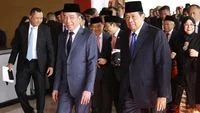
Jakarta, Indonesia — The Legal and Party Security Agency (Badan Hukum dan Pengamanan Partai – BHPP) of the central executive board of the Democratic Party (Partai Demokrat) has officially issued formal legal warnings, known locally as somasi, directed at three distinct YouTube channels. This legal action comes in response to the publication and dissemination of unverified claims, speculative narratives, and alleged misinformation concerning senior party figures, specifically the Chairman of the Democratic Party’s High Council and sixth President of the Republic of Indonesia, Susilo Bambang Yudhoyono (SBY), alongside the current General Chairperson, Agus Harimurti Yudhoyono (AHY).
The targeted digital platforms—identified in official party documents as Dangkal Politik, Berita Semampir, and Tinta Kahivang—are accused of broadcasting fabricated stories regarding high-level political meetings that never took place. The legal reprimand underscores a growing institutional intolerance within major Indonesian political organizations toward unauthorized digital content creation that exploits prominent political names for algorithmic engagement, audience monetization, or targeted political disinformation campaigns.
The escalation highlights the delicate nature of political alignments, coalition building, and public perception management in the lead-up to future national electoral cycles, particularly as political actors and analysts increasingly look ahead toward the 2029 Indonesian presidential and legislative elections.
Chronology of the Alleged Digital Infractions
The formal legal notices issued by the BHPP Demokrat detail specific timelines and content markers associated with each of the three channels under scrutiny. The controversy crystallized in late November, following a flurry of algorithmic content generation across various video-sharing platforms that capitalized on speculative political commentary.
According to the legal documents released by the Democratic Party’s legal wing, the sequence of disputed publications unfolded rapidly:
-
Dangkal Politik: This channel published a video on November 27, featuring prominent visual and auditory claims that SBY had traveled specifically to Solo, Central Java, to visit former President Joko Widodo (Jokowi). The narrative asserted that the purported closed-door meeting was designed to forge an early political coalition aimed at the 2029 presidential and vice-presidential elections. The legal team pinpointed a specific timestamp at minute 2:57 of the broadcast as containing the most egregious misrepresentations of fact.
-
Berita Semampir: Operating on the same date, November 27, this channel circulated a parallel narrative mirroring the claims made by Dangkal Politik. The channel’s broadcast similarly insisted that SBY had undertaken a clandestine political pilgrimage to Solo to negotiate strategic political terms with Jokowi, framing the alleged encounter as a pivotal realignment of major political forces.
-
Tinta Kahivang: Expanding the scope of the alleged misinformation, this channel targeted the current Minister of Agrarian Affairs and Spatial Planning/Head of the National Land Agency and Democratic Party Chairman, Agus Harimurti Yudhoyono (AHY). The channel broadcasted a sensationalized premise alleging that AHY had also traveled to Solo to meet not only the former president but also Jokowi’s sons—namely, current Vice President Gibran Rakabuming Raka and Indonesian Solidarity Party (PSI) Chairman Kaesang Pangarep. The title and framing of the video utilized provocative phrasing, suggesting that political alliances were shifting rapidly and warning that President Prabowo Subianto should remain vigilant regarding the evolving 2029 political landscape.
In response to these broadcasts, the BHPP Demokrat categorically rejected the assertions, classifying the videos as deliberate hoaks (hoaxes), malicious slander, character assassination, and incitement designed to mislead the public and disrupt political stability.
Legal Demands and Ultimatums Issued by BHPP Demokrat
The legal framework governing defamation, electronic information, and transactions in Indonesia provides political entities and public figures with clear avenues to challenge defamatory digital content. Exercising these rights, the BHPP Demokrat did not immediately file a criminal police report under the Electronic Information and Transactions (ITE) Law, opting instead to issue a strict administrative and legal ultimatum.
Through the formal somasi, the Democratic Party’s legal defense team has given the administrators of Dangkal Politik, Berita Semampir, and Tinta Kahivang a strict deadline of three times twenty-four hours (3×24 hours) from the issuance of the notice to rectify their actions.
The mandatory remediation demands require the respective channel operators to:
- Immediately remove and permanently delete the offending video content from their platforms.
- Broadcast an open, unreserved public apology directed specifically at Susilo Bambang Yudhoyono and Agus Harimurti Yudhoyono.
- Publish the formal apology across multiple recognized national media outlets to ensure equal visibility to the original erroneous broadcasts.
Failure to comply within the stipulated 3×24-hour window will result in the immediate escalation of the matter to formal criminal proceedings. The BHPP legal team has signaled that they are fully prepared to file official police reports with the Indonesian National Police (Polri), citing violations of prevailing criminal statutes concerning defamation, dissemination of false information intended to cause public harm, and online harassment.
The legal notice was officially authorized and signed by a formidable collective of nine advocates representing the BHPP Demokrat. The legal panel includes Muhajir, Cepi Hendrayani, Muhammad Mualimin, Nadya Prita Gemala D, Nurhidayat Umacina, Yandri Sudarso, Novianto Rahmantyo, Dedy Dwi Yulianto, and Andhika Yuda Perwira.
Broader Political Context: Navigating Coalitions and Rumor Mills
The swift and assertive reaction from the Democratic Party reflects the high-stakes environment of contemporary Indonesian politics. Following the successful transition of power and the formation of the current Red and White Cabinet (Kabinet Merah Putih) under President Prabowo Subianto—in which the Democratic Party holds strategic ministerial and governmental positions—party consolidation and internal discipline are paramount.
The Democratic Party, alongside its coalition partners within the current administration, operates under a carefully calibrated power-sharing arrangement. Speculative narratives suggesting independent, clandestine political maneuvering or early coalition talks for the distant 2029 electoral cycle not only introduce unnecessary friction within the ruling coalition but also threaten to undermine public trust in the party’s institutional integrity.
Political analysts have frequently noted the vulnerability of the Indonesian digital ecosystem to sensationalized political content. The rise of hyper-partisan YouTube channels, political gossip aggregators, and algorithmic content farms has created a persistent challenge for mainstream political parties. These digital actors frequently leverage the names of high-profile national figures—such as SBY, Jokowi, Prabowo Subianto, Megawati Soekarnoputri, and AHY—to generate clickbait traffic, maximize advertising revenue, and manipulate public sentiment through unverified rumor-mongering.
Implications for Digital Media Ethics and Political Communication
The formal warning issued by the Democratic Party serves as an important benchmark for digital accountability in Indonesia’s evolving media landscape. It highlights several critical developments in how political organizations manage external communications and combat disinformation:
-
Proactive Legal Defense: Political parties are increasingly establishing dedicated legal task forces—such as the BHPP—equipped to monitor, analyze, and swiftly counter unauthorized digital narratives before they can mainstream into traditional media or shape public consensus.
-
Defense of Institutional Stability: By aggressively clamping down on narratives that depict coalition friction or premature succession planning, political elites aim to maintain internal cohesion and signal unwavering loyalty to the existing governmental framework led by President Prabowo Subianto.
-
The Shrinking Toleration for Algorithmic Disinformation: The ultimatum sets a rigorous legal precedent that content creators operating on decentralized platforms like YouTube cannot hide behind the veil of commentary or freedom of expression when disseminating fabricated factual claims about identifiable individuals.
As the 3×24-hour countdown lapses, all eyes remain fixed on whether Dangkal Politik, Berita Semampir, and Tinta Kahivang will issue the mandated public apologies or face the imminent weight of a formal police investigation. For the Democratic Party, the incident underscores the ongoing necessity of vigilant legal oversight in an era where digital channels possess the unprecedented capacity to manufacture and amplify political fiction at digital speed.
