
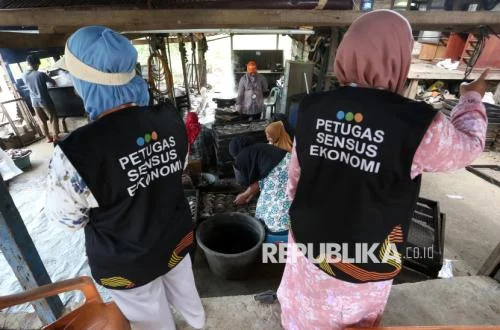
The Central Bureau of Statistics (BPS) Semarang City has confirmed a significant wave of resignations among its data collection personnel for the upcoming 2026 Economic Census, coinciding with allegations of stalled wage payments to these vital field partners. Rudi Cahyono, Head of BPS Semarang City, addressed the growing concerns on Saturday, July 18, 2026, acknowledging that 30 enumerators had withdrawn from their duties, a development that casts a shadow over the meticulous preparations for this critical national data collection effort. The total workforce mobilized by BPS Semarang for the 2026 Economic Census stands at 1,437 enumerators, making the departure of 30 individuals, while numerically small, a potent indicator of underlying challenges.
The Unfolding Situation: Enumerator Resignations and Their Causes
Cahyono clarified that the 30 resignations were not a synchronized mass exodus but rather a staggered process, occurring based on individual circumstances. He firmly asserted that these departures were primarily due to external factors rather than any internal issues within the BPS Semarang operations or the census project itself. According to his breakdown, a significant portion—approximately 50 percent, or 16 individuals—resigned because they had secured permanent employment elsewhere, a common occurrence for temporary contract workers engaged in large-scale government surveys. The remaining enumerators cited a variety of personal reasons: five individuals withdrew due to illness, others were compelled to leave to care for elderly parents, and some found it challenging to manage their time effectively between academic commitments and the demanding schedule of data collection.
However, the departure of these enumerators comes with a specific contractual implication: those who resign, even after having commenced work, are not eligible to receive their honorarium. Cahyono emphasized that this policy is explicitly stipulated in the Work Agreement Letter (SPK) signed by all partners. "In accordance with the provisions in the SPK, if they resign, they do not receive their honorarium," he stated, highlighting the strict adherence to contractual terms that BPS Semarang maintains. Given the tight deadlines inherent in the 2026 Economic Census, BPS Semarang is now faced with the immediate task of recruiting and training replacements to ensure that data collection remains on schedule and does not compromise the integrity or completeness of the census. "This is so that the work can continue," Cahyono added, underscoring the urgency of the situation.
Allegations of Payment Delays and Contractual Ambiguities
The issue of enumerator resignations has unfortunately converged with more serious allegations regarding the timely disbursement of wages, with reports suggesting that payments to data collection partners in Semarang have been "macet" or stalled. These claims have fueled discontent among the remaining workforce and raised questions about the BPS’s financial management practices for such a large-scale operation. While BPS Semarang acknowledges the concern, Rudi Cahyono vehemently denied any alteration to the agreed-upon contract terms or payment mechanisms. He reiterated that BPS Semarang meticulously follows the provisions outlined in the initial SPK, ensuring transparency and fairness in all financial transactions. "We have not changed the payment mechanism. Everything still refers to the initial SPK," Cahyono asserted when pressed on the rumored contract modifications.
The core of the payment dispute appears to revolve around the interpretation of Clause 8, Paragraph (3), Letter (a) of the SPK, which governs the conditions for the first-term payment. This clause states that the initial payment is disbursed after the enumerator completes 40 percent of their total workload. However, the ambiguity arises because the SPK does not explicitly delineate what constitutes this "total workload" in terms of specific deliverables, particularly regarding Statistical Blocks (SLS). Enumerators reportedly interpreted "40 percent of the total workload" as exclusively pertaining to the completion of a certain number of SLS, which are geographically defined areas containing a group of households or businesses to be enumerated.
Cahyono offered a detailed explanation of BPS Semarang’s interpretation: "In the SPK, it’s 40 percent of the task load. This task load includes SLS and its assignments. So, when an officer is given 10 SLS, for example, 40 percent of that is four. When the total assignments are 1,000, then 40 percent is 400." He further clarified, "So, the fulfillment meant is having completed 40 percent of their workload from those two components, namely SLS and its assignments." This explanation suggests that the workload encompasses not just the physical completion of statistical blocks but also the associated administrative and data entry tasks, or "assignments," that accompany them. The discrepancy between the enumerators’ understanding and BPS’s interpretation seems to be a major friction point, potentially leading to perceived delays if enumerators believe they have met their quota based on SLS alone, while BPS awaits completion of other associated tasks.
A copy of the SPK obtained by Republika indeed confirms that the said clause regarding the first-term payment does not explicitly mention the fulfillment of SLS. It broadly refers to the completion of "40 percent of the total workload." This lack of explicit detail in the contractual language could understandably lead to different interpretations among the diverse workforce. Cahyono acknowledged this potential for misunderstanding, suggesting that many enumerators might not have fully grasped the nuances of the payment mechanism. He pointed out that BPS Semarang conducts weekly briefings every Friday, where such payment procedures are regularly communicated. "Perhaps this information has not been fully understood by our field officers," he speculated, indicating a need for clearer, more accessible communication channels regarding contractual obligations.
Beyond the contractual interpretation, Cahyono also highlighted the bureaucratic realities of government payments. He explained that even once enumerators meet the 40 percent workload threshold, the actual disbursement of funds is not instantaneous. Citing Minister of Finance Regulation (PMK) Number 190/PMK.05/2012, which governs state financial management, he noted that the processing of claims to the state can take up to 17 working days after the right to claim arises. This regulatory framework means that an enumerator completing their 40 percent workload on, for example, July 15, 2026, should not expect immediate payment on that date, but rather within the stipulated 17-day window. This delay, while legally mandated, can still create financial strain and frustration for temporary workers relying on timely income.
Background: The 2026 Economic Census – A National Imperative
The 2026 Economic Census (SE2026) is not merely a regional undertaking for Semarang but a monumental national project with far-reaching implications for Indonesia’s economic future. Conducted every ten years, the Economic Census by BPS is the most comprehensive data collection exercise on the nation’s economic activities. Its primary objective is to map the entire economic landscape of Indonesia, encompassing all types of businesses, from micro-enterprises and small and medium-sized enterprises (MSMEs) to large corporations across various sectors, excluding agriculture, which is covered by a separate agricultural census.
The data gathered from SE2026 will serve as the backbone for national economic planning, policy formulation, and investment promotion for the next decade. It provides crucial insights into the structure of the economy, business demographics, employment patterns, capital investment, and regional economic disparities. Policymakers rely on this data to design targeted programs for MSME development, assess the impact of regulations, identify new growth sectors, and inform infrastructure development. For investors, the census offers a detailed understanding of market potential, supply chains, and consumer behavior. Without accurate and complete data from SE2026, the government’s ability to make informed decisions and steer the nation towards sustainable economic growth would be severely hampered. Semarang, as a bustling provincial capital and a significant economic hub in Central Java, plays a particularly crucial role in contributing to this national dataset, making the smooth execution of the census in this region paramount.
The Role and Challenges of Enumerators
Enumerators, or data collection partners, are the frontline soldiers of any census. Their role is arduous, requiring meticulous attention to detail, strong communication skills, and resilience. They are tasked with visiting thousands of businesses, often door-to-door, to conduct interviews, explain complex questionnaires, and accurately record sensitive economic data. The job is physically demanding, involving extensive travel within designated statistical blocks, and intellectually challenging, as they must ensure data quality and consistency.
For many, becoming an enumerator offers a temporary income opportunity and a chance to contribute to a national cause. However, the temporary nature of the work often means limited benefits, and reliance on timely payments for their livelihood. Previous censuses, both economic and population, have highlighted common challenges faced by enumerators, including difficulties in accessing respondents, dealing with uncooperative businesses, working in remote or challenging terrains, and the psychological stress of meeting demanding targets. Payment delays, ambiguous contract terms, and a lack of clear grievance mechanisms can severely demotivate these crucial personnel, potentially impacting the quality and speed of data collection. The BPS’s large workforce of 1,437 enumerators in Semarang underscores the massive logistical and human resource management challenge involved in such an undertaking.
Implications and Broader Context
The issues unfolding in Semarang, while localized, carry broader implications for the success of the entire 2026 Economic Census and the public’s trust in BPS. A significant number of resignations can lead to delays in data collection, requiring BPS to expend additional resources on recruitment and training of new personnel, which in turn can impact the overall timeline and budget. More critically, high turnover can affect data quality. New enumerators, despite training, may not immediately achieve the same level of proficiency or consistency as experienced personnel, potentially introducing variations in data collection methodologies.
The dispute over payment terms highlights a common challenge in large-scale government contracts involving temporary workers: the need for absolute clarity in contractual language. Ambiguity in the SPK, particularly concerning what constitutes "40 percent of the total workload," creates a fertile ground for misunderstanding and mistrust. This situation underscores the importance of not just having legal contracts but ensuring that these contracts are easily comprehensible by all parties, especially those without legal training. Effective communication, beyond formal briefings, is essential to bridge the gap between institutional interpretation and field-level understanding.
Furthermore, perceived payment delays, even if technically within regulatory frameworks like PMK 190/PMK.05/2012, can severely demoralize a temporary workforce. For individuals relying on this income, a delay of 17 working days can create significant financial hardship, leading to a loss of enthusiasm, reduced productivity, and potentially further resignations. This situation in Semarang could serve as a cautionary tale for other BPS regional offices and government agencies undertaking similar large-scale temporary employment projects, emphasizing the need for robust HR systems, clear contractual terms, and efficient payment processing mechanisms that prioritize the well-being of their field partners.
Moving Forward: Remedial Actions and Oversight
BPS Semarang’s immediate priority is to swiftly replace the 30 enumerators who have resigned to prevent further disruptions to the census timeline. This will involve accelerated recruitment drives and intensive training programs to bring new personnel up to speed. Beyond this immediate fix, the incident calls for a proactive review of BPS’s engagement strategies with its temporary workforce.
To prevent similar issues in the future, BPS could consider several measures:
- Enhanced Contract Clarity: Revisiting the SPK to make the "total workload" definition for payment explicitly clear, perhaps with examples or a detailed breakdown of components (SLS, assignments, data entry, quality checks).
- Improved Communication: Beyond weekly briefings, BPS could implement more interactive and accessible communication channels, such as FAQs, dedicated helplines, or digital platforms, where enumerators can quickly get clarifications on contract terms and payment status.
- Financial Literacy and Expectation Management: Providing enumerators with clear information at the outset about the payment processing timeline, including the 17-day grace period stipulated by the Ministry of Finance, to manage expectations and alleviate anxiety.
- Grievance Mechanism: Establishing a clear and responsive grievance mechanism for enumerators to address payment issues, contractual disputes, or other work-related concerns promptly.
- Exit Interviews: Conducting exit interviews with resigning enumerators to gather detailed feedback on their reasons for leaving, which can provide valuable insights for improving working conditions and retention strategies.
The Ministry of Finance, as the body responsible for state financial regulations, may also need to monitor the implementation of PMK 190/PMK.05/2012 in the context of large-scale temporary contracts to ensure that while fiscal prudence is maintained, the welfare of temporary government partners is not unduly compromised by bureaucratic delays.
In conclusion, the situation in Semarang serves as a microcosm of the immense logistical and human resource challenges inherent in conducting a national census. While BPS Semarang asserts its adherence to contractual obligations and regulatory frameworks, the concurrent issues of enumerator resignations and payment disputes highlight the critical need for absolute clarity, transparent communication, and empathetic management of its temporary workforce. The success of the 2026 Economic Census, a cornerstone of Indonesia’s future economic planning, ultimately hinges on the effective resolution of these issues and the sustained motivation of the thousands of dedicated individuals on its front lines.
