
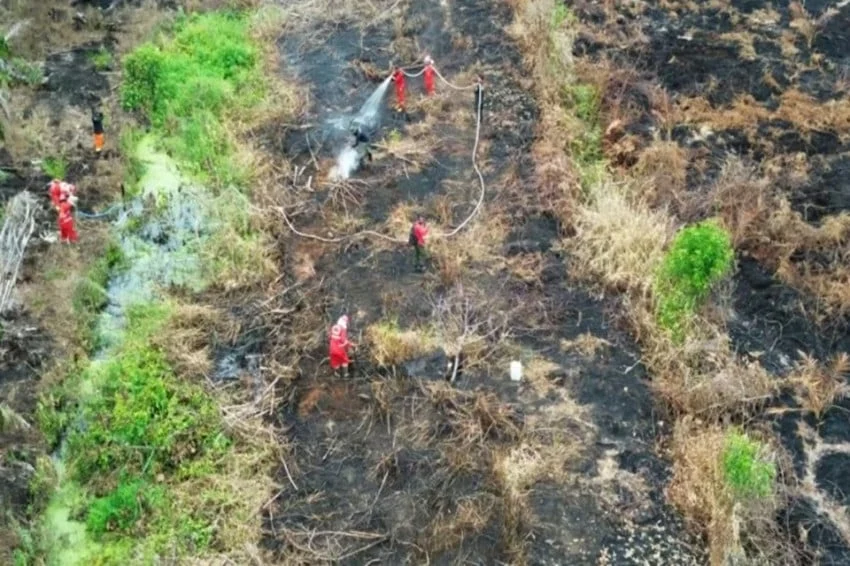
The ongoing ecological and humanitarian crisis posed by forest and land fires, commonly known in Indonesia as kebakaran hutan dan lahan (karhutla), has prompted a firm legislative response regarding corporate accountability. Wakil Ketua Komisi IV Dewan Perwakilan Rakyat (DPR) Republik Indonesia, Alex Indra Lukman, has formally suggested that the economic profits generated by corporations implicated in illegal land burning be entirely confiscated by the state. This aggressive policy recommendation is framed as a critical deterrent against repeat offenders, aimed at fundamentally dismantling the financial incentives that drive illegal clearing practices across Indonesia’s carbon-rich landscapes.
During a public briefing and legislative evaluation addressing recurring environmental violations, Alex emphasized that traditional punitive measures—such as modest fines or temporary revocations of operational permits—have largely failed to curb corporate negligence and intentional burning. By targeting the ill-gotten gains through cumulative charges and supplementary criminal penalties, the legal system could impose severe economic distress on defiant entities, thereby shifting the calculus of corporate environmental crime from profitable disregard to high-risk liability.
The Legislative Push for Cumulative Charges and Asset Confiscation
The core of the proposal centers on the implementation of a multi-layered legal strategy. Law enforcement agencies, including the Indonesian National Police (Mabes Polri) and the Ministry of Forestry (Kemenhut), are being urged to adopt a comprehensive approach when prosecuting corporate entities involved in repeated environmental offenses. Instead of relying solely on single-article indictments under environmental or forestry laws, prosecutors should leverage cumulative indictments that combine administrative, civil, and criminal charges.
Alex pointed out that multiple investigative reports indicate a troubling trend: several corporate players allegedly responsible for seasonal fires are repeat offenders. For these entities, paying standard fines or weathering nominal legal penalties has historically been calculated simply as a standard cost of doing business. The profit margin derived from using fire as a cheap land-clearing method vastly outweighs the legal risks under the status quo.
To break this cycle, the DPR leadership insists that prosecutors must incorporate requests for additional criminal penalties (pidana tambahan) into their indictments. Specifically, this involves the legal seizure and confiscation of all economic benefits accrued directly or indirectly from the unlawfully cleared land. By stripping corporations of their financial gains, the state can neutralize the profit motive that underpins recurrent ecological destruction.
Collaborative Law Enforcement and Systematic Investigation
To operationalize this recommendation, the Commission IV leadership has called for enhanced synergy between the Ministry of Forestry and national investigative bodies. The Ministry of Forestry, holding the administrative authority over concession licenses, possesses critical spatial data, historical land-use records, and monitoring technologies. When cross-referenced with police investigation dossiers, this data can expose complex corporate webs, subsidiary structures, and ultimate beneficial ownership behind shell companies often utilized to mask the true perpetrators of land fires.
The urgency of this coordinated effort is highlighted by ongoing administrative and criminal actions. Recent regulatory tracking has identified a significant cohort of corporate entities formally listed as suspects in ongoing karhutla investigations. With a substantial roster of companies currently facing legal scrutiny, the alignment between investigators and prosecutors becomes paramount. The integration of financial crime specialists into forestry crime task forces is viewed as an essential step to trace, freeze, and eventually confiscate corporate assets linked to environmental degradation.
Background and Context of Indonesia’s Karhutla Crisis
Forest and land fires in Indonesia are not merely localized accidents; they represent a complex socio-economic, ecological, and governance challenge that spans decades. Annually, particularly during the protracted dry seasons driven by climatic anomalies such as El Niño, vast tracts of land—especially in Sumatra and Kalimantan—are systematically engulfed in flames.
Historically, fire has been utilized by various actors as the fastest, most cost-effective method to clear land for agricultural expansion, predominantly for oil palm plantations and industrial timber estates. While smallholders and local communities occasionally use traditional swidden agriculture methods, large-scale corporate actors have frequently been implicated in systematic, widespread burning due to the sheer scale of the affected areas, which often exceed the capabilities of manual clearing.
The consequences of these fires extend far beyond national borders. The thick, acrid haze generated by karhutla frequently blankets neighboring Southeast Asian nations, including Malaysia and Singapore, triggering diplomatic tensions and public health emergencies. Domestically, the impacts are catastrophic: millions of citizens suffer from acute respiratory infections (ARIs), schools and airports are forced to close, and local economies experience profound disruptions.
Ecologically, the burning of Indonesia’s tropical rainforests and carbon-dense peatlands releases staggering quantities of greenhouse gases into the atmosphere. Peatland fires are particularly insidious; because peat is composed of accumulated organic matter over thousands of years, these subterranean fires can smolder for weeks or months, resisting superficial rainfall and releasing deep-seated carbon reserves that exacerbate global climate change. Furthermore, the fires devastate critical habitats for endangered wildlife, including orangutans, Sumatran tigers, and rhinoceroses, pushing vulnerable species closer to the brink of extinction.
Chronology of Policy Evolution and Legal Responses
Efforts to combat karhutla have evolved significantly over the past two decades, shifting from reactive firefighting to proactive prevention, legal deterrence, and institutional reform.
Following the catastrophic fires of 1997–1998, which caused billions of dollars in economic losses and unprecedented environmental damage, the Indonesian government recognized the urgent need for structural reform in forestry management. Subsequent years saw the enactment of foundational legislation, including Law No. 41 of 1999 on Forestry and Law No. 32 of 2009 on Environmental Protection and Management. These laws explicitly prohibited the use of fire for land clearing and established strict strictures of corporate liability, including strict liability principles where companies could be held accountable for fires originating within their concessions regardless of direct proof of intent.

A major turning point occurred in the aftermath of the severe 2015 fires, which burned an estimated 2.6 million hectares of land and generated massive international condemnation. In response, President Joko Widodo instituted stringent policy directives, including a permanent moratorium on the conversion of primary natural forests and peatlands, the establishment of the Peatland and Mangrove Restoration Agency (BRGM), and a strict mandate for law enforcement agencies to aggressively prosecute corporate offenders.
Despite these measures, enforcement faced persistent hurdles. While numerous civil lawsuits resulted in landmark court victories ordering corporations to pay massive compensation fees for environmental restoration, actual collection rates remained low due to protracted legal appeals, corporate bankruptcies, and bureaucratic friction. Criminal convictions often resulted in lenient sentences that failed to reflect the true magnitude of ecological harm.
By 2026, the focus of legislative oversight has shifted from merely securing guilty verdicts to cutting off the financial lifeblood of environmental criminals. The recent identification of dozens of corporate suspects has created a renewed political impetus within the DPR to push for asset recovery and profit confiscation as standard legal practice.
Economic and Ecological Implications of Profit Confiscation
The proposal advanced by Alex Indra Lukman carries profound implications for corporate governance, investor behavior, and environmental jurisprudence in Indonesia. If systematically adopted by prosecutors and upheld by the judiciary, the confiscation of economic profits could redefine how corporations manage supply chain risks and land acquisition ethics.
From an economic perspective, the threat of losing all revenue generated from illegally cleared land alters the risk-reward matrix entirely. Traditional corporate risk assessment for illegal clearing typically weighed the probability of getting caught and the standard fine against the immense financial upside of rapid plantation establishment. Introducing asset and profit forfeiture transforms the potential penalty from a manageable operational expense into a potentially fatal corporate solvency threat. Consequently, institutional investors, banks, and parent conglomerates will face heightened pressure to conduct rigorous environmental, social, and governance (ESG) due diligence before financing agricultural or forestry expansions.
Ecologically, a rigorous asset confiscation regime is expected to act as a powerful deterrent against seasonal burning. When corporate boards realize that environmental crimes lead not just to temporary legal embarrassment but to the outright stripping of financial gains, compliance mechanisms within concession areas are likely to be heavily reinforced. Companies will be compelled to invest in modern mechanical land-clearing technologies, early-warning fire detection systems, and community-based fire prevention programs to protect their operational licenses and balance sheets.
Moreover, the successful implementation of profit confiscation could establish a vital financial mechanism for environmental restoration. The funds seized through court verdicts could be directly funneled back into the state budget earmarked for peatland rewetting, reforestation initiatives, and community resilience programs in fire-prone regions, directly addressing the physical scars left by historical blazes.
Challenges in Implementation and Judicial Execution
Despite its strategic appeal, legal experts and environmental watchdogs note that executing the confiscation of corporate profits is fraught with procedural and technical challenges.
First, proving and quantifying the exact economic profits directly attributable to illegally burned land requires sophisticated forensic accounting. Corporations often operate through complex webs of subsidiaries, offshore holding companies, and intricate supply chains that obscure the flow of capital and the origin of agricultural commodities. Disentangling lawful revenue from profits tainted by environmental violations demands specialized investigative capacity that spans financial auditing, environmental science, and corporate law.
Second, the judiciary must be fully aligned with the rationale of economic deterrence. Judges accustomed to traditional penal interpretations may hesitate to apply cumulative charges or extensive asset forfeiture without clear, standardized guidelines. Ensuring that lower and appellate courts consistently accept and apply these supplementary criminal demands will require targeted capacity-building programs for judges, prosecutors, and investigators alike.
Finally, resisting political and economic lobbying by powerful agrarian and industrial conglomerates remains a perpetual hurdle. The plantation and forestry sectors are major contributors to regional employment, export revenues, and local government budgets, often wielding significant political influence at both national and regional levels. Overcoming potential institutional hesitation requires sustained public oversight, transparency, and unwavering political will from legislative and executive branches.
Broader Outlook and Future Trajectory
As Indonesia continues to grapple with the dual pressures of economic development and international climate commitments—such as achieving net-zero emissions and curbing deforestation rates—the management of forest and land fires remains a critical test of state governance.
The proposal by the leadership of Commission IV DPR RI signals a hardening stance against environmental impunity. By framing karhutla not merely as an administrative or ecological violation, but as a lucrative economic crime demanding complete financial restitution, Indonesian lawmakers are signaling a new phase in environmental enforcement.
Moving forward, the effectiveness of this strategy will depend heavily on the concrete actions taken by the Ministry of Forestry, the Indonesian National Police, and the Attorney General’s Office. If translated into systematic indictments and robust judicial rulings, the confiscation of corporate profits could mark a watershed moment in safeguarding Indonesia’s remaining forests, protecting public health, and establishing a formidable precedent for corporate environmental accountability across the region.
