
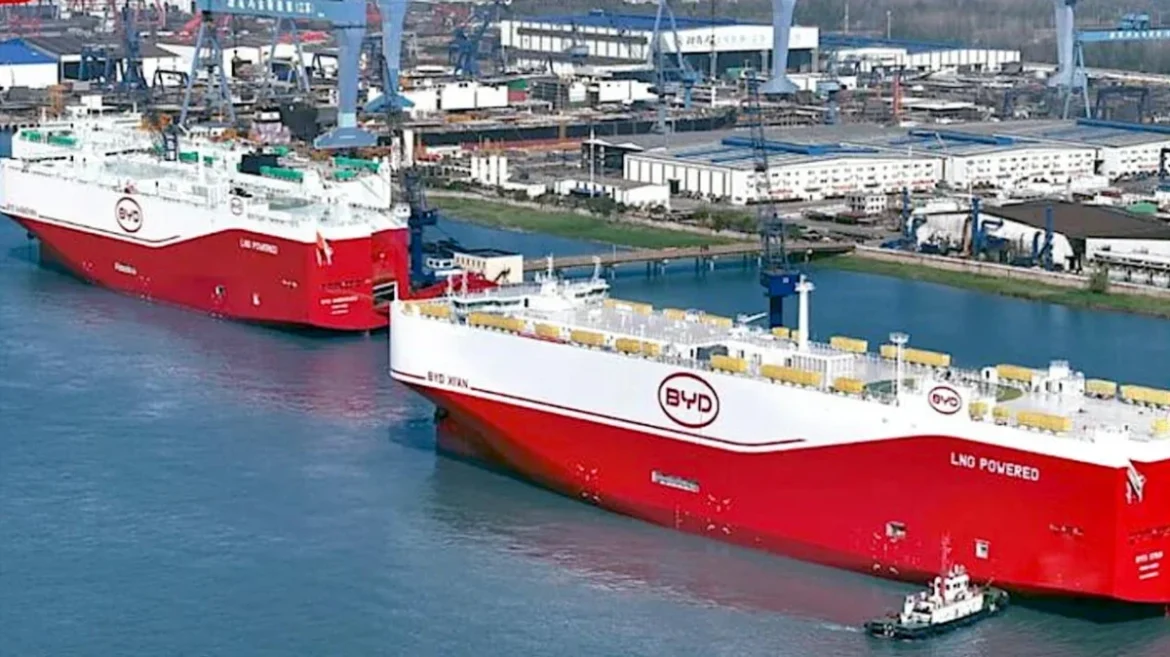
Beijing — In a bold strategic move designed to cement its dominance in the fast-evolving global electric vehicle landscape, Chinese automotive giant BYD is reportedly expanding its private maritime logistics fleet. According to industry reports emerging from specialized automotive publications and supply chain analysts, BYD has placed a monumental order for ten additional Roll-on/Roll-off (RoRo) car carrier vessels. Each of these new ships is engineered to possess a staggering capacity of approximately 9,200 cars, translating to a cumulative theoretical addition of 92,000 car equivalent units (CEU) per single deployment cycle.
This ambitious multi-vessel procurement underscores a transformative shift in how major automotive manufacturers approach international distribution. By significantly scaling up its self-owned maritime fleet, BYD is proactively insulating its export operations from the volatile capacity constraints, skyrocketing charter rates, and logistical bottlenecks that have historically plagued third-party shipping markets. As Chinese automotive manufacturers aggressively target overseas markets across Europe, Southeast Asia, Latin America, and the Middle East, securing dedicated maritime transport has transitioned from a logistical luxury to an operational necessity.
The reported acquisition schedule indicates that these ten vessels will be constructed in phases, with deliveries anticipated to take place progressively between 2027 and 2029. When combined with its existing and previously ordered tonnage, this new wave of ship construction is projected to expand BYD’s proprietary fleet to a formidable total of 18 specialized vessels. While individual ship dimensions and internal configurations may vary slightly depending on shipyard specifications and delivery timelines, the collective capacity of this fleet will comfortably exceed 130,000 CEUs. Such immense logistics bandwidth gives BYD unprecedented agility in deploying passenger vehicles, SUVs, and commercial models to distant shores with minimized transit friction and optimized delivery schedules.
The Evolution of Automotive Maritime Logistics
To fully comprehend the magnitude of BYD’s logistics strategy, one must examine the specialized nature of modern car carrier vessels. Unlike traditional bulk freighters or container ships, automotive carriers are engineered as floating parking structures utilizing the Roll-on/Roll-off (RoRo) methodology. Vehicles drive directly into the vessel’s cavernous interior via reinforced ramps upon loading at the port of departure and are systematically secured across multiple internal decks before being driven off upon arrival at their destination port. This system maximizes volumetric efficiency and minimizes the risk of cosmetic or structural transit damage.
Historically, automakers relied almost exclusively on independent third-party maritime logistics providers—such as specialized shipping conglomerates from Norway, Japan, and South Korea—to transport finished vehicles across oceans. However, the post-pandemic global supply chain crisis, coupled with the meteoric rise of China’s automotive export industry, exposed the fragility of this dependency. A severe shortage of global RoRo capacity drove charter rates to unprecedented highs, leaving many emerging exporters stranded without reliable ship availability.
In response to these systemic vulnerabilities, forward-thinking Chinese automakers pioneered a vertical integration strategy, bringing maritime transport in-house. By operating their own vessels, companies like BYD can guarantee fixed shipping schedules, bypass escalating spot-market freight costs, and tailor internal vessel climate control and fire-suppression systems specifically to the unique battery safety requirements of electric and hybrid vehicles.
Chronology of BYD’s Maritime Expansion
BYD’s transition from a domestic automotive powerhouse to a globally integrated maritime operator did not happen overnight. The company’s journey into shipownership represents a meticulously planned response to its soaring international sales figures.
The foundational phase of this maritime strategy materialized when early indicators of the global shipping crunch began affecting Chinese exports. Recognizing that third-party vessel orders had backlogs stretching for years, BYD initiated partnerships with domestic shipyards to design proprietary car carriers.
A major milestone was reached with the introduction of high-capacity vessels bearing the company’s name, most notably the BYD Shenzhen. Measuring approximately 219 meters in length and boasting a carrying capacity of 9,200 vehicles, the BYD Shenzhen served as a floating testament to the company’s engineering capabilities and commitment to global expansion. Equipped with modern dual-fuel propulsion systems—often utilizing Liquefied Natural Gas (LNG) to minimize carbon emissions—these pioneering ships set a new benchmark for environmentally sustainable maritime transport.
The current announcement regarding the order of ten additional vessels represents the second major wave of fleet expansion. If fully realized through the 2027–2029 delivery window, this escalation will transform BYD from a regional player experimenting with fleet ownership into one of the most formidable maritime operators in the global automotive sector. Industry observers note that while initial reports of the ten-vessel order stem from specialized media reporting and have yet to receive formal corporate ratification via official stock exchange filings, the trajectory aligns perfectly with BYD’s aggressive overseas manufacturing and sales targets.
Market Context: The Surge of Chinese EV Exports
The timing of BYD’s fleet expansion coincides with a historic paradigm shift in international trade. China has rapidly evolved from being primarily a manufacturing hub for foreign joint ventures into the world’s leading automotive exporter, surpassing traditional powerhouses like Japan and Germany.
A significant driver of this export boom is the widespread adoption of New Energy Vehicles (NEVs), an umbrella category encompassing both Battery Electric Vehicles (BEVs) and Plug-in Hybrid Electric Vehicles (PHEVs). BYD occupies a dominant position within this sector, having successfully scaled production to achieve economies of scale that few global competitors can rival.
As trade barriers, tariff discussions, and regulatory scrutiny intensify in key Western markets—particularly within the European Union and North America—having a flexible, cost-effective, and independent supply chain becomes an invaluable competitive advantage. By controlling its shipping costs, BYD can absorb potential tariff impacts more effectively, maintain competitive retail pricing in destination markets, and ensure that vehicles reach showrooms without the protracted delays that plague competitor supply chains. Furthermore, BYD’s expansion is not restricted to Europe. The company is actively scaling up deliveries to emerging markets across Southeast Asia, Latin America, Australia, and the Middle East, regions where localized distribution networks and dependable shipping schedules are critical for maintaining customer satisfaction and brand loyalty.
Fact-Based Analysis of Strategic Implications
The decision to expand a private car-carrying fleet to 18 vessels carries profound strategic, financial, and environmental implications for BYD and the broader automotive industry.
From a financial perspective, operating a proprietary fleet requires substantial upfront capital expenditure. Constructing a modern, eco-friendly 9,200-CEU RoRo vessel involves investments running into the hundreds of millions of dollars per ship. However, financial analysts point out that over a vessel’s multi-decade operational lifespan, self-ownership shields the company from the volatile fluctuations of the charter market. During periods of high global demand, third-party shipping rates can skyrocket, severely compressing profit margins. By locking in its own transport capacity, BYD effectively fixes its long-term logistics costs, protecting its bottom line and preserving price competitiveness abroad.
Operationally, owning the distribution network allows for precision scheduling. Traditional shipping lines operate on rigid, multi-port milk-run routes that may not align with the dynamic inventory requirements of a rapidly growing automaker. BYD can deploy its vessels directly from Chinese manufacturing and export hubs—such as Shenzhen, Guangzhou, and regional ports—straight to key overseas reception hubs in Europe and beyond. This direct routing reduces transit times, minimizes port congestion delays, and accelerates cash flow by ensuring vehicles transition faster from factory floors to customer deliveries.
From an environmental standpoint, modern car carriers commissioned by Chinese automakers increasingly incorporate advanced propulsion technologies. Older generations of car carriers relied heavily on heavy fuel oil, contributing significantly to maritime carbon emissions. In contrast, newer vessels in fleets like BYD’s frequently utilize dual-fuel engines capable of running on LNG or incorporate energy-saving hull designs and shore-power capabilities. This aligns with BYD’s corporate identity as a clean-energy technology leader, ensuring that the maritime leg of its supply chain maintains a reduced carbon footprint compared to legacy shipping fleets.
Broader Industry Reactions and Competitive Landscape
BYD’s aggressive vertical integration is not occurring in a vacuum. The success of pioneering private fleets has prompted other major Chinese automotive exporters—such as Chery, SAIC Motor, and JAC Motors—to invest in their own maritime transport assets. This collective pivot toward private shipping is fundamentally reshaping the global maritime brokerage and shipping industries, as traditional shipping lines face the prospect of losing major automotive clients to in-house logistics operations.
Established global shipping giants, particularly specialized RoRo operators based in Scandinavia and East Asia, are closely monitoring these developments. While traditional carriers still command the lion’s share of global vehicle transport, the rapid rise of dedicated manufacturer fleets in China signals a permanent structural change in the market. Shipping analysts suggest that third-party operators will increasingly need to pivot toward specialized value-added services, digital tracking innovations, and long-term strategic partnerships with emerging automakers to remain competitive.
Outlook and Future Considerations
As the global automotive industry navigates the transition toward electrification, logistics capabilities will increasingly serve as a key differentiator between market leaders and also-rans. BYD’s reported move to commission ten additional ultra-large car carriers demonstrates a clear long-term commitment to international expansion, signaling to competitors worldwide that the company is fully prepared to build the physical infrastructure required to support global scale.
Nevertheless, industry analysts emphasize that several variables remain. Because the news of the ten-vessel order stems from preliminary trade reports rather than a formal, binding corporate announcement, final fleet numbers, exact delivery milestones, and shipyard allocations are subject to fine-tuning. Global shipbuilding capacity is currently facing high demand across multiple sectors, meaning that delivery schedules through 2027–2029 will require tight coordination between BYD and its chosen maritime partners.
Ultimately, whether these ten ships represent the culmination of BYD’s fleet expansion or merely the next stepping stone in a continuous scaling process, the message is unmistakable. BYD is actively constructing a resilient, self-sufficient global trade network designed to project its electric vehicle dominance across the world’s oceans for decades to come.
