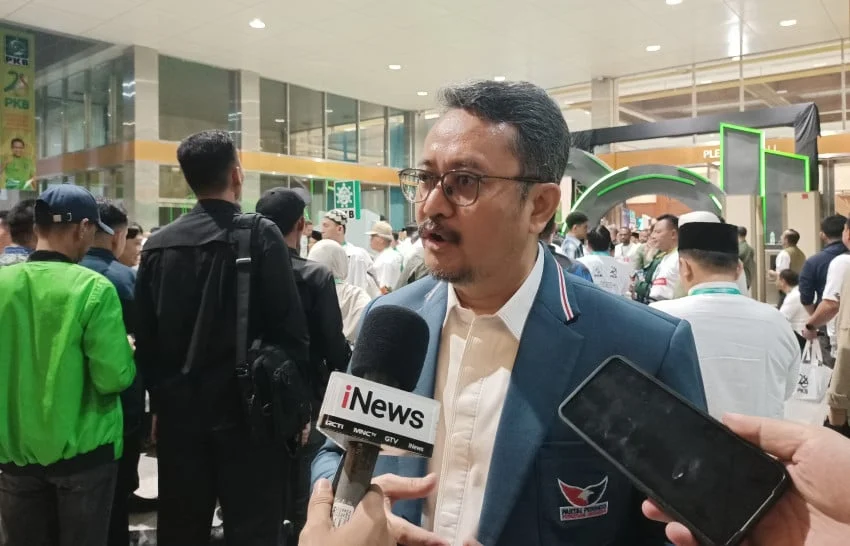
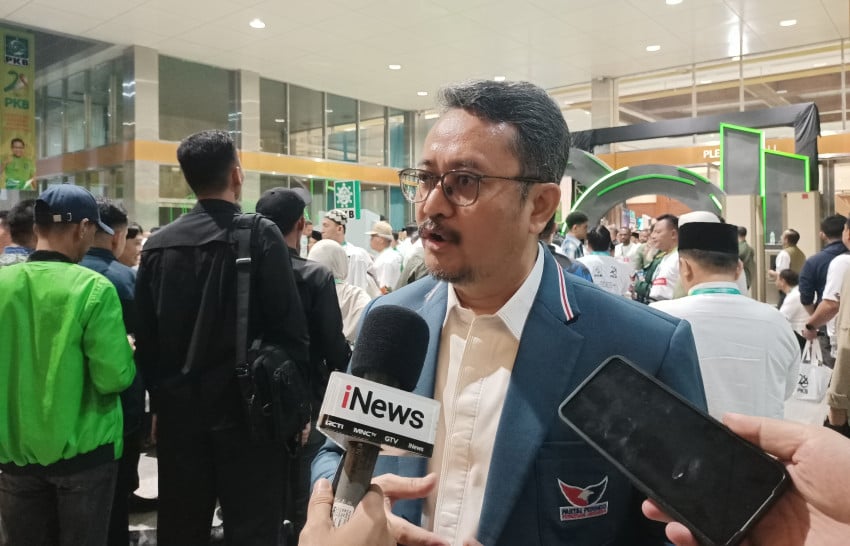
The Secretary General of the Perindo Party, Ferry Kurnia Rizkiyansyah, alongside the Chairperson of the Perindo Party, Angela Tanoesoedibjo, attended the peak celebration of the 28th Anniversary (Harlah) of the National Awakening Party (PKB) held at the Jakarta Convention Center (JCC), Senayan, on the evening of Thursday, July 23, 2026. The high-profile attendance underscores a burgeoning strategic alignment between the two political entities, with a specific focus on fostering a robust "people-based economy" (ekonomi kerakyatan) through the empowerment of Micro, Small, and Medium Enterprises (MSMEs) and cooperatives.
Speaking to the press following the event, Ferry Kurnia Rizkiyansyah extended his warmest congratulations to PKB, expressing hope that the party would continue to flourish and provide a positive direction for the nation, the community, and the state. He emphasized that the Perindo Party views PKB as a vital partner in the quest to stabilize and grow Indonesia’s domestic economy. According to Ferry, both parties share a fundamental vision regarding the "keumatan" (community welfare) and the necessity of fortifying the national economy through grassroots initiatives.
The Significance of the 28th Harlah PKB
The 28th Anniversary of PKB was more than a mere ceremonial gathering; it served as a platform for the party to articulate its vision for the future under the theme "Arah Baru Amanat Ekonomi Konstitusi" (New Direction of the Constitutional Economic Mandate). This theme reflects a commitment to returning to the economic roots stipulated in the Indonesian Constitution, particularly Article 33, which mandates that the economy be organized as a common endeavor based on the principle of the family system.
By attending this event, the Perindo Party leadership signaled their readiness to collaborate on these specific ideological grounds. Ferry noted that the spirit of Perindo is intrinsically linked to the spirit of PKB, particularly in how both parties aim to strengthen the nation through economic channels that directly benefit the common people. The presence of Angela Tanoesoedibjo, who has been vocal about modernizing the Indonesian economy while maintaining social safety nets, further highlighted the importance Perindo places on this cross-party synergy.
A Chronology of the Evening’s Events
The celebration at JCC Senayan began early in the evening, with a diverse array of political figures, religious leaders, and grassroots activists filling the plenary hall. The atmosphere was one of camaraderie and strategic reflection.
- Arrival of Dignitaries: Around 7:00 PM, senior officials from various political parties began arriving. The Perindo delegation, led by Angela Tanoesoedibjo and Ferry Kurnia Rizkiyansyah, was received with high honors, signaling the respect between the two parties.
- Opening Ceremonies: The event opened with traditional performances and the singing of the national anthem, followed by a prayer for the nation’s prosperity.
- Keynote Address by PKB Leadership: The Chairman of PKB delivered a keynote speech focusing on the "New Direction" of the economy, criticizing purely capitalistic models that leave behind the marginalized. The speech called for a "Constitutional Economic Mandate" where the state plays a proactive role in ensuring wealth distribution.
- Perindo’s Participation: While the event was hosted by PKB, the interactions on the sidelines and the subsequent statements by Perindo officials showed a deep level of engagement with the theme. Ferry and Angela were seen consulting with PKB strategists, discussing how their respective party platforms could merge on the issue of MSME development.
- Closing Statements: The event concluded with a call for national unity, particularly in facing global economic uncertainties that are expected to persist into the late 2020s.
Strengthening the People’s Economy: The Perindo-PKB Nexus
The core of the collaboration proposed by the Perindo Party lies in the concept of Ekonomi Kerakyatan. For Perindo, this has long been their "trademark" policy, often manifested in their programs providing carts for street vendors and training for small business owners. For PKB, whose roots are deeply embedded in the Nahdlatul Ulama (NU) community, the focus is on the welfare of the "ummah" and the development of Islamic cooperatives and rural agriculture.
Ferry Kurnia Rizkiyansyah explained that the intersection of these two approaches could create a powerful political and economic force. "We have the same spirit. Perindo focuses on the modernization and scaling of MSMEs, while PKB has a massive grassroots network. If we collaborate, we can ensure that the ‘Constitutional Economic Mandate’ is not just a slogan but a reality for millions of Indonesians," Ferry stated.
Supporting Data: The Vital Role of MSMEs in Indonesia
The emphasis on MSMEs by Perindo and PKB is backed by significant economic data. As of the mid-2020s, MSMEs continue to be the backbone of the Indonesian economy.
- GDP Contribution: MSMEs contribute approximately 61% of Indonesia’s total Gross Domestic Product (GDP).
- Employment: The sector absorbs nearly 97% of the total workforce in Indonesia, making it the primary vehicle for poverty reduction and job creation.
- Quantity: There are over 65 million MSME units across the archipelago, though many still struggle with access to formal financing and digital literacy.
- Cooperatives: The revitalization of cooperatives, a point stressed during the PKB Harlah, is seen as essential for collective bargaining power for farmers and small-scale producers.
The Perindo Party argues that by focusing on these sectors, the government can create an "economic shield" against global market volatility. Ferry’s call for collaboration suggests that the two parties may push for joint legislative initiatives in the House of Representatives (DPR) to increase the budget for MSME digitalization and to simplify the legal framework for cooperatives.
Analyzing the "Constitutional Economic Mandate"
The theme of "Amanat Ekonomi Konstitusi" mentioned by PKB and echoed by Perindo refers to a specific interpretation of the 1945 Constitution. Article 33 is the cornerstone of this philosophy. It states that branches of production which are important for the state and which affect the lives of most people shall be controlled by the state, and that the land, waters, and natural resources shall be used for the greatest prosperity of the people.
In the context of 2026, this mandate is being reinterpreted to address modern challenges such as the digital economy, green energy transitions, and food security. Perindo and PKB appear to be positioning themselves as the champions of "Distributive Justice." Their collaboration aims to ensure that the rapid infrastructure development seen in previous years now translates into direct economic empowerment for individuals at the bottom of the pyramid.
Statements from Party Leadership
Angela Tanoesoedibjo’s presence at the event was particularly symbolic. As the Chairperson of Perindo, her attendance reflects a strategy of "open-door diplomacy." By engaging with PKB, Perindo is expanding its reach into the traditional and religious voter bases that PKB commands.
"Our presence here is a form of appreciation for the long journey PKB has taken in the Indonesian political landscape," a representative from the Perindo central board noted. "But beyond that, it is a statement of intent. We are looking for partners who are serious about the welfare of the people. We find that PKB’s focus on the economic mandate of the constitution aligns perfectly with our vision of a prosperous Indonesia."
On the other hand, PKB officials welcomed the gesture. Sources within the PKB leadership suggested that the party is looking to broaden its appeal to urban voters and the youth—demographics where Perindo has a significant presence. The collaboration on the "people-based economy" serves as a bridge between PKB’s rural/religious base and Perindo’s urban/entrepreneurial focus.
Broader Political Implications and Future Outlook
The timing of this interaction is significant. With the political landscape shifting toward the next major election cycle, the alignment between Perindo and PKB could signal the formation of a new "Economic Bloc" in the legislature.
1. Legislative Synergy
If these two parties align their votes in the DPR, they could influence major economic bills, particularly those related to banking regulations for small businesses, trade protections for local products, and social security for informal workers.
2. Electoral Strategy
The 28th Harlah of PKB serves as a reminder of the party’s endurance. For Perindo, a relatively younger party, aligning with a seasoned veteran like PKB provides institutional stability. Conversely, Perindo provides PKB with a modern media apparatus and a platform to reach a more diverse economic class.
3. Policy Shift
The focus on "Ekonomi Konstitusi" suggests a move away from purely neoliberal policies. We may see a push for more protectionist measures for local industries and a more aggressive expansion of the state’s role in managing essential commodities.
Conclusion: A Shared Path Toward National Prosperity
The attendance of the Perindo Party at the PKB 28th Anniversary celebration marks a pivotal moment in the discourse of Indonesian political economy. By moving beyond mere political rhetoric and focusing on the tangible "people-based economy," Ferry Kurnia Rizkiyansyah and Angela Tanoesoedibjo have laid the groundwork for a partnership that could redefine how prosperity is achieved in Indonesia.
As PKB enters its 29th year and Perindo continues to solidify its influence, the focus remains clear: strengthening the "ummah" and the nation through MSMEs and cooperatives. The "New Direction of the Constitutional Economic Mandate" is no longer just a theme for an anniversary; it is a burgeoning policy framework that seeks to ensure that the fruits of Indonesia’s growth are shared by all its citizens, from the bustling streets of Jakarta to the furthest reaches of the archipelago. The collaboration between these two parties may well be the catalyst needed to realize the economic promises of the 1945 Constitution in the modern era.