
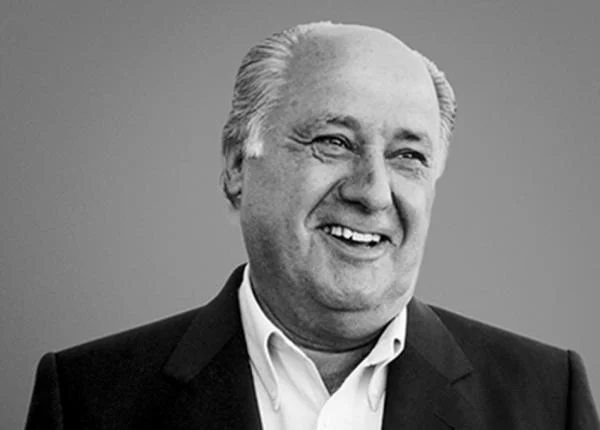
Amancio Ortega, the visionary force behind Inditex and the globally ubiquitous fashion giant Zara, is widely celebrated for revolutionizing the retail industry through his "fast fashion" business model. However, to define Ortega solely by his prowess in garment manufacturing and retail distribution is to overlook one of the most sophisticated wealth preservation and diversification strategies in modern financial history. While his name is synonymous with high-street fashion, the 90-year-old Spanish billionaire has quietly cultivated a secondary empire in real estate that stands as one of the most formidable property portfolios in the world.
With a staggering net worth currently estimated at 145.4 billion dollars, equivalent to approximately 2.638 quadrillion Indonesian Rupiah, Ortega remains a titan of global commerce, consistently ranking among the top fifteen wealthiest individuals on the planet according to Forbes. Yet, as he enters his tenth decade, the narrative of his wealth has shifted from the volatile cycles of retail trends to the enduring, tangible stability of prime global real estate.
The Evolution of an Investment Strategy
The transition from a retail operator to a real estate mogul was not a sudden pivot, but rather a calculated strategy of capital allocation. For decades, Inditex generated massive cash flows, far exceeding the reinvestment needs of the company’s retail operations. Ortega, known for his famously private and conservative financial nature, sought an asset class that could absorb these vast surpluses while providing long-term security.
Real estate offered the perfect hedge against the cyclical nature of the fashion industry. Since 2001, through his private investment vehicle, Pontegadea Inversiones, Ortega has aggressively moved to acquire high-value assets across the globe. By prioritizing "trophy" properties—landmark buildings located in the most prestigious financial and shopping districts of global cities—Ortega has insulated his wealth against the fluctuations of consumer spending habits.
Today, his real estate portfolio is valued at approximately 25 billion dollars, or roughly 453 trillion Rupiah. This collection comprises more than 200 high-end assets spanning 13 countries. The portfolio is not merely a collection of buildings; it is a strategic map of global economic power, featuring a blend of office towers, luxury hotels, industrial logistics hubs, and premium retail spaces.
A Timeline of Strategic Acquisitions
Ortega’s journey into the property market began in earnest at the turn of the millennium. Following the successful public offering of Inditex in 2001, which provided him with significant liquidity, he began systematically acquiring iconic buildings.
- 2001-2005: The Foundation Phase. During this period, Ortega focused on securing prime locations in his native Spain, specifically in Madrid and Barcelona. These acquisitions established the operational blueprint for Pontegadea, focusing on long-term ownership and prime location aesthetics.
- 2006-2015: The Global Expansion. Ortega turned his attention to the United States and the United Kingdom. He famously purchased the Epic Residences & Hotel in Miami and secured significant office spaces in London’s West End. This period marked his transition from a domestic investor to a global real estate player.
- 2016-Present: The Diversification Phase. In recent years, the strategy has evolved to include logistics centers and data centers, acknowledging the shift in the global economy toward e-commerce and digital infrastructure. Notably, he has acquired massive distribution centers utilized by companies like Amazon and FedEx, further diversifying his income streams beyond traditional retail environments.
The Anatomy of the Portfolio
The sheer scale of Ortega’s real estate holdings is best illustrated by the caliber of his assets. Unlike investors who flip properties for short-term gain, Ortega follows a "buy and hold" philosophy. Out of the 216 properties acquired since 2001, he has reportedly sold fewer than 10, underscoring his commitment to long-term asset retention.
His portfolio includes:
- Office Towers: These assets often house multinational corporations and financial institutions. By securing long-term leases with high-credit-rating tenants, Ortega ensures a steady, reliable revenue stream that remains largely immune to the retail fashion cycle.
- Luxury Hospitality: Ortega has invested in some of the most exclusive hotel properties, particularly in North America and Europe, capitalizing on the post-pandemic resurgence of international travel and tourism.
- Industrial Logistics: Recognizing the logistical demands of modern commerce, he has invested heavily in warehouses and fulfillment centers. This is arguably his most forward-thinking move, ensuring that his real estate footprint covers the "last mile" of the global supply chain.
- Premium Retail Spaces: Unsurprisingly, many of his retail properties are occupied by the very brands he helped build, such as Zara, Massimo Dutti, and Bershka. However, he also leases space to luxury competitors and high-end lifestyle brands, creating a diversified rental income stream.
Economic Implications and Market Analysis
From an analytical perspective, Ortega’s investment strategy offers a masterclass in wealth preservation. By shifting a significant portion of his Inditex dividends into real estate, he has effectively created a dual-engine economy for his family office. Inditex provides the high-growth, high-risk retail component, while Pontegadea provides the low-risk, high-stability real estate component.
Financial analysts often point to the "Ortega Effect" when discussing his market influence. When Pontegadea enters a market, it is often viewed as a signal of long-term stability for that specific district. Because he does not rely on traditional debt-heavy leveraged buyouts—instead using the cash dividends from his 59% stake in Inditex—he is insulated from the interest rate hikes that have devastated many other property developers in the current economic climate.
Furthermore, the concentration of his assets in Tier-1 cities—London, New York, Paris, and Madrid—means his portfolio is less susceptible to the regional downturns that affect smaller investors. His strategy is one of geographic and sectoral diversification, which protects his capital against local political instability or sector-specific shocks.

The Role of Pontegadea Inversiones
Pontegadea serves as the nerve center for these operations. Based in A Coruña, Spain, the firm functions as a private holding company that manages not only his real estate assets but also his dividends and other strategic investments. The firm’s management approach is notably lean, prioritizing conservative fiscal practices and avoiding the complex derivative structures that characterize many modern hedge funds.
The firm’s approach to acquisitions is often characterized by a lack of fanfare. Ortega rarely engages in bidding wars that drive prices to unsustainable levels. Instead, he utilizes his reputation as a reliable, cash-ready buyer to secure off-market deals. This preference for direct, private transactions allows him to acquire prime real estate at prices that often outperform the market average over a ten-year horizon.
Looking Toward the Future
As Amancio Ortega reaches the age of 90, the question of succession and the future of his massive portfolio inevitably arises. However, the structure of his investments suggests a legacy designed to endure well beyond his own lifetime. By building a portfolio centered on prime, income-generating real estate, he has ensured that his wealth remains productive and resilient.
Industry observers suggest that the next phase for the Ortega family office will likely involve further integration of green technology and sustainable building practices. As global regulations on energy efficiency in commercial real estate tighten, Pontegadea’s focus on high-quality, modern infrastructure positions the portfolio well for future regulatory environments.
The story of Amancio Ortega is not just one of a humble shop assistant who built a fashion empire. It is a comprehensive case study in the lifecycle of wealth. From the aggressive, innovative early years of Zara to the disciplined, preservation-focused era of global real estate, Ortega’s career path offers profound insights into how extreme wealth can be sustained, diversified, and protected against the inevitable shifts of the global economy. His legacy is no longer just in the clothes on the racks, but in the very foundations of the cities where those clothes are sold.
