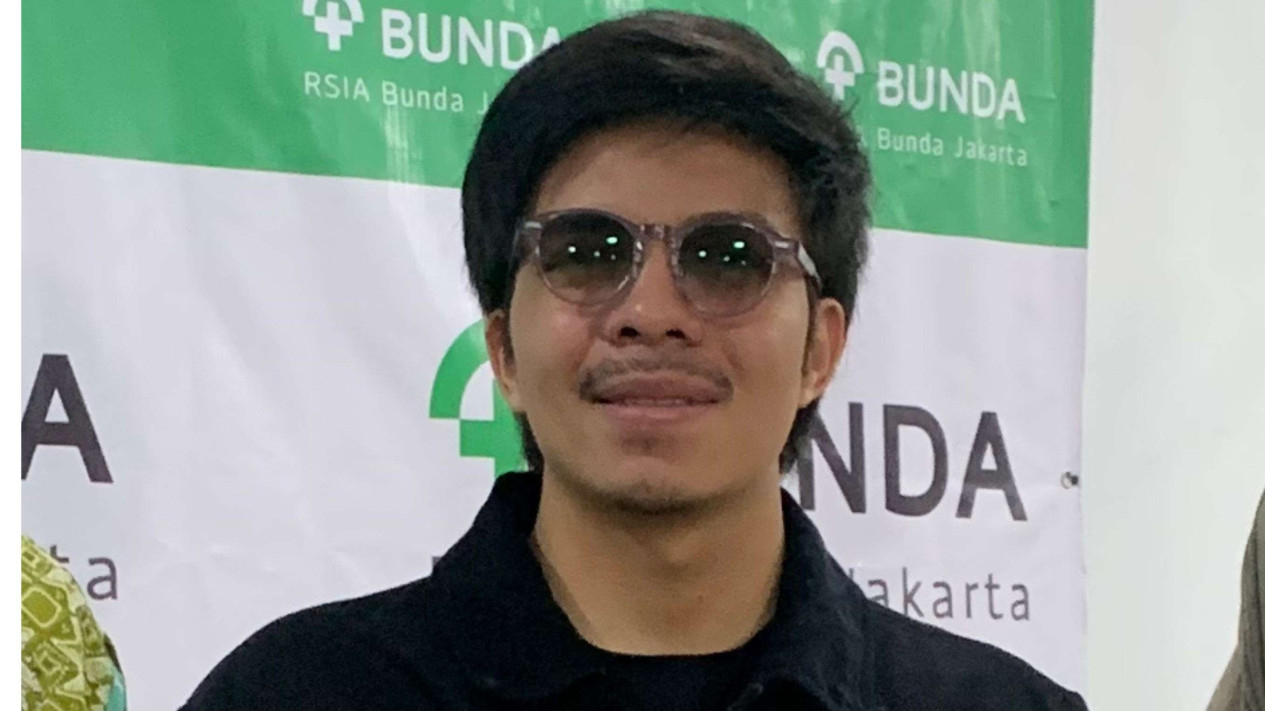
The digital landscape has once again become a battleground for truth as Indonesian celebrity and content creator Atta Halilintar found himself at the center of a viral controversy. A manipulated image, purportedly depicting the YouTuber in a compromising position with Mexican football influencer Mercedes Roa, circulated across social media platforms, triggering widespread speculation regarding his personal life and marriage to Aurel Hermansyah. The incident has reignited critical discussions surrounding the ethical implications of Artificial Intelligence (AI) in content creation and the ease with which deepfake technology can be weaponized to damage personal reputations.
The Origin of the Incident
The controversy began when a photograph surfaced on various social media platforms showing Atta Halilintar and Mercedes Roa in what appeared to be an intimate moment. The image was quickly shared, garnering significant engagement and negative commentary, particularly within the Indonesian online community. Given the high-profile nature of Atta Halilintar’s marriage, the image was immediately leveraged by some internet users to construct narratives of infidelity, leading to intense scrutiny of his public persona.
However, investigations and subsequent statements from the parties involved revealed that the image was a fabrication. The original, authentic interaction between the two creators occurred during a professional event, where influencers from various nations gathered to collaborate and network. In this context, posing for photographs with fellow attendees is standard practice. The circulating image, however, was clearly altered to distort the reality of that interaction, transforming a standard professional portrait into a fabricated scene of intimacy.
A Chronology of the Digital Fallout
The spread of the image followed a rapid trajectory characteristic of viral misinformation.
- The Initial Encounter: Atta Halilintar and Mercedes Roa attended an international content creator summit where they, along with many others, participated in casual networking and photo opportunities.
- The Fabrication: Shortly after the event, a manipulated version of a photo featuring the two began circulating on platforms like X (formerly Twitter) and Instagram. The manipulation utilized AI-generative tools to alter the proximity and facial orientation of the subjects.
- The Viral Spread: Within 48 hours, the image reached a critical mass of views. Comment sections on both Atta and Mercedes Roa’s social media accounts were flooded with inquiries and accusations.
- The Clarification: Recognizing the potential for long-term reputational damage, Atta Halilintar took to his social media channels to address the rumors directly, identifying the image as a malicious AI-generated hoax.
Official Responses and the Fight Against Digital Deception
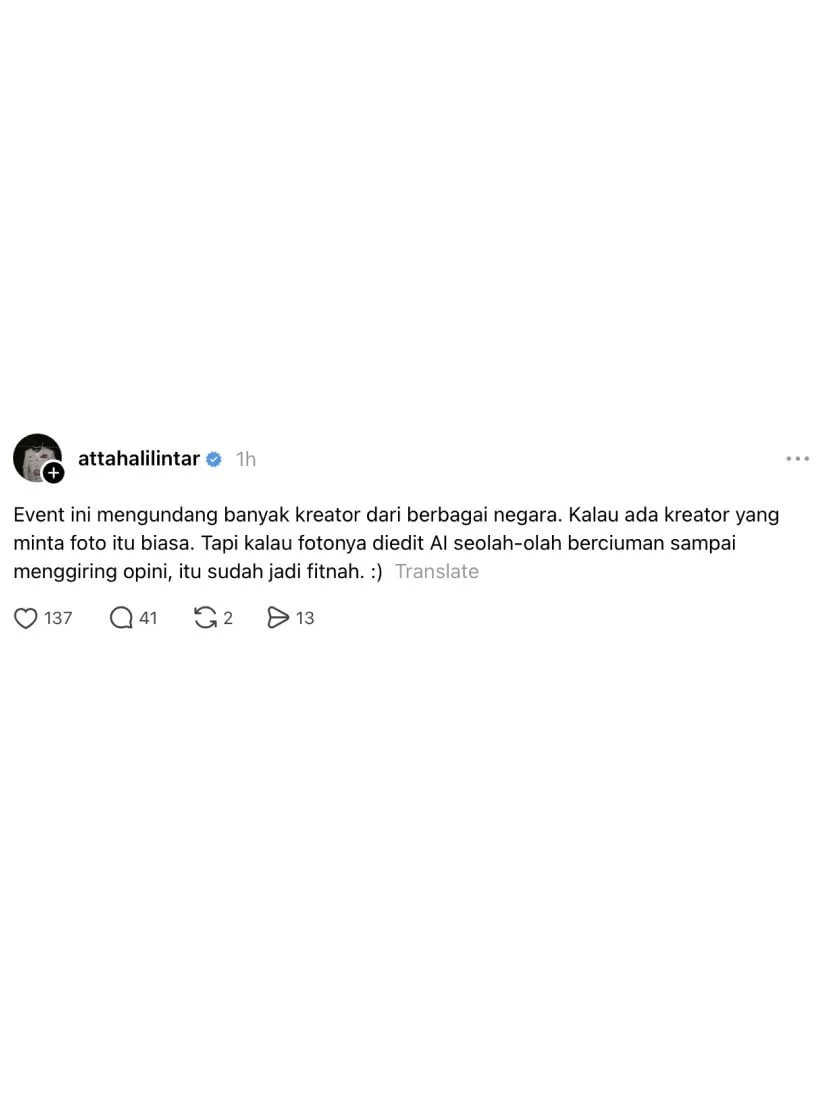
Atta Halilintar’s response was swift and firm. Utilizing his Threads and Instagram Story accounts, the influencer clarified the context of the original photo. He emphasized that the image was not merely a misinterpretation of a candid shot, but a deliberate act of digital forgery.
"This event invited many creators from various countries. It is common for creators to ask for photos," Atta stated in his Threads post. He further elaborated on the severity of the situation, noting, "But if the photo is edited with AI to look as if we are kissing, in order to drive a false narrative, that is slander."
The influencer did not stop at mere clarification. He actively called upon his followers and the public to assist in identifying the originators of the manipulated content. By publicly declaring, "The one who made this AI slander must be found," Atta signaled a move toward accountability, suggesting that digital defamation should be met with investigation rather than silent endurance.
Mercedes Roa, for her part, also navigated the fallout by acknowledging the confusion caused by the image. She noted that the surge of traffic to her profile from Indonesian users served as an indicator of the image’s reach and the intensity of the misinformation campaign.
The AI Challenge: Implications for Public Figures
The incident involving Atta Halilintar and Mercedes Roa is emblematic of a broader, systemic issue facing the digital age: the "Deepfake Dilemma." As AI tools become more accessible, the barrier to creating realistic but entirely false imagery has virtually disappeared. For public figures, this represents a significant security and reputational risk.
According to cybersecurity experts, the ease with which malicious actors can now manipulate photos to depict individuals in compromising situations creates a "liar’s dividend." This phenomenon occurs when public figures find it increasingly difficult to prove their innocence because the public has been conditioned to believe that "seeing is believing," even when the media in question is synthetically generated.
The implications for celebrities like Atta Halilintar are twofold. First, there is the immediate personal impact on their relationships and public image. Second, there is the ongoing administrative burden of managing misinformation, which often requires significant time and legal resources to address.
The Ethics of Content Moderation and Platform Responsibility
This incident also underscores the responsibility of social media platforms in curbing the spread of non-consensual synthetic media. While platforms have implemented various policies to label or remove AI-generated content, the enforcement remains inconsistent. In the case of the Atta-Mercedes image, the speed at which the content spread before it could be flagged or removed highlights a gap in current digital safety infrastructure.
The call for accountability issued by Atta Halilintar raises an important question regarding the legal recourse available to victims of AI-generated defamation. In many jurisdictions, laws regarding digital identity theft and defamation are still struggling to catch up with the pace of AI advancement. For victims, the process of tracing the original source of an AI-generated image is often complex, involving forensic analysis and the cooperation of multiple international tech platforms.
Moving Forward: Media Literacy and Critical Consumption
For the general public, the case serves as a stark reminder of the necessity of media literacy. The ability to distinguish between authentic media and AI-generated content is becoming an essential life skill. Experts recommend that users verify viral images by:
- Checking for Source Consistency: Determining if the image appears on verified news outlets or the official accounts of the individuals involved.
- Analyzing Technical Artifacts: Looking for common signs of AI generation, such as unnatural skin textures, distorted backgrounds, or inconsistent lighting, which often betray a forged image.
- Contextual Evaluation: Asking whether the content aligns with the known activities and public schedules of the subjects.
As the situation continues to settle, the incident stands as a case study in the vulnerability of public figures to technological malice. Atta Halilintar’s proactive approach to debunking the image provides a blueprint for how others might address similar challenges, emphasizing transparency, direct communication, and a refusal to allow anonymous fabrications to define one’s personal life.
The controversy surrounding the edited photo of Atta Halilintar and Mercedes Roa is more than just a momentary distraction in the world of celebrity gossip. It is a symptom of a digital environment where truth is increasingly malleable. As society moves further into the era of advanced AI, the protection of personal integrity will require a combined effort of improved platform regulation, stronger legal frameworks, and a more vigilant, media-literate public. For now, the primary lesson remains clear: in the age of the algorithm, the first version of the story is rarely the most accurate.