
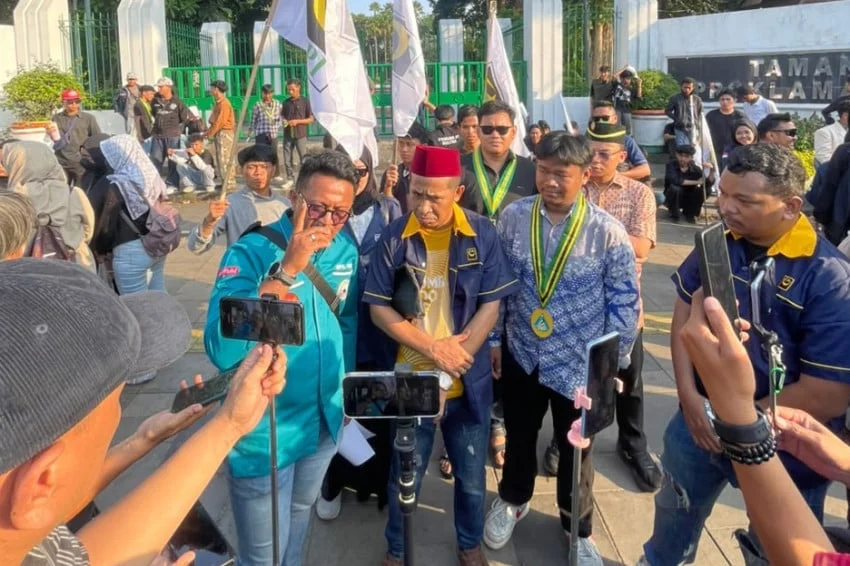
In a significant display of public accountability and institutional reform, three prominent youth and student organizations—the Central Leadership of the Islamic Youth Movement (PP GPI), the Executive Board of the Indonesian Islamic Student Association (PB PII), and the Central Board of the Maluku Kie Raha Muslim Student Alliance (DPP AL-MULK)—have formally expressed their appreciation for the decisive actions taken by the National Police Chief, General Suyudi Ario Seto. The commendation follows the Chief of Police’s immediate intervention regarding the controversial raid on the Hamalatul Quran Islamic Boarding School in Sukoharjo, Central Java.
The official statement was delivered by the leaders of these organizations at the historic Tugu Proklamasi in Central Jakarta on Tuesday, November 3, 2026. This public acknowledgment serves as a critical milestone in the ongoing discourse regarding police conduct, the protection of educational institutions, and the broader efforts to maintain public trust in law enforcement agencies across Indonesia.
The Chronology of the Sukoharjo Incident
The controversy began when law enforcement officials conducted a raid on the Hamalatul Quran Islamic Boarding School in Sukoharjo. The nature of the operation quickly drew intense scrutiny from the local community and national organizations, who alleged that the execution of the raid lacked the necessary adherence to procedural propriety and human rights standards. Concerns were raised regarding the potential for excessive force and the impact such operations have on the sanctity of religious educational facilities.
Upon the circulation of reports detailing the conduct of the raid, public outcry grew rapidly. Stakeholders argued that such actions, if left unchecked, could undermine the relationship between the police force and the Muslim community. Recognizing the potential for civil unrest and the erosion of institutional credibility, General Suyudi Ario Seto initiated an immediate internal review of the operation.
Within 48 hours of the public outcry, the National Police leadership announced the removal of the Sukoharjo Police Chief from his post. This move was not merely a symbolic gesture; it was framed as a necessary corrective measure to ensure that the investigation into the raid would proceed without internal interference. The National Police further committed to an open, transparent, and comprehensive investigation, inviting oversight to ensure that justice would be served.
Institutional Accountability and the Reform Agenda
The reaction from civil society has been largely supportive, characterizing the National Police Chief’s swift response as a positive shift toward a more accountable policing model. Khoirul Amin, Chairman of PP GPI, highlighted that this incident provides a litmus test for the effectiveness of the current reform agenda within the Indonesian National Police (Polri).
"The decision to remove the Sukoharjo Police Chief is an essential step in restoring public trust," Amin stated during the press briefing at Tugu Proklamasi. "It demonstrates that the National Police leadership is willing to hold its own personnel accountable when procedural errors are identified. This is a vital component of a professional police force that serves the people rather than acting above them."
The incident brings to the forefront the long-standing challenge of balancing law enforcement duties with the protection of civil liberties. In recent years, the Indonesian National Police have faced pressure to modernize their investigative techniques and improve their public engagement strategies. The handling of the Sukoharjo case suggests a shift toward a more responsive leadership style that prioritizes de-escalation and transparency over rigid, unilateral enforcement.
Perspectives from Student and Youth Organizations
For student organizations like PB PII and DPP AL-MULK, the Sukoharjo incident is not an isolated event but rather a point of reference for how the state interacts with religious and educational institutions. Amsal Alfian, Chairman of PB PII, emphasized the necessity of a "humanistic approach" in law enforcement.
"We are not opposed to law enforcement; rather, we are advocates for justice that is carried out with dignity," Alfian noted. "The commitment from General Suyudi Ario Seto to maintain transparency is a breath of fresh air. However, it must be matched by a thorough process that leaves no room for bias. The youth of Indonesia are watching this case closely, as it sets a precedent for how future operations will be conducted."
Fauzan Ohorela, Chairman of DPP AL-MULK, reinforced this sentiment, adding that the "administrative sanction" of removing the local police chief is only the beginning. "The ultimate goal is the truth," Ohorela explained. "The police must ensure that the findings of the investigation are made accessible to the public, as the community at large deserves to understand the underlying rationale and the sequence of events that occurred during the raid. We expect the investigation to be exhaustive, reaching all levels of the command structure involved in the decision-making process."
Analysis of Implications for Law Enforcement
From an analytical standpoint, the National Police Chief’s handling of the Sukoharjo incident carries significant implications for the future of internal discipline within the force. By acting preemptively, the National Police command has effectively neutralized a potentially volatile situation that could have been weaponized by various political and social factions.
The move to replace the regional leadership in Sukoharjo serves as a strategic maneuver to signal that the National Police Headquarters (Mabes Polri) maintains firm control over its subordinate units. Furthermore, the emphasis on a "transparent and open" investigation is likely an attempt to align with broader government initiatives to improve the "Police Trust Index."
According to recent data on public perception of the Indonesian police, institutional trust is highly sensitive to high-profile cases involving perceived abuses of power. When leadership responds with transparency, trust metrics tend to stabilize or improve. Conversely, any perceived attempt to "cover up" or "protect" internal personnel often leads to long-term reputational damage. The swiftness of the response in this instance suggests that the current police leadership is acutely aware of the digital-age reality, where public sentiment can shift rapidly based on information flow and institutional reaction time.
The Role of Independent Oversight
While the police leadership has pledged a transparent investigation, the student organizations are calling for sustained vigilance. They have suggested that independent observers, potentially including members of the National Police Commission (Kompolnas), should be integrated into the investigative process to ensure impartiality.
The call for such oversight is a reminder that the relationship between the state and the public is built on mutual expectations. For the Indonesian Muslim community, the sanctity of boarding schools (pesantren) is of paramount importance. Consequently, any intrusion by law enforcement is viewed through a lens of social and religious sensitivity. The challenge for the National Police in the coming weeks will be to prove that the investigation can reach a definitive conclusion that satisfies both the legal requirements of the case and the community’s demand for accountability.
Looking Forward: A Call for Lasting Reform
As the investigation continues, the spotlight remains on the National Police. The leaders of PP GPI, PB PII, and DPP AL-MULK have made it clear that their appreciation is contingent upon the successful completion of the promised investigation. They have signaled that they will continue to monitor the proceedings, ensuring that the momentum for reform is not lost.
The Sukoharjo incident may well become a defining moment for the current administration of the National Police. It represents a pivot point where institutional policy meets the expectations of a modern, democratic society. By choosing to prioritize accountability, the National Police Chief has opened a path toward rebuilding the bond between the law enforcement sector and the youth, students, and religious communities that form the backbone of Indonesia’s civil society.
The consensus among the youth leaders is unanimous: the police must evolve into an institution that is not only feared for its enforcement capabilities but respected for its commitment to justice, fairness, and transparency. As the nation watches the developments in Sukoharjo, the actions taken by General Suyudi Ario Seto will undoubtedly serve as a model—or a warning—for the future of police-community relations in Indonesia.
The commitment to "usut tuntas" (investigate thoroughly) remains the watchword for the coming months. Whether this incident leads to systemic structural changes or remains a localized administrative adjustment will depend on the willingness of the authorities to follow through on their promises. For now, the move is being hailed as a step in the right direction, providing a rare opportunity for the National Police to reinforce their role as the true protectors and servants of the public.
