
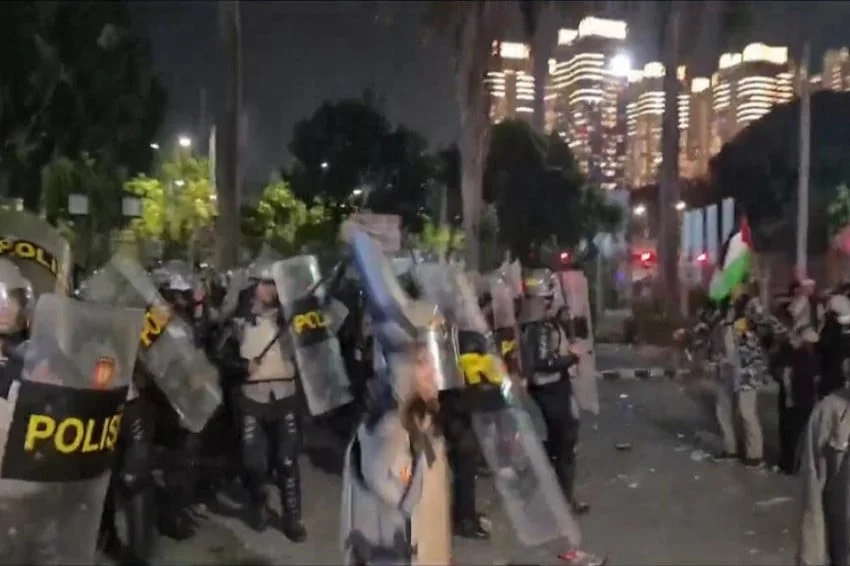
JAKARTA — A peaceful evening in central Jakarta descended into chaos on Tuesday, November 3, 2026, when a mass protest aimed at shutting down a concert by renowned Italian tenor Andrea Bocelli at JIExpo Kemayoran escalated into a violent physical confrontation with law enforcement officers. What began as a politically charged demonstration regarding international geopolitics quickly transformed into a public security crisis, resulting in hours of street battles, property damage, and heightened security measures across the Indonesian capital.
The incident highlights the complex intersection of global geopolitical conflicts and local civil demonstrations in Indonesia, where international solidarity movements frequently manifest through high-profile public actions. As authorities work to restore normalcy and assess the damages, the clash has ignited broader national conversations concerning public assembly, security protocols for international events, and the limits of protest.
Chronology of the Disturbance and Police Confrontation
The events unfolded late Tuesday afternoon and stretched well into the night. According to preliminary police reports and eyewitness accounts, the mobilization began earlier in the day when various hardline Islamic factions and civil groups converged on central Jakarta. Prior to reaching the venue in Kemayoran, segments of the crowd had gathered at iconic locations such as the Horse Statue (Patung Kuda) area near the National Monument, waving Palestinian flags and delivering fiery speeches condemning foreign artists perceived to support Israel.
As evening approached, the crowd—led by prominent figures including Habib Bahar bin Smith under the banner of the Front Brotherhood of Islam (Front Persaudaraan Islam)—shifted its focus toward the Jakarta International Expo (JIExpo) in Kemayoran, Central Jakarta. Andrea Bocelli, the celebrated classical crossover artist, was scheduled to perform inside the venue as part of his international tour.
Anticipating potential unrest, the Jakarta Metropolitan Police, supported by personnel from the Central Jakarta Resort Police and auxiliary security units, had established a robust security perimeter around JIExpo hours before the event doors opened. Concrete barriers, razor wire, and rows of tactical personnel effectively sealed off the primary access points to the exhibition grounds.
Upon arriving at the venue gates, the demonstrators attempted to breach the security cordons to forcefully halt the concert. Meeting impassioned resistance from the heavily guarded lines, the mood of the crowd quickly deteriorated. Frustrated by their inability to penetrate the perimeter, elements within the mass demonstration began launching projectiles at the police line.
For several tense hours, the front gates of JIExpo transformed into a localized riot zone. Demonstrators hurled paving stones, iron bars, and segments of security fences at the officers. In response, police initially maintained a defensive posture, utilizing protective shields and riot gear to absorb the onslaught. However, as the volleys of dangerous debris intensified and the crowd attempted to swarm the barricades, law enforcement authorities authorized tactical dispersal measures. Officers deployed tear gas and used progressive crowd-control formations to systematically push the aggressive crowds back, eventually clearing the immediate vicinity of the venue and restoring order late into the night.
Roots of the Protest: The Controversy Surrounding Andrea Bocelli
The violent confrontation in Kemayoran did not stem from domestic grievances, but rather from international geopolitical alignments tied to the ongoing Israeli-Palestinian conflict. Protest organizers and participating groups targeted Andrea Bocelli due to historical actions and associations that they argue demonstrate pro-Israel partisanship.

Specifically, demonstrators pointed to a high-profile charity event in 2010 where Bocelli performed at a gala for the Friends of the Israel Defense Forces (FIDF) in the United States—an organization that raises funds for the wellbeing of soldiers in the Israeli military. Although the performance occurred more than a decade prior, activist networks resurrected the archival details in the wake of escalating Middle Eastern hostilities, framing the Italian tenor’s Jakarta tour stop as an affront to Palestinian solidarity.
In a country with the world’s largest Muslim-majority population, public sentiment regarding the Palestinian cause runs exceptionally deep. Civil society organizations, religious leaders, and political groups frequently mobilize massive public demonstrations to protest perceived injustices against Palestinians. In recent years, this solidarity has expanded beyond traditional political rallies to encompass consumer boycotts, cultural pushbacks, and direct protests against international public figures, artists, and corporations with historical or financial ties to Israel.
Security and Economic Implications for International Events
The clashes at JIExpo Kemayoran have raised immediate concerns regarding the safety and viability of hosting international artists and global events in Indonesia. Jakarta has long positioned itself as a premier destination for world tours, cultural exchanges, and international business conventions, drawing millions of foreign tourists and generating substantial revenue for the domestic creative economy.
Security analysts point out that the incident exposes vulnerabilities in threat assessment protocols for cultural events that intersect with sensitive foreign policy issues. While freedom of expression and the right to peaceful assembly are constitutionally protected in Indonesia, public safety agencies face the delicate task of balancing civic rights with the imperative to protect public infrastructure, private property, and the physical safety of both foreign visitors and local citizens.
The economic fallout could also prove significant if international event promoters perceive a heightened risk of civil disruption. Insurance premiums for international tours could rise, and foreign artists may demand enhanced private security details or reconsider routing through Indonesian venues if security guarantees cannot be robustly enforced. Conversely, tourism and creative economy officials are under pressure to demonstrate that Tuesday’s riot was an isolated, albeit severe, flashpoint rather than a systemic threat to the nation’s entertainment sector.
Official Responses and Ongoing Investigations
In the wake of the violence, Jakarta law enforcement authorities have initiated comprehensive investigations to identify instigators, assess property damage, and evaluate operational responses. Senior officials from the Jakarta Metropolitan Police are expected to release detailed briefings outlining the number of arrests made, injuries sustained by both police officers and civilians, and the extent of vandalism inflicted upon public and private property around the JIExpo complex.
Human rights advocates and legal observers are simultaneously monitoring the situation, calling for transparency regarding the use of force by police during the dispersal operations, while also condemning acts of vandalism and violence committed by members of the protesting crowd. Civil society organizations have urged all parties to channel grievances through peaceful, lawful avenues rather than resorting to destruction and physical combat.
As the dust settles on Kemayoran, the confrontation serves as a stark reminder of how global conflicts can rapidly manifest on local streets, testing the resilience of urban security infrastructure and the commitment of communities to peaceful dialogue in an increasingly interconnected world.
