
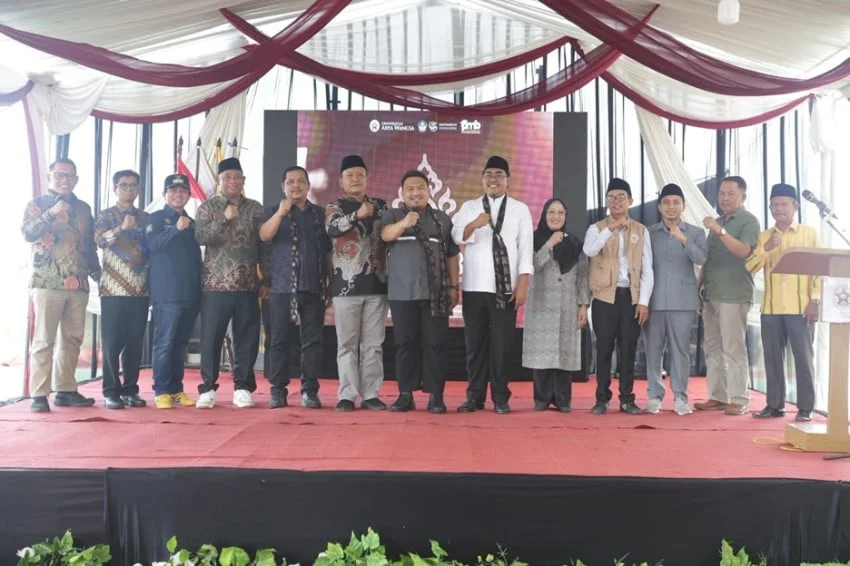
The ongoing battle against narcotics in Indonesia reached a critical juncture on Saturday, October 31, 2026, as high-ranking officials and lawmakers converged on Universitas Arya Wangsa (UAW) in Subang, West Java. In a concerted effort to safeguard the nation’s youth from the devastating impacts of illicit substances, the National Narcotics Agency (Badan Narkotika Nasional, or BNN) partnered with Commission III of the House of Representatives (DPR RI) to host a high-profile symposium. Titled the "Symposium on Strengthening the Prevention and Eradication of Drug Abuse," the event served as an urgent call to action for incoming university freshmen, positioning them as primary agents of change in the nationwide campaign for a drug-free campus environment.
The gathering featured prominent figures, including Jazilul Fawaid, a senior lawmaker from Commission III of the DPR RI, and Fathur Rohman, Head of the Karawang Regency BNN office. Both officials underscored that while law enforcement remains vital, community-level prevention—particularly within academic institutions—is the most potent weapon against the evolving threat of modern narcotics.
Main Facts and Event Overview
The symposium at Universitas Arya Wangsa brought together hundreds of enthusiastic students, academic leaders, and local law enforcement representatives. The core message of the assembly was unambiguous: preventing drug experimentation among young adults is vastly more effective, humane, and economically sustainable than treating and rehabilitating individuals once addiction has taken hold.
During the interactive sessions, officials highlighted the shifting tactics of drug syndicates, which increasingly target young, educated demographics through synthetic drugs, novel psychoactive substances, and sophisticated digital distribution networks. By engaging students during their orientation phase, BNN and legislative leaders aimed to build psychological resilience and critical awareness before freshmen encounter peer pressure or predatory trafficking rings in their new university environments.
Chronology and Background Context of the Initiative
The initiative at Universitas Arya Wangsa forms part of a broader, intensified national campaign launched by the Indonesian government to counteract rising drug penetration rates among secondary and tertiary education students. In recent years, BNN has expanded its memorandum of understanding with various ministries, including the Ministry of Education, Culture, Research, and Technology, to mandate preventive educational frameworks across campuses nationwide.
The selection of Universitas Arya Wangsa for this specific high-level engagement holds symbolic and strategic weight. As a rapidly growing institution in the Subang regency—an area experiencing significant industrial and demographic shifts due to regional infrastructure developments—the university represents a crucial frontline in West Java’s security apparatus.
Preparations for the October 31 symposium began months prior, following alarming local intelligence reports regarding the expansion of drug distribution routes connecting metropolitan hubs like Jakarta and Bandung with secondary cities in West Java. Recognizing UAW’s unique vulnerability as a magnet for students from diverse socioeconomic backgrounds, university founder and DPR member Jazilul Fawaid coordinated directly with BNN leadership to establish a proactive campus defense strategy.
Legislative Support and Official Statements
Speaking before a packed auditorium of students and faculty members, Jazilul Fawaid—widely known as Gus Jazil—expressed profound appreciation for the relentless dedication demonstrated by BNN and the Indonesian National Police (Polri). He emphasized that safeguarding tertiary education spaces is a national security priority.
"I am genuinely pleased that BNN has taken the initiative to conduct direct socialization and preventative outreach among young people, particularly the incoming freshmen of Universitas Arya Wangsa," stated Gus Jazil, who also serves as a senior legislator from the National Awakening Party (PKB) faction.
The lawmaker elaborated on the insurmountable challenges associated with treating severe narcotics addiction, contrasting it sharply with the cost-effectiveness and high efficacy of primary prevention. "Preventative measures are infinitely more important and much easier to implement than trying to rescue someone who has already fallen into addiction. The rehabilitation process is extraordinarily difficult, emotionally draining, and places a massive burden on families and the state healthcare system."
Furthermore, Gus Jazil stressed that eradicating the drug menace cannot be delegated solely to state apparatuses. He called for an unyielding, synchronized commitment encompassing government bodies, law enforcement agencies, academic institutions, families, and civil society organizations.
"As the founder of Universitas Arya Wangsa, I firmly believe that we must forge a united front. I urge BNN and the National Police to continuously innovate and intensify their strategic operations to sever the supply chains and distribution networks plaguing Indonesia," Gus Jazil added, drawing robust applause from the student body.
Cementing the legislative branch’s commitment to the cause, he concluded with a firm assurance: "We in Commission III of the DPR RI will continue to provide comprehensive, unwavering support—both politically and legislatively—to empower BNN and Polri in their mission to eradicate the circulation and abuse of narcotics across the archipelago."
Complementing the parliamentary perspective, Fathur Rohman, representing the Karawang Regency BNN, provided localized operational insights. He detailed how regional BNN branches are pivoting from reactive enforcement to community-based resilience models. Fathur urged students to cultivate critical thinking, resist peer-driven curiosity regarding synthetic narcotics, and report suspicious activities within their neighborhoods to local authorities.
Supporting Data and Statistical Landscape
To contextualize the urgency of the UAW symposium, public health and law enforcement data illustrate the persistent gravity of Indonesia’s drug situation. According to national surveys conducted by BNN in collaboration with the Indonesian Institute of Sciences (LIPI, now part of BRIN), the prevalence rate of drug abuse among youths aged 15 to 35 remains a critical concern. While targeted interventions have yielded stabilization in certain urban corridors, rural-urban peripheries and rapidly developing industrial zones like Subang have witnessed shifts in trafficking patterns.
Global drug reports from the United Nations Office on Drugs and Crime (UNODC) further emphasize that synthetic drugs—such as new psychoactive substances (NPS) and methamphetamine analogues—pose unprecedented challenges due to their low production costs, ease of concealment, and aggressive marketing toward digital-native demographics. In Indonesia, synthetic narcotics account for a dominant share of illicit market seizures, outstripping traditional plant-based drugs like cannabis in urban and collegiate settings.
Rehabilitation data from BNN facilities nationwide reinforce Gus Jazil’s remarks regarding the arduous nature of recovery. Statistics consistently show that relapse rates among severe synthetic drug users remain high, often requiring long-term psychological therapy, social reintegration programs, and continuous family support. Consequently, health economists and policy analysts overwhelmingly agree with the preventative doctrine: every rupiah invested in campus-level educational campaigns saves tens of thousands of rupiahs in future law enforcement, healthcare, and lost productivity costs.
Broader Impact and Implications for Higher Education
The symposium at Universitas Arya Wangsa carries significant implications for the broader landscape of Indonesian higher education. By positioning campus leadership and student organizations as active partners in anti-narcotics intelligence and prevention, the event sets a replicable benchmark for universities across West Java and beyond.
-
Institutional Accountability: Modern universities are increasingly evaluated not only on academic rigor and employability metrics but also on their ability to provide a safe, secure, and morally sound environment. Proactive partnerships with BNN protect institutional reputations and shield students from predatory criminal networks.
-
Peer-to-Peer Advocacy: Traditional top-down lectures by law enforcement officials often meet with psychological resistance from young adults. By leveraging events like the UAW sarasehan, agencies foster peer-to-peer dialogues where students internalize anti-drug messaging as a matter of personal and collective pride rather than authoritarian imposition.
-
Inter-Agency Synergy: The collaboration between Commission III DPR—which holds budgetary and oversight authority over law enforcement—and operational bodies like BNN demonstrates a cohesive state response. This alignment ensures that policy formulation at the national level directly translates into tangible resources and protective frameworks on the ground.
As the symposium concluded, students participated in signing a symbolic anti-narcotics pledge, committing to uphold academic integrity, foster healthy lifestyles, and actively resist any form of drug involvement throughout their collegiate careers. For Universitas Arya Wangsa and the wider Subang community, the event marks a vital milestone in fortifying the next generation against one of society’s most insidious threats.
