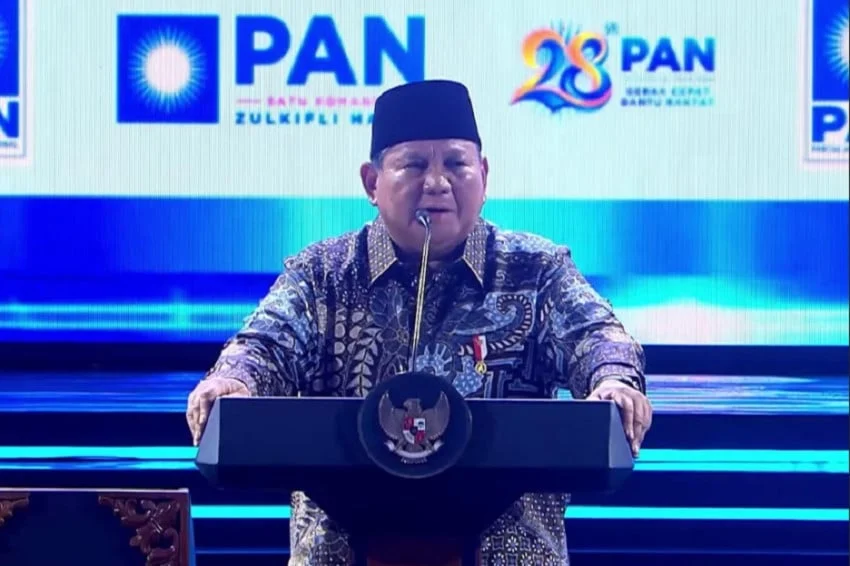
The political discourse in Indonesia reached a heightened state of intensity on Friday, September 18, 2026, as President Prabowo Subianto delivered a combative address during the 28th-anniversary celebration of the National Mandate Party (PAN) at the Jakarta International Convention Center (JICC) in Senayan. In a speech that underscored the friction between the executive branch and the academic community, President Prabowo explicitly characterized the criticisms directed at his administration’s flagship programs as slanderous, while dismissing the intellectual rigor of certain experts who have questioned his policy directions.
The Core of the Contention
The President’s remarks were rooted in his long-standing commitment to addressing structural socio-economic challenges, specifically poverty, food insecurity, and the high prevalence of stunting among Indonesian children. Prabowo framed his political trajectory as a moral imperative rather than a mere pursuit of power. He articulated a vision of a nation where parental anxiety over medical costs is eradicated and where the academic performance of the youth is no longer compromised by malnutrition.
"I wish to defend my nation. My goal is to see an Indonesia that is honorable, where its people are prosperous and no one suffers from hunger," Prabowo stated, his tone reflecting the urgency he places on his administration’s core pillars. He specifically highlighted the physical and cognitive development of the next generation, noting that nutritional deficiencies in early childhood lead to weakened biological and cognitive foundations, effectively preventing the nation’s youth from competing on the global stage.
The Confrontation with Academic Critics
The most significant segment of the speech occurred when the President pivoted to address the feedback loop between the government and independent policy experts. Prabowo did not mince words, characterizing some of these critics as having become "too smart to the point of being foolish"—a phrase that immediately drew thunderous applause from the thousands of PAN cadres in attendance.
The President expressed skepticism regarding the motives behind academic critique, suggesting that these analyses are often detached from the harsh realities of governance and the immediate needs of the populace. By invoking the Quranic principle found in Surah Al-Baqarah, verse 191, which states that "slander is more severe than killing," Prabowo categorized the opposition not merely as dissenting opinion, but as a malicious effort to undermine the moral legitimacy of his government’s development agenda. This rhetorical move signals a hardening stance by the administration against external oversight that it deems politically motivated or intellectually dishonest.
Chronology and Contextual Background
The relationship between President Prabowo and the academic sector has been increasingly strained over the past eighteen months. Since his inauguration, the administration has pushed forward with large-scale interventions in education and health, including a comprehensive free school lunch program and nationwide health infrastructure overhauls.
- Early 2026: Critics, including researchers from several prominent public universities, began publishing papers suggesting that the fiscal burden of these programs could jeopardize the national debt-to-GDP ratio.
- Mid-2026: The discourse shifted from fiscal sustainability to implementation efficacy. Experts questioned the logistics of food distribution and the clinical oversight of national health initiatives.
- September 2026: The tension reached a boiling point leading up to the PAN event, as several televised panel discussions featured experts predicting significant gaps in the government’s 2027 budget projections.
The PAN anniversary event served as the President’s primary platform to reclaim the narrative. As a key coalition partner, PAN has consistently supported Prabowo’s populist programs, providing a sympathetic audience for his critique of the academic establishment.
Supporting Data on National Health and Poverty
The President’s focus on stunting is supported by stark national statistics. As of the most recent health survey conducted by the Ministry of Health, the national stunting rate remains a significant hurdle to achieving the "Golden Indonesia 2045" vision. While the rate has seen a downward trend from 24.4% in 2021, the government’s target of reducing it to below 14% by 2027 remains an ambitious goal that requires sustained, massive investment.
Furthermore, the World Bank’s latest report on Indonesia’s poverty alleviation efforts notes that while extreme poverty has decreased, the "near-poor" population remains vulnerable to inflation and food price shocks. The government’s argument, as articulated by the President, is that technical policy critiques often ignore these existential risks, favoring macroeconomic stability over the immediate human capital development required to escape the middle-income trap.
Official Reactions and Political Implications
The aftermath of the speech has prompted a flurry of reactions from civil society organizations and political analysts. While supporters of the government praise the President for his "straight talk" and determination to bypass bureaucratic and academic gatekeepers, others have expressed concern over the shrinking space for objective criticism.
Representatives from the Association of Indonesian Academics have refrained from issuing a collective rebuttal, though individual observers noted that labeling critique as "slander" could have a chilling effect on democratic discourse. The spokesperson for the opposition bloc in the House of Representatives (DPR) suggested that such rhetoric from the executive branch undermines the checks-and-balances mechanism essential to a functioning democracy.
From a political standpoint, Prabowo’s stance is a calculated risk. By framing the conflict as a battle between "the people’s welfare" and "out-of-touch elites," he is effectively mobilizing his base. This populist appeal is a common strategy in Indonesian politics, but it carries the risk of alienating the technocratic class whose expertise is required for the complex implementation of large-scale social programs.
Analysis: The Impact on Policy and Governance
The friction between the President and academic experts suggests a shifting landscape for public policy in Indonesia. There is a perceptible move toward "executive-led policy making," where feedback is increasingly channeled through internal government task forces rather than public academic debate.
The implications of this shift are twofold:
- Efficiency vs. Accountability: By silencing or delegitimizing external critique, the government may be able to implement its programs with greater speed. However, it also loses the opportunity to refine policies through the scrutiny of independent experts, which could lead to systemic errors being caught too late.
- Social Polarization: The rhetoric of "slander" creates a binary narrative. It positions the administration as the sole champion of the poor, while casting any dissenter as an antagonist. This could lead to a more polarized public sphere where academic discourse is viewed through a partisan lens rather than an empirical one.
As the government moves into the next phase of its budgetary cycle, the effectiveness of these social programs will be the ultimate arbiter of the debate. If the stunting rates decrease and nutritional outcomes improve, the President’s argument will be bolstered by tangible success. Conversely, if the initiatives face logistical failures, the absence of robust, critical discourse—which the President has currently dismissed—may leave the administration with fewer tools to diagnose and correct course.
In conclusion, the President’s address at the PAN 28th anniversary represents a significant inflection point in the current administration’s relationship with the intellectual community. By declaring that his commitment to the nation outweighs the validity of his critics, Prabowo has set a clear tone for the remainder of his term: one of unwavering dedication to his specific vision of welfare, regardless of the pushback from the academic establishment. The coming months will likely see whether this approach leads to the "honorable" and "prosperous" Indonesia he envisions, or if the lack of critical engagement will create blind spots in the government’s grand design.