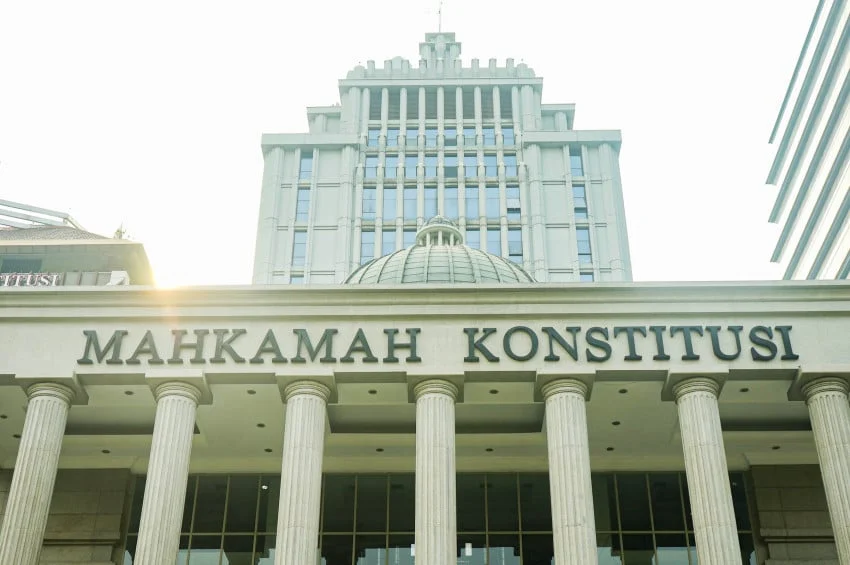
The Indonesian Constitutional Court, known locally as Mahkamah Konstitusi or MK, has officially enacted a new regulatory framework to address an unprecedented legal challenge concerning the 2024 Presidential and Vice-Presidential Election Results. The newly issued regulation, designated as Constitutional Court Regulation (Peraturan Mahkamah Konstitusi or PMK) Number 1 of 2026, outlines the specific stages, procedural activities, and official schedules for handling the dispute petition. This extraordinary legal development was triggered by a formal lawsuit filed by prominent constitutional law expert and advocate Denny Indrayana, alongside co-petitioners, who challenged aspects of the 2024 electoral outcome with a primary focus on the statutory educational qualifications and diploma validity of Vice President Gibran Rakabuming Raka.
The publication of PMK Number 1 of 2026 marks a significant procedural milestone in Indonesia’s post-election legal landscape. Signed formally by Chief Justice of the Constitutional Court Suhartoyo on September 16, 2026, the regulation serves as an administrative and legal necessity to accommodate a petition submitted nearly two years after the initial inauguration of the elected national leadership. According to the foundational considerations outlined within the regulation itself, the institutional impetus for this new decree arose directly from the receipt of a fresh Presidential Election Dispute (Perselisihan Hasil Pemilihan Umum or PHPU) petition filed on September 10, 2026, by Denny Indrayana and his legal coalition.
Background Context of the Legal Challenge and the 2024 Election Cycle
To understand the weight of PMK 1 of 2026, it is essential to contextualize the timeline of Indonesia’s 2024 general elections. The democratic exercise, which took place on February 14, 2024, resulted in the decisive victory of the presidential and vice-presidential ticket comprising Prabowo Subianto and Gibran Rakabuming Raka. Following the official vote tally announced by the General Elections Commission (KPU), several legal challenges were immediately lodged before the Constitutional Court by losing candidate pairs. Those initial disputes were rapidly processed and adjudicated in April 2024 under a strict constitutional timeline mandated by the Election Law, which grants the judiciary a narrow window of roughly 14 working days to resolve presidential election disputes.
Once those initial verdicts were handed down in the spring of 2024, dismissing the challenges and confirming the legitimacy of the electoral outcome, the political and legal architecture appeared fully settled. Prabowo Subianto and Gibran Rakabuming Raka were subsequently inaugurated into office in October 2024. However, lingering controversies regarding administrative prerequisites, candidate eligibility, and alleged procedural flaws during the nomination phase continued to be scrutinized by various civil society actors and legal scholars.
Denny Indrayana, a former Deputy Minister of Law and Human Rights, persisted in analyzing the legal parameters surrounding the election, eventually culminating in the September 2026 filing. The core of Indrayana’s lawsuit challenges the foundational legality of Gibran Rakabuming Raka’s candidacy, specifically zeroing in on documentation related to the Vice President’s educational background and academic credentials. The petitioners have demanded that the Constitutional Court review the matter and issue a ruling that could potentially impact Gibran’s standing in office, including a formal plea for disqualification.
Procedural Necessity and the Replacement of PMK 1 of 2024
The filing of a major electoral dispute in late 2026 presented an immediate administrative hurdle for the Constitutional Court. The handling of the original 2024 presidential election disputes had been governed entirely by PMK Number 1 of 2024, a regulation tailored specifically to the statutory deadlines, preliminary checks, evidentiary hearings, and decision-making windows applicable during the active election cycle of early 2024.
Because the legal framework under PMK 1/2024 was structurally bound to the operational calendar of the 2024 electoral year, it legally and practically could not accommodate the activities required to process a petition filed in 2026. The institutional mechanisms for summoning parties, reviewing evidentiary submissions, scheduling expert testimonies, and deliberating in a justices’ chamber were completely out of sync with a calendar two years removed from the ballot box. Consequently, the leadership of the Constitutional Court determined that enacting an entirely new regulatory instrument was imperative to maintain legal certainty, procedural transparency, and institutional accountability.
PMK 1 of 2026 was thus formulated to bridge this unexpected gap. It establishes a bespoke timeline and procedural pathway exclusively dedicated to managing the late-filed petition regarding the 2024 presidential election results. By replacing the obsolete 2024 regulatory framework with the updated 2026 guidelines, the court has ensured that the extraordinary legal action undergoes a structured, predictable, and legally defensible administrative review process.
Strict Judicial Boundaries: Procedural Rule Versus Substantive Merit
In an effort to maintain absolute judicial neutrality and preempt public speculation, the Constitutional Court included explicit provisions within PMK Number 1 of 2026 to clarify the exact nature of the regulation. The Court emphasized that the issuance of this administrative schedule is strictly a procedural measure and does not constitute any preliminary judgment, endorsement, or evaluation regarding the underlying merits of the petition itself.
This critical distinction is codified explicitly in Article 3 of the new regulation. Article 3 paragraph (1) of PMK 1/2026 states unequivocally that the establishment of stages, activities, and schedules does not represent a formal stance or prejudgment by the Constitutional Court regarding several vital legal thresholds. These protected thresholds include the Court’s own jurisdictional authority to hear the case at this juncture, the legal standing (legal standing) of the Petitioners, the strictness of the statutory timeframes for filing applications, the precise legal object of the dispute, or the ultimate substance and core arguments of the petition.
Furthermore, Article 3 paragraph (2) reinforces that any formal assessment or legal determination regarding these complex preliminary and substantive questions will only be conducted later. The justices of the Constitutional Court will evaluate these elements strictly based on established procedural law (hukum acara) and will formally deliberate them within a final constitutional Court Decision (Putusan) or formal Court Determination (Ketetapan). This safeguards the integrity of the judicial process, ensuring that the creation of a calendar to process the lawsuit should not be misconstrued as a signal that the court has accepted the validity or viability of Denny Indrayana’s legal arguments.
Chronology of Events Leading to the 2026 Regulation
To trace the trajectory of this complex legal saga, a clear chronology highlights the key milestones:
- February 14, 2024: Indonesia conducts its nationwide general elections, culminating in the apparent victory of the Prabowo-Gibran ticket.
- March to April 2024: The General Elections Commission announces the final results, prompting initial legal challenges at the Constitutional Court, which are adjudicated and dismissed under PMK 1 of 2024.
- October 20, 2024: Prabowo Subianto and Gibran Rakabuming Raka are officially sworn in as President and Vice President of the Republic of Indonesia for the 2024–2029 term.
- Late 2024 to mid-2026: Civil society groups, legal analysts, and figures like Denny Indrayana continue research and public discourse regarding candidate eligibility requirements, culminating in the assembly of a new legal challenge.
- September 10, 2026: Denny Indrayana and his co-petitioners officially file a late-stage PHPU petition with the Constitutional Court, targeting the election results and requesting the disqualification of Vice President Gibran Rakabuming Raka over credential disputes.
- September 16, 2026: Chief Justice Suhartoyo signs and officially enacts PMK Number 1 of 2026, establishing the updated procedural stages, activities, and schedules required to process the newly submitted lawsuit.
Implications and Broad Political-Legal Analysis
The emergence of PMK 1/2026 and the underlying lawsuit filed by Denny Indrayana carry profound implications for Indonesian constitutional law, administrative jurisprudence, and political stability. While election disputes are historically intended to be resolved swiftly before a government takes office to ensure immediate state continuity, this case tests the boundaries of post-inauguration judicial remedies when fundamental questions of eligibility are raised by legal scholars.
Legal analysts point out that the Constitutional Court faces a delicate balancing act. On one hand, the judiciary must uphold the principle of legal certainty and finality, ensuring that electoral outcomes cannot be perpetually contested indefinitely by dissatisfied political actors long after a government has assumed power. On the other hand, the court must demonstrate institutional responsiveness to serious allegations concerning administrative compliance and candidate prerequisites, particularly when violations are argued to touch upon constitutional requirements for holding high office.
The preliminary hurdle for Denny Indrayana and his legal team will be overcoming the strict doctrines of legal standing and timeliness. Under standard Indonesian electoral law, timelines for filing election disputes are tightly bound to the immediate post-election phase. Establishing why a petition of this magnitude is permissible years after the fact—and whether the Constitutional Court retains the legal competence to unseat a sitting vice president through an electoral dispute mechanism—will form the core legal battle during the upcoming hearings.
As the Constitutional Court initiates the structured phases outlined in PMK Number 1 of 2026, all eyes within the national legal and political community will remain fixed on the tribunal. The eventual ruling will not only determine the specific outcome of the challenge against Gibran Rakabuming Raka’s credentials but will also set a monumental legal precedent regarding the temporal limits of electoral justice and the accountability of state leaders under Indonesian constitutional democracy.