The pinnacle of motorsport has always served as the ultimate testing ground for elite drivers seeking to cement their legacy among the fastest competitors in history. From the era of pioneering legends who forged unbreakable dynasties to the high-stakes, technologically advanced battles of the modern era, the Formula 1 World Drivers’ Championship represents the absolute summit of global racing prestige. A historic new chapter in this illustrious sporting narrative was written during the 2025 season, which culminated in a thrilling and emotionally charged conclusion that forever altered the landscape of modern motorsport.
Lando Norris officially etched his name into the history books by securing his maiden Formula 1 World Drivers’ Championship. Operating at the peak of his abilities with the McLaren F1 Team, the British driver navigated a grueling, highly competitive 24-race calendar to clinch the ultimate prize. The championship battle came down to the absolute wire at the Yas Marina Circuit during the Abu Dhabi Grand Prix on Sunday, December 7, 2025. Demonstrating the poise, consistency, and strategic maturity that characterized his entire campaign, Norris drove a calculated race to finish in third position.
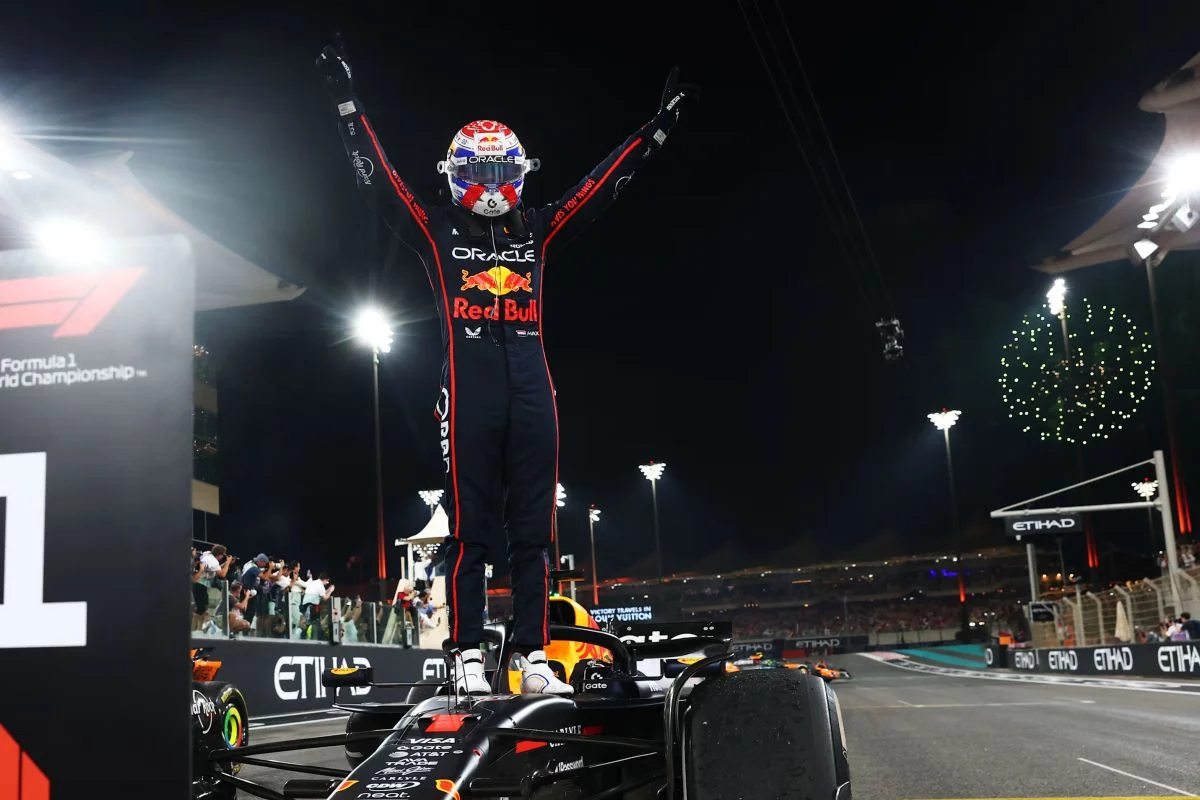
That crucial podium finish yielded enough points to cement his status at the summit of the drivers’ standings, bringing his final tally to an impressive 423 points. The margin of victory was razor-thin, highlighting the immense intensity of the 2025 season. Norris edged out reigning powerhouse Max Verstappen of Red Bull Racing by a mere two points, as the Dutchman was forced to settle for second place in the overall standings despite a ferocious late-season charge. Though Verstappen and Norris’s own teammate, the highly talented Oscar Piastri, crossed the finish line ahead of him in the season-ending race, the accumulated points buffer was more than enough to secure the British driver’s lifelong dream.
The emotional weight of the achievement was palpable as Norris stepped out of his McLaren MCL39. Reflecting on his journey to the championship, the newly crowned world champion openly admitted to navigating numerous difficult moments, intense pressures, and technical challenges throughout his career before finally reaching the promised land.
The Anatomy of a Championship: 2025 Season Chronology
The path to the 2025 world title was far from straightforward, marked by fluctuating team performances, tactical masterclasses, and intense psychological warfare at the front of the grid. The season kicked off with high anticipation, and early rounds immediately established that McLaren had engineered a machine capable of fighting for both the constructors’ and drivers’ crowns.
As the calendar progressed through the European leg and into the flyaway races, momentum swung dynamically between McLaren, Red Bull Racing, and Ferrari. A critical turning point in the championship narrative occurred during the late-season American and South American swings. A stellar performance by Norris, highlighted by a masterclass victory in the dramatic sprint race at the São Paulo Grand Prix at Interlagos, allowed him to consolidate his lead at the top of the drivers’ standings under mounting pressure.
Even as Verstappen mounted a relentless defense of his crown—highlighted by defiant podium finishes and characteristic tenacity—Norris maintained his composure. Speaking to the media after missing out on the 2025 title by the slimmest of margins, Max Verstappen displayed remarkable sportsmanship and grace, stating that he remained profoundly proud of his team’s efforts and his own driving over the course of the grueling campaign. The mutual respect between the title contenders underscored the elite sporting ethos of contemporary Formula 1.
Historical Context: The Evolution of the F1 World Championship
To truly understand the magnitude of Lando Norris’s achievement, one must examine the rich tapestry of the Formula 1 World Drivers’ Championship since its inception. Established in 1950 by the Fédération Internationale de l’Automobile (FIA), the championship has evolved from a dangerous, romanticized era of front-engined roadsters into a multi-billion-dollar global technological powerhouse.
The historical roll of honor features titans of motorsport whose names evoke awe across generations. The inaugural crown in 1950 was claimed by Italian driver Giuseppe Farina behind the wheel of an Alfa Romeo. This sparked a decade defined by iconic pioneers, most notably the legendary Argentine maestro Juan Manuel Fangio, who dominated the 1950s with five world titles across four different constructors—Alfa Romeo, Maserati, Mercedes-Benz, and Ferrari—a versatility and dominance that remained a benchmark for decades.
As the sport transitioned into the 1960s and 1970s, engineering ingenuity shifted toward rear-engined designs and aerodynamic ground effects. This era produced legendary champions such as Jack Brabham, the charismatic Jim Clark, the trailblazing Graham Hill, and the fearless Austrian tactician Niki Lauda. The battles of the 1970s and 1980s also highlighted the rise of Brazilian excellence through Emerson Fittipaldi and Nelson Piquet, alongside the fierce, legendary rivalry between Alain Prost and Ayrton Senna that transfixed a global audience.
The 1990s and 2000s belonged firmly to the statistical giants of the sport. Michael Schumacher redefined athletic preparation, dominance, and endurance, securing a record-shattering seven world titles—five consecutively with Ferrari from 2000 to 2004. Following Schumacher’s era, the sport witnessed the meteoric rises of Fernando Alonso, Kimi Räikkönen, and Jenson Button, before Lewis Hamilton emerged to match Schumacher’s immortal record of seven championships, dominating the turbo-hybrid era alongside fierce rivals like Nico Rosberg and Sebastian Vettel.
Most recently, the sport entered a high-downforce, ground-effect era characterized by the unstoppable synergy between Max Verstappen and Red Bull Racing, who secured four consecutive titles from 2021 to 2024. Lando Norris’s triumph in 2025 successfully breaks this recent Red Bull hegemony, signaling a new competitive paradigm in Formula 1.
Comprehensive Chronological List of Formula 1 World Champions (1950–2025)
- 1950 – Giuseppe Farina (Alfa Romeo, Italy)
- 1951 – Juan Manuel Fangio (Alfa Romeo, Argentina)
- 1952 – Alberto Ascari (Ferrari, Italy)
- 1953 – Alberto Ascari (Ferrari, Italy)
- 1954 – Juan Manuel Fangio (Maserati/Mercedes-Benz, Argentina)
- 1955 – Juan Manuel Fangio (Mercedes-Benz, Argentina)
- 1956 – Juan Manuel Fangio (Ferrari, Argentina)
- 1957 – Juan Manuel Fangio (Maserati, Argentina)
- 1958 – Mike Hawthorn (Ferrari, United Kingdom)
- 1959 – Jack Brabham (Cooper Climax, Australia)
- 1960 – Jack Brabham (Cooper Climax, Australia)
- 1961 – Phil Hill (Ferrari, United States)
- 1962 – Graham Hill (BRM, United Kingdom)
- 1963 – Jim Clark (Lotus Climax, United Kingdom)
- 1964 – John Surtees (Ferrari, United Kingdom)
- 1965 – Jim Clark (Lotus Climax, United Kingdom)
- 1966 – Jack Brabham (Brabham Repco, Australia)
- 1967 – Denny Hulme (Brabham Repco, New Zealand)
- 1968 – Graham Hill (Lotus Ford, United Kingdom)
- 1969 – Jackie Stewart (Matra Ford, United Kingdom)
- 1970 – Jochen Rindt (Lotus Ford, Austria)
- 1971 – Jackie Stewart (Tyrrell Ford, United Kingdom)
- 1972 – Emerson Fittipaldi (Lotus Ford, Brazil)
- 1973 – Jackie Stewart (Tyrrell Ford, United Kingdom)
- 1974 – Emerson Fittipaldi (McLaren Ford, Brazil)
- 1975 – Niki Lauda (Ferrari, Austria)
- 1976 – James Hunt (McLaren Ford, United Kingdom)
- 1977 – Niki Lauda (Ferrari, Austria)
- 1978 – Mario Andretti (Lotus Ford, United States)
- 1979 – Jody Scheckter (Ferrari, South Africa)
- 1980 – Alan Jones (Williams Ford, Australia)
- 1981 – Nelson Piquet (Brabham Ford, Brazil)
- 1982 – Keke Rosberg (Williams Ford, Finland)
- 1983 – Nelson Piquet (Brabham BMW, Brazil)
- 1984 – Niki Lauda (McLaren TAG, Austria)
- 1985 – Alain Prost (McLaren TAG, France)
- 1986 – Alain Prost (McLaren TAG, France)
- 1987 – Nelson Piquet (Williams Honda, Brazil)
- 1988 – Ayrton Senna (McLaren Honda, Brazil)
- 1989 – Alain Prost (McLaren Honda, France)
- 1990 – Ayrton Senna (McLaren Honda, Brazil)
- 1991 – Ayrton Senna (McLaren Honda, Brazil)
- 1992 – Nigel Mansell (Williams Renault, United Kingdom)
- 1993 – Alain Prost (Williams Renault, France)
- 1994 – Michael Schumacher (Benetton Ford, Germany)
- 1995 – Michael Schumacher (Benetton Renault, Germany)
- 1996 – Damon Hill (Williams Renault, United Kingdom)
- 1997 – Jacques Villeneuve (Williams Renault, Canada)
- 1998 – Mika Häkkinen (McLaren Mercedes, Finland)
- 1999 – Mika Häkkinen (McLaren Mercedes, Finland)
- 2000 – Michael Schumacher (Ferrari, Germany)
- 2001 – Michael Schumacher (Ferrari, Germany)
- 2002 – Michael Schumacher (Ferrari, Germany)
- 2003 – Michael Schumacher (Ferrari, Germany)
- 2004 – Michael Schumacher (Ferrari, Germany)
- 2005 – Fernando Alonso (Renault, Spain)
- 2006 – Fernando Alonso (Renault, Spain)
- 2007 – Kimi Räikkönen (Ferrari, Finland)
- 2008 – Lewis Hamilton (McLaren Mercedes, United Kingdom)
- 2009 – Jenson Button (Brawn Mercedes, United Kingdom)
- 2010 – Sebastian Vettel (Red Bull Renault, Germany)
- 2011 – Sebastian Vettel (Red Bull Renault, Germany)
- 2012 – Sebastian Vettel (Red Bull Renault, Germany)
- 2013 – Sebastian Vettel (Red Bull Renault, Germany)
- 2014 – Lewis Hamilton (Mercedes, United Kingdom)
- 2015 – Lewis Hamilton (Mercedes, United Kingdom)
- 2016 – Nico Rosberg (Mercedes, Germany)
- 2017 – Lewis Hamilton (Mercedes, United Kingdom)
- 2018 – Lewis Hamilton (Mercedes, United Kingdom)
- 2019 – Lewis Hamilton (Mercedes, United Kingdom)
- 2020 – Lewis Hamilton (Mercedes, United Kingdom)
- 2021 – Max Verstappen (Red Bull Honda, Netherlands)
- 2022 – Max Verstappen (Red Bull RBPT, Netherlands)
- 2023 – Max Verstappen (Red Bull Honda RBPT, Netherlands)
- 2024 – Max Verstappen (Red Bull Honda RBPT, Netherlands)
- 2025 – Lando Norris (McLaren Mercedes, United Kingdom)
Broader Impact and Implications for the Future of Formula 1
Lando Norris capturing the 2025 world title carries profound implications for the sport, both commercially and competitively. For the McLaren F1 Team, this championship validates years of meticulous restructuring, engineering development, and cultural rebuilding under team leadership. It marks McLaren’s first drivers’ world championship since Lewis Hamilton’s dramatic triumph in 2008, re-establishing the Woking-based outfit as an undisputed powerhouse of modern motorsport.
Furthermore, the razor-thin margin of victory—decided by just two points over Max Verstappen—underscores the tightening competitive spread across the Formula 1 grid. With regulatory changes on the horizon and multiple constructor teams closing the performance gap, the 2025 season has effectively signaled the dawn of a highly unpredictable and intensely competitive multi-team era. Fans and analysts alike anticipate that the psychological breakthrough of winning his maiden title will only embolden Norris, setting the stage for an even more ferocious championship defense in the years to come.