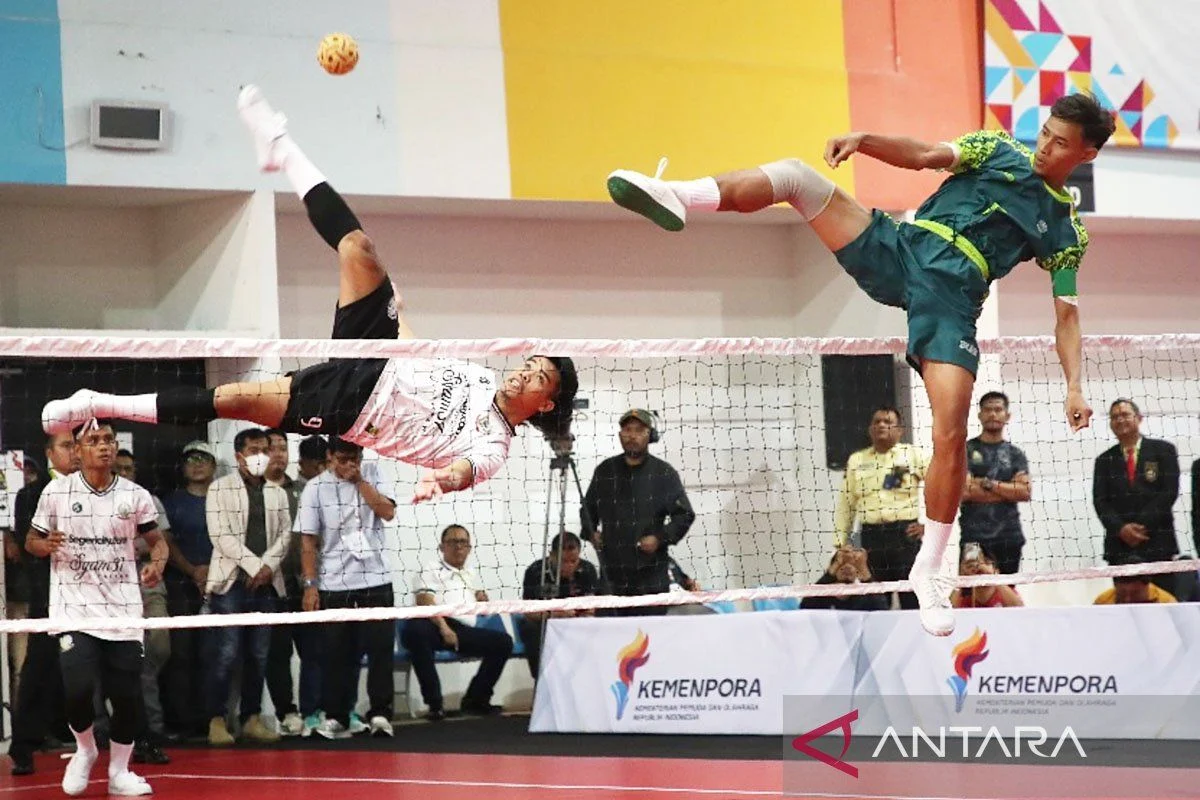
Jakarta, Indonesia – Imagine a sport that fuses the aerial artistry of volleyball with the dazzling footwork and acrobatic kicks reminiscent of football, all played without a single touch of the hand. This captivating game is Sepak Takraw, a traditional Southeast Asian sport that continues to enthrall audiences across Indonesia, Thailand, Malaysia, the Philippines, and beyond. Its unique blend of athleticism, strategy, and cultural heritage makes it a compelling spectacle, a testament to the region’s rich sporting traditions.
The name "Sepak Takraw" itself is a linguistic tapestry, woven from two distinct languages. "Sepak" originates from the Malay language, meaning "to kick," while "Takraw" is a Thai word referring to a "woven rattan ball." Literally translated, the name signifies "to kick the rattan ball." The sport’s formal recognition as Sepak Takraw was cemented following a match between Malaysia and Thailand in Kuala Lumpur in 1960, marking a pivotal moment in its evolution from a localized pastime to an internationally recognized sport.
Before its current iteration, the game held different names and forms in various regions. In Malaysia, it was known as "Sepak Raga Jaring." The addition of the term "jaring" (net) is attributed to Hamid Mydin, widely regarded as a founder of modern Sepak Takraw. In Penang around 1945, Mydin introduced the net, distinguishing it from the earlier, net-less traditional game of Sepak Raga. This innovation fundamentally altered the game’s dynamics, introducing a vertical challenge that demanded new levels of aerial skill and precision.
Often dubbed "Kick Volleyball," Sepak Takraw is fundamentally a team sport, typically played by two to four players per side on a court similar in dimensions to a badminton court. The game’s essence lies in its restriction of player contact to specific body parts: feet, knees, shoulders, chest, and head. This limitation transforms the game into a remarkable display of controlled aerial maneuvers, where players must employ their entire bodies to propel the ball over the net, mirroring the objective of volleyball but with an entirely different set of tools.
Internationally, the sport’s governance falls under the purview of the International Sepaktakraw Federation (ISTAF), established in 1988. ISTAF plays a crucial role in standardizing rules, organizing global championships, and promoting the sport’s growth worldwide. The sport’s diverse nomenclature across Asia further highlights its deep roots and widespread appeal. It is known as Sepak Raga in Indonesia, Brunei, Malaysia, and Singapore; Sipa in the Philippines; Chinlone in Myanmar; and Takraw in Thailand, among other regional variations. This linguistic diversity underscores its organic integration into the cultural fabric of these nations.
The Genesis of Sepak Takraw: A Journey Through Centuries
The historical trajectory of Sepak Takraw traces back approximately 500 years to Malaysia, where it gained considerable popularity among royalty during the 15th century. From its Malaysian origins, the game, under the name Sepak Raga, journeyed to Indonesia around the 16th century. Its pan-Southeast Asian popularity began to surge in the 1940s, a period marked by the formalization of its rules and structures.
The first official competition for the sport, then known as "Sepak Raga Jaring," was held in Penang in 1945. This event was instrumental in standardizing gameplay and laying the groundwork for future development. A significant milestone arrived in 1960 with the establishment of the Malaysian Sepak Raga Federation in Penang. Its inclusion in the Southeast Asian Peninsular Games in 1965 marked a crucial step towards wider regional recognition. It was during this pivotal 1965 event that the sport was officially christened "Sepak Takraw," a name that would come to represent this dynamic athletic pursuit on the global stage.
Intriguingly, some historical accounts suggest that Sepak Takraw’s introduction to Southeast Asia may have been influenced by Chinese migration, positing a shared ancestry with football. This theory links Sepak Takraw to Cuju, an ancient Chinese sport recognized by FIFA as an early precursor to modern football. Cuju, described as an ancient military exercise, involved soldiers kicking a leather ball, with the objective of keeping it airborne for as long as possible. This connection highlights the enduring human fascination with ball games and the evolution of athletic expression across cultures.
Navigating the Court: Fundamental Rules and Gameplay
Sepak Takraw is played on a court measuring 13.4 meters by 6.1 meters, divided by a net set at a height of 1.52 meters for men and 1.42 meters for women. The game involves two teams, each consisting of three players: a ‘Tekong’ (server), a ‘Feeder,’ and a ‘Killer.’ The court is divided into two service zones and two main playing areas. The strategic positioning of these players is paramount to successful gameplay.
The initial serve is initiated by the Tekong, who stands within the service circle. The ball is first tossed into the air and then kicked over the net into the opponent’s court. The toss can be done with the hands, but the subsequent kick must be performed with the feet, knees, chest, or head. The right to serve first is determined by a coin toss, granting the winning team the choice to either serve or receive.
The game unfolds with teams exchanging volleys, using any part of their body except their hands and arms to keep the ball in play. The objective is to land the ball within the opponent’s court in a manner that they cannot legally return. Points are scored when the ball is successfully grounded in the opponent’s court or when the opposing team commits a fault, such as hitting the ball out of bounds or touching the net with their body.
A match typically consists of three sets, with the first two sets played to 21 points. A team must win a set by a margin of at least two points, with a cap of 25 points. If a third set is required, it is played to 15 points, again with a two-point winning margin and a cap of 20 points. This scoring system ensures intense, back-and-forth rallies and rewards consistent performance.
The Art of the Play: Strategy and Player Roles
The synergy between the three players on each side is crucial for success in Sepak Takraw. The Tekong, while primarily responsible for the serve, also plays a defensive role. Their initial kick sets the tone for the rally, and their ability to deliver powerful and accurate serves can immediately put the opposing team on the back foot.
The Feeder’s role is to set up scoring opportunities. They are responsible for receiving the opponent’s serve or return and skillfully passing the ball to the Killer in a position where they can launch an attack. This requires exceptional ball control, vision, and an understanding of their teammate’s movements and strengths.
The Killer is the primary offensive weapon. Their objective is to execute powerful and precise shots, often employing acrobatic aerial maneuvers, to score points. This requires a combination of explosive power, agility, and the ability to read the game and anticipate defensive weaknesses. The coordination between the Feeder and the Killer is a hallmark of high-level Sepak Takraw, creating breathtaking offensive plays.
Global Reach and Recent Developments
The International Sepaktakraw Federation (ISTAF) has been instrumental in the sport’s global expansion. ISTAF organizes major international tournaments, including the Sepak Takraw World Cup and the ISTAF Super Series, which attract top talent from around the world. The sport’s inclusion in multi-sport events like the Asian Games further boosts its visibility and appeal.
In recent times, the sport in Indonesia has seen significant developments aimed at resolving internal administrative issues. The resolution of dualism within the Indonesian Sepak Takraw governance, as reported by ANTARA, signifies a positive step towards a more unified and streamlined approach to managing and developing the sport within the nation. Such resolutions are vital for fostering stability, attracting investment, and ensuring that athletes receive the best possible support and opportunities to compete on the international stage. The ISTAF’s positive reception to these developments underscores the global community’s commitment to the sport’s healthy growth.
The evolution of Sepak Takraw, from its ancient origins to its modern, highly athletic form, is a compelling narrative of cultural adaptation and sporting innovation. It stands as a vibrant testament to the ingenuity and athleticism of Southeast Asia, captivating audiences with its unique blend of grace, power, and aerial artistry. As the sport continues to evolve and gain a wider international following, its future promises even more thrilling spectacles and a deeper appreciation for this extraordinary game.