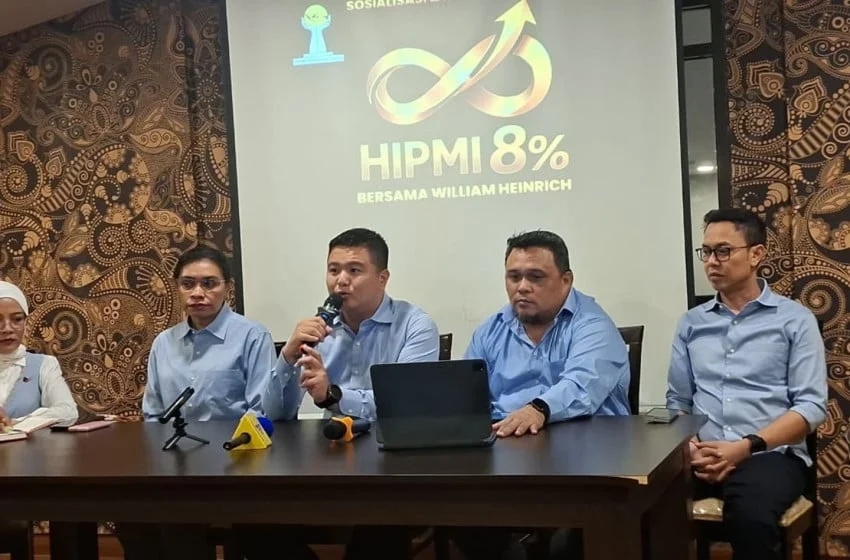
JAKARTA – William Heinrich, a prospective Chairman of the Indonesian Young Entrepreneurs Association (HIPMI), has expressed strong optimism that a robust collaboration between the government and the business community will be the pivotal factor in achieving the nation’s "Golden Indonesia" vision. Heinrich articulated this viewpoint during a press conference held at SCBD, South Jakarta, on Wednesday, April 15, 2026.
His remarks come at a critical juncture for Indonesia, as the nation navigates its path towards advanced economic status. The "Golden Indonesia" vision, a broad national aspiration, typically refers to a period of significant economic prosperity and improved quality of life for all citizens, often associated with the centenary of Indonesian independence in 2045. Heinrich’s proactive stance, even as a candidate for HIPMI leadership, underscores the urgency and forward-thinking approach he intends to bring to the organization.
Introducing the "HIPMI 8%" Initiative: A Strategic Imperative for National Economic Growth
Central to Heinrich’s presentation was the unveiling of a strategic initiative he terms "HIPMI 8%." This initiative is envisioned as a concrete contribution from HIPMI towards strengthening the national economy, aligning directly with the policy direction of President-elect Prabowo Subianto. The proposed 8% economic growth target, as articulated by Heinrich, is not merely an ambitious figure but a pressing necessity to extricate Indonesia from the persistent "middle-income trap."
The middle-income trap refers to a situation where a country’s economic growth stagnates after reaching a certain level of development, failing to transition into a high-income economy. This often occurs due to a lack of innovation, declining competitiveness, and an inability to move up the value chain. For Indonesia, a nation blessed with a large population and abundant resources, escaping this trap is paramount for sustained development and realizing its full potential.
Heinrich emphasized that the current demographic bonus, characterized by a large proportion of the working-age population, presents a unique and fleeting opportunity. He asserted that this demographic dividend can only be fully leveraged through a synergistic partnership between the state and the business sector, with a particular focus on empowering young entrepreneurs. The rationale behind this emphasis is clear: young entrepreneurs are often more agile, innovative, and adaptable to changing economic landscapes, making them crucial drivers of future growth.
He further elaborated on the limitations of government fiscal capacity, suggesting that the private sector, particularly the real economy, must assume a more significant role in driving economic expansion. This implies a call for deregulation, improved investment climate, and targeted incentives to encourage private sector investment and expansion. The "HIPMI 8%" initiative, therefore, appears to be a framework designed to mobilize the entrepreneurial spirit and resources to complement and amplify government efforts.
Contextualizing the "HIPMI 8%" Vision: A Look at Indonesia’s Economic Trajectory
The Indonesian economy has demonstrated resilience and growth in recent years, but achieving sustained double-digit growth or even a consistent 8% has been a long-standing challenge. Historical data from the World Bank indicates that while Indonesia has successfully transitioned from a low-income to a middle-income country, its per capita income growth has often hovered in the single digits, making the leap to high-income status a formidable task.
For instance, in the decade leading up to 2020, Indonesia’s average annual GDP growth rate was around 5%, with occasional dips and peaks. While commendable for a large economy, this pace has historically kept the nation within the upper-middle-income bracket. The "Golden Indonesia" vision, often tied to the 2045 centenary of independence, implicitly requires an accelerated growth trajectory to achieve a per capita income comparable to high-income nations.
The concept of a demographic bonus, which Indonesia is currently experiencing, refers to a period where the dependency ratio (the ratio of dependents – children and elderly – to the working-age population) is low. This typically leads to an increase in the labor force, higher savings rates, and potentially higher economic growth. However, this bonus is a temporary phenomenon. If the growing workforce is not adequately employed or if productivity does not increase significantly, the demographic dividend can turn into a demographic burden when the population ages without sufficient economic capacity to support it. Heinrich’s call to action directly addresses this temporal aspect, urging immediate and strategic utilization of this demographic advantage.
The Role of Government-Entrepreneur Collaboration: A Historical Perspective and Future Outlook
The relationship between government and entrepreneurs in Indonesia has evolved over time. Historically, large conglomerates, often with close ties to the government, dominated the economic landscape. However, there has been a growing recognition of the importance of a vibrant small and medium-sized enterprise (SME) sector and the dynamism that young entrepreneurs bring.
The current administration and the incoming one have both expressed commitments to fostering a more conducive business environment. President Joko Widodo’s administration, for instance, initiated several reforms aimed at simplifying regulations and attracting foreign investment. President-elect Prabowo Subianto’s campaign platform also highlighted economic development and job creation as key priorities, suggesting a continuity and potential acceleration of these efforts.
Heinrich’s emphasis on collaboration suggests a belief that a more proactive and integrated approach is needed. This could involve:
- Policy Co-creation: Engaging entrepreneurs in the formulation of economic policies to ensure they are practical and effective.
- Investment Promotion: Joint efforts to attract both domestic and foreign investment, with HIPMI playing a role in identifying opportunities and facilitating investor engagement.
- Infrastructure Development: Partnerships in developing critical infrastructure that supports business operations and connectivity.
- Skills Development: Collaborative programs to upskill the workforce and align educational outcomes with industry needs.
- Access to Finance: Streamlining access to capital for startups and expanding businesses, particularly for young entrepreneurs who may face challenges securing loans.
The reference to the "HIPMI 8%" initiative as a "concrete contribution" implies that HIPMI is prepared to go beyond advocacy and actively participate in implementing solutions. This could involve developing specific programs, platforms, or investment vehicles to drive growth.
Potential Reactions and Broader Implications
While specific reactions from government officials or other business organizations were not detailed in the initial report, Heinrich’s proposal is likely to be met with considerable interest. The government, keen on achieving its economic targets, would likely welcome proactive initiatives from major business associations. The Ministry of Cooperatives and SMEs, the Ministry of Investment/BKPM, and the Ministry of Finance are key stakeholders who would be involved in any such collaboration.
Other business associations, such as the Indonesian Chamber of Commerce and Industry (KADIN) and the Indonesian Employers Association (APINDO), might also weigh in on the "HIPMI 8%" proposal. Their responses would likely depend on how the initiative aligns with their own strategic priorities and their perceived role in the broader economic development agenda.
The broader implications of a successful government-entrepreneur collaboration, as championed by Heinrich, could be significant:
- Accelerated Economic Growth: A sustained 8% growth rate could propel Indonesia into the ranks of high-income economies much sooner than currently projected, potentially by the mid-2030s.
- Job Creation: Increased economic activity would naturally lead to the creation of more employment opportunities, absorbing the growing workforce and reducing unemployment.
- Poverty Reduction: Higher economic growth and job creation are directly linked to poverty reduction and improved living standards.
- Enhanced Competitiveness: A more dynamic and innovative business sector would improve Indonesia’s global competitiveness.
- Innovation and Technological Advancement: Increased investment and entrepreneurial activity are catalysts for innovation and the adoption of new technologies, crucial for moving up the value chain.
Challenges and the Path Forward
However, realizing the ambitious "HIPMI 8%" target and the broader "Golden Indonesia" vision will not be without its challenges. These include:
- Bureaucratic Hurdles: Overcoming red tape and simplifying regulatory processes remain persistent challenges in Indonesia.
- Infrastructure Gaps: Despite significant investment, infrastructure development still needs to catch up with the demands of a rapidly growing economy.
- Human Capital Development: Ensuring the workforce has the necessary skills and education to support advanced industries is critical.
- Global Economic Volatility: External factors such as global recessions, trade wars, and geopolitical instability can significantly impact Indonesia’s economic performance.
- Corruption: Addressing corruption remains a fundamental requirement for creating a fair and efficient business environment.
William Heinrich’s candidacy for HIPMI leadership and his proactive proposal signal a commitment to addressing these challenges head-on. His focus on collaboration suggests a pragmatic approach, recognizing that the government cannot achieve these ambitious goals alone. The success of his vision will hinge on his ability to build consensus, forge strong partnerships, and translate strategic ideas into tangible economic outcomes. The coming period will be crucial in observing how this collaboration unfolds and its impact on Indonesia’s journey towards becoming a truly "Golden Indonesia."
The press conference, held on April 15, 2026, marks a significant step in Heinrich’s campaign and his articulation of a clear economic agenda. As he progresses in his bid for HIPMI leadership, his "HIPMI 8%" initiative is poised to become a central theme in discussions about Indonesia’s economic future, underscoring the vital role of the entrepreneurial spirit in shaping the nation’s destiny.