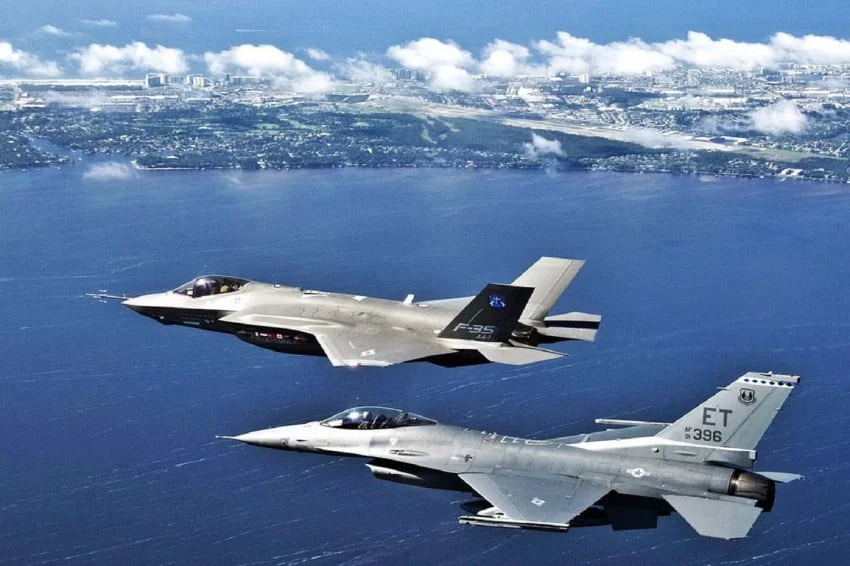
In a remarkable conversation that contrasted the cutting edge of military aviation with the proven reliability of a cold-war era design, a United States Air Force pilot made a surprising admission to the Commander-in-Chief. During a traditional Thanksgiving holiday phone call, Lieutenant Colonel Brent Smith informed then-President Donald Trump that given the choice between America’s most advanced stealth fighters and the legacy platform he currently flies, he would choose the venerable F-16 Fighting Falcon every single time.
The exchange occurred while President Trump was stationed at his Mar-a-Lago resort in Palm Beach, Florida, connecting via satellite with members of the United States Armed Forces deployed overseas. Lieutenant Colonel Smith, serving at Prince Sultan Air Base in the Kingdom of Saudi Arabia alongside the 510th Expeditionary Fighter Squadron, was asked directly by the president to compare the multi-role capabilities of the F-16 to the much-touted F-35 Lightning II and the air-superiority-focused F-22 Raptor.
Without hesitation, Smith championed the lightweight multi-role fighter that has served as the backbone of Western air power for decades. His comments immediately sparked discussions among defense analysts, aviation enthusiasts, and military strategists regarding the balance between high-tech stealth capabilities and the rugged, versatile utility of fourth-generation combat aircraft.
The Chronology of the Thanksgiving Exchange
The dialogue took place on a Thursday during the Thanksgiving holiday window. It is a long-standing presidential custom to reach out to service members deployed across various combat commands and overseas installations to express gratitude on behalf of the American people. However, the conversation quickly transitioned from standard holiday pleasantries into a candid technical discussion about military hardware.
President Trump, known for his keen interest in defense procurement, military budgets, and the aesthetic and functional qualities of military equipment, prompted Smith for an unvarnished assessment of the Air Force’s premier aircraft. Specifically, the president asked Smith to weigh the operational value of the F-16 against the extraordinarily expensive and technologically complex F-35 Lightning II, manufactured by Lockheed Martin, as well as the elite F-22 Raptor air-superiority fighter.
"F-16, sepanjang hari," or "F-16, all day long," Smith replied to the president, utilizing a colloquialism that emphasizes absolute preference. When probed further about whether he would trade his current assignment or aircraft for a seat in the fifth-generation stealth fleet, Smith doubled down on his endorsement. "You couldn’t pay me to switch planes," he declared, further labeling the F-16 as the "greatest fighter jet in the world."
The reaction from the commander-in-chief captured the sentiment of many defense observers who view fifth-generation fighters as the undisputed pinnacle of modern warfare. Visibly surprised by the pilot’s staunch loyalty to the older platform, Trump responded with skepticism: "Really? Is that so?"
Understanding the Platforms: F-16 Versus the Fifth-Generation Fleet
To fully contextualize Lieutenant Colonel Smith’s preference, it is essential to examine the unique roles, operational histories, and design philosophies behind the three aircraft discussed during the call. Each represents a distinct era and doctrine of American military aviation.
The General Dynamics (now Lockheed Martin) F-16 Fighting Falcon first entered operational service with the United States Air Force in 1978. Originally designed as a lightweight, day-VFR air-superiority day fighter, the F-16 evolved into a remarkably adaptable multi-role combat aircraft capable of performing air-to-air combat, precision ground attack, electronic suppression, and reconnaissance missions. Its bubble canopy provides exceptional pilot visibility, its fly-by-wire control system revolutionized agile flight dynamics, and its relatively low cost per flight hour has made it the most widely exported Western fighter jet in history, operating in the air forces of over two dozen nations.
Conversely, the Lockheed Martin F-22 Raptor represents the dawn of fifth-generation air combat. Entering service in December 2005, the Raptor was built exclusively to establish and maintain absolute air dominance. It combines extreme stealth characteristics, unprecedented supercruise capabilities (the ability to fly at supersonic speeds without using afterburners), highly integrated avionics, and extreme maneuverability through thrust-vectoring engines. However, the F-22’s production run was truncated due to high maintenance costs, budgetary constraints, and a ban on export sales designed to protect its classified technologies, leaving the fleet at a relatively small total inventory of roughly 185 aircraft.
The F-35 Lightning II, also developed by Lockheed Martin, represents the Department of Defense’s flagship joint-strike platform. Designed to replace a wide variety of aging aircraft across the Air Force, Navy, and Marine Corps—including the F-16, F/A-18 Hornet, and AV-8B Harrier—the F-35 emphasizes sensor fusion, advanced data-link connectivity, and low-observable stealth across three distinct variants (the F-35A conventional takeoff and landing variant, the F-35B short takeoff/vertical landing variant, and the F-35C carrier-based variant). Despite being the most expensive defense program in history, the F-35 has faced well-documented challenges regarding software maturity, maintenance logjams, engine durability, and high sustainment costs.
Why a Veteran Pilot Chose the Falcon
Despite acknowledging the formidable capabilities of the newer jets, Smith’s preference highlights a common sentiment among seasoned combat aviators who prioritize operational flexibility, tactile engagement, and mission reliability over raw technological complexity.
During the call, Smith made sure to clarify that he did not dismiss the value of advanced stealth platforms. "Both of those planes are great and they have their place in the world and in warfare," Smith noted, referring to the F-22 and F-35. However, he emphasized the pure flying enjoyment and unmatched utility of his current aircraft. "Flying this airplane is a blast. We can do everything, and this airplane can do it very well."
Aviation analysts note that while fifth-generation fighters like the F-35 are unmatched in contested, high-threat environments where enemy integrated air defense systems (IADS) must be penetrated undetected, fourth-generation aircraft like the F-16 continue to shoulder a massive percentage of routine combat patrols, coalition support missions, and theater-level taskings. Furthermore, the F-16’s high mission-capable rate, simpler maintenance requirements, and extensive weapons integration make it an exceptionally reliable workhorse in regions like the Middle East, where operations often involve sustained sortie rates over extended periods.
Strategic Implications and Operational Context
The deployment of Lieutenant Colonel Smith’s unit to Prince Sultan Air Base in Saudi Arabia underscores the ongoing strategic importance of fourth-generation assets in volatile geopolitical theaters. Prince Sultan Air Base has served as a crucial hub for United States Air Forces Central (AFCENT), hosting various fighter, tanker, and air defense squadrons designed to project stability and deter regional aggression.
In environments where absolute stealth is not the primary tactical requirement—such as countering asymmetric threats or conducting patrols in airspace without sophisticated peer-level air defense networks—the F-16 offers a cost-effective, highly responsive capability. The ongoing debates surrounding the United States Air Force’s tactical fighter roadmap often center on this exact dilemma: balancing the urgent need to procure and modernize fifth- and sixth-generation assets (such as the Next Generation Air Dominance program) with the fiscal and operational reality that legacy fleets remain essential for day-to-day global presence.
Moreover, recent security incidents in European and Middle Eastern theaters have highlighted the multifaceted nature of modern air base defense. For instance, reports of mysterious drone incursions near critical installations hosting F-35 fleets in the United Kingdom have underscored that advanced fighter jets are only as secure as the infrastructure protecting them on the ground. These evolving threats remind military planners that air power relies just as heavily on robust force protection, rapid sortie generation, and logistical resilience as it does on low-radar cross-sections.
Reactions and Defense Industry Response
While the exchange between Trump and Lieutenant Colonel Smith was lighthearted, it struck a chord within the broader defense community. Representatives from major defense contractors, including Lockheed Martin—which manufactures both the F-16 and the F-35—frequently emphasize that these platforms are designed to complement rather than replace one another entirely. The concept of a "high-low mix" has guided United States military procurement strategy for decades, ensuring that expensive, specialized assets are supported by affordable, versatile workhorses.
Military commentators and retired generals weighed in on social media and defense forums following the broadcast of the phone call. Many retired fighter pilots expressed understanding of Smith’s perspective, noting that the F-16 offers a visceral, highly connected flying experience due to its exceptional agility, uninhibited cockpit visibility, and intuitive handling characteristics. At the same time, tacticians reiterated that in a high-end conflict against a peer adversary like China or Russia, a pilot would undoubtedly trade a legacy platform for the revolutionary sensor fusion and radar-evading capabilities of an F-35 or F-22 to survive the opening phases of air combat.
Conclusion
Lieutenant Colonel Brent Smith’s candid remarks to the president serve as a reminder of the human element embedded within modern military technology. While billions of dollars are poured into artificial intelligence, stealth coatings, and advanced avionics, the ultimate success of air power still rests upon the judgment, skill, and personal affinity of the men and women strapped into the cockpit. Whether soaring in the digitized stealth of an F-35 or carving through the skies in the time-tested frame of an F-16, America’s fighter pilots continue to define the cutting edge of global aviation readiness.