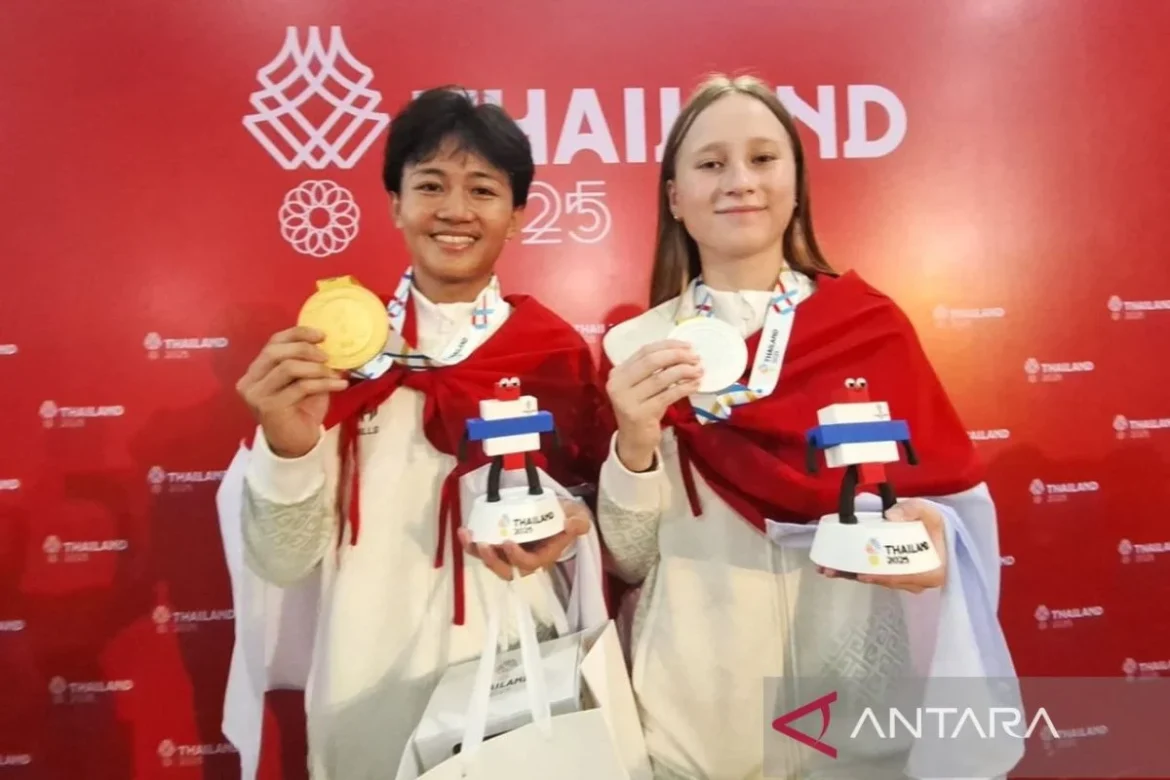
The landscape of Indonesian action sports reached a triumphant milestone at the 2025 Southeast Asian (SEA) Games in Bangkok, Thailand, where young skateboard sensation Basral Graito Hutomo clinched a hard-fought and prestigious gold medal. Competing in the fiercely contested men’s street event at the Rajamangala Extreme Sport Park, the then-eighteen-year-old athlete delivered a masterclass in composure, technical execution, and tactical risk management. His victory not only underscored his individual ascent as a dominant force in regional skateboarding but also reinforced Indonesia’s growing competitive pedigree in modern, youth-centric Olympic disciplines.
Displaying an exceptional blend of consistency and mental fortitude, Basral navigated the preliminary heats and the high-pressure final round with a relaxed yet razor-sharp demeanor. In a sport where fractional errors can result in devastating falls and ruined routines, his ability to execute high-tariff maneuvers under immense scrutiny captured the attention of international judges, spectators, and rival delegations alike. The culmination of his routine—a breathtaking combination of a 360 flip transitioning seamlessly into a boardslide on his final trial—sealed his triumph, earning him a decisive and competition-leading total of 166,67 points to edge out formidable competitors from the host nation, Thailand.
This comprehensive profile examines the meteoric rise of Basral Graito Hutomo, tracing his journey from modest beginnings in Central Java to the continental podium, while evaluating the systemic shifts, personal sacrifices, and broader implications of his breakthrough victory for Indonesian skateboarding.
Humble Beginnings and the Spark of a Dream
Born in Tangerang, Banten, on January 22, 2007, Basral’s formative years unfolded in Karanganyar, Central Java, a region not traditionally recognized as an incubator for elite urban action sports athletes. Long before he commanded international podiums, his introduction to the world of wheels was entirely organic, sparked by adolescent curiosity and local visual culture.
During 2017 and 2018, a young Basral frequently gravitated toward the vicinity of the Manahan Stadium in Surakarta. There, he watched local enthusiasts perform bicycle motocross (BMX) stunts. The raw energy, vertical dynamics, and improvisational nature of street sports captivated him, planting the seeds of an ambition that would quickly consume his daily routine. However, the financial realities of pursuing an equipment-intensive sport presented an immediate barrier.
Lacking the capital for professional-grade gear, Basral’s entry into skateboarding began with a salvaged artifact: a worn, second-hand skateboard purchased from a friend for a mere five thousand rupiahs. Operating with a cracked deck and worn bearings, he spent countless hours practicing on the pavement surrounding his family home and navigating the concrete contours of the skatepark located near the campus of the Universitas Muhammadiyah Surakarta (UMS). Recognizing his unyielding dedication and the genuine potential hidden behind a battered piece of wood, Basral’s father intervened, gifting him a proper, reliable skateboard. This pivotal upgrade allowed the young prodigy to safely elevate the complexity of his repertoire, transitioning from basic ollies to intricate flatground and ledge tricks.
Educational Dilemmas and the Nonformal Pathway to Excellence
As Basral’s talent matured, so did the friction between his rigorous athletic aspirations and the traditional demands of Indonesia’s formal education system. By the time he was transitioning from the fifth to the sixth grade of elementary school, he faced a life-altering crossroads: balance a standard academic trajectory with an increasingly demanding training schedule, or commit fully to the relentless pursuit of athletic mastery.
The friction intensified significantly in 2019 when, at just twelve years old, Basral was selected to join the national training camp (Pelatnas) for a grueling nine-month preparation cycle in Bandung, West Java, ahead of regional multi-sport engagements. The opportunity represented a massive leap forward in professional development, offering access to advanced coaching, structured nutrition, and world-class facilities. Yet, institutional rigidity threatened to derail his progress. School authorities raised concerns over prolonged absenteeism, issuing warnings of grade retention and academic penalties if he chose to remain in Bandung.
Faced with the prospect of abandoning his sporting ambitions for the sake of traditional classroom attendance, Basral and his family made a calculated, high-stakes gamble. Backed by the unwavering support of his father, Basral stepped away from the conventional school system and enrolled in the Paket C nonformal education program. This alternative equivalency pathway granted him the schedule flexibility required to travel, train intensively, and absorb the mental pressures of elite competition without the constant threat of academic penalties. In hindsight, sports sociologists and national federation officials view this juncture as the foundational sacrifice that enabled his later international success.
The Road to Bangkok: Execution and Strategy at the 2025 SEA Games
The years of isolated training, familial sacrifice, and institutional navigation culminated on the concrete of the Rajamangala Extreme Sport Park during the 2025 SEA Games. The men’s street skateboarding event featured a deep pool of Southeast Asia’s finest technical skaters, with Thailand fielding a strong contingent aiming to leverage home-court advantage.
From the drop-in of the preliminary rounds, Basral established a distinct psychological edge. Observers and coaching staff noted his adoption of a "no-pressure" competitive philosophy—an intentional mental framework designed to mitigate the suffocating expectations associated with representing the national flag. Rather than skating defensively to preserve a baseline score, Basral maintained an aggressive, progressive line selection throughout the competition.
The tension reached its apex during the single-trick showdowns in the final phase. Needing a defining score to surpass the leading marks set by the host nation’s athletes, Basral approached the obstacle course for his final run. With the stadium holding its collective breath, he launched into a technically demanding 360 flip, catching the board with surgical precision before locking into a clean, extended boardslide down the rail. The execution was flawless, drawing an eruption of applause from teammates, neutral spectators, and international technical officials alike.
When the judges finalized the scoring tabulation, Basral’s name sat at the summit with an unbeatable 166,67 points. The victory cemented his status as the undisputed king of men’s street skateboarding in Southeast Asia, validating years of obscure grinding in Central Javanese skateparks.
Institutional Reactions and Broader Implications
The reverberations of Basral’s gold medal extended far beyond the immediate celebrations in Bangkok. National sports authorities and the Indonesian Skateboarding Federation (FSPI) praised the victory as a testament to the country’s decentralized talent pool. For years, elite athletic infrastructure has remained heavily concentrated within major metropolitan hubs like Jakarta, Bandung, and Surabaya. Basral’s emergence from Karanganyar and Surakarta serves as empirical evidence that world-class talent thrives in secondary and tertiary cities, provided grassroots infrastructure and community-driven skateparks are available to nurture them.
Furthermore, sports economists and youth development analysts point to Basral’s journey as a compelling case study regarding the modernization of Indonesia’s athletic portfolio. As urban sports continue to secure permanent footing within the Olympic program—starting with their successful inclusion at the Tokyo Games and extending through Paris 2025 and Los Angeles 2028—traditional paradigms of sports funding and athlete education are being forced to evolve. The friction Basral experienced regarding his schooling in 2019 highlights an ongoing institutional challenge: the need for mainstream educational frameworks in Indonesia to formally accommodate and credit elite youth athletes who pursue non-traditional sports paths.
In the wake of his SEA Games triumph, international media attention and regional rivalries have also brought new dynamics to light. Controversies and tactical analyses from neighboring delegations, such as post-event commentaries from Malaysian coaching staff regarding strategic celebrations, have only served to elevate the profile of the sport within the regional media ecosystem, transforming niche action sports into headline-making mainstream news.
Looking Ahead
As Basral Graito Hutomo returns to Indonesia adorned in gold, his focus immediately pivots toward the horizon of global competition. With qualification cycles for upcoming global championships and future international circuits looming, the teenage phenom is no longer an underdog testing the waters with a five-thousand-rupiah used deck. He is a regional champion, a symbol of modern youth perseverance, and a standard-bearer for a new generation of Indonesian athletes who refuse to let institutional boundaries or geographical limitations cap their ambitions.