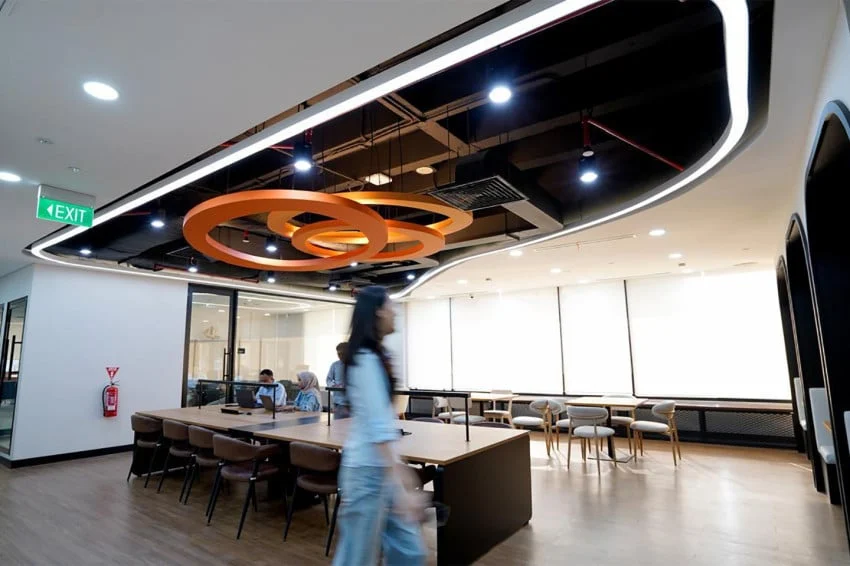
Marking a significant milestone in its more than a decade-long journey in the Indonesian archipelago, Hanwha Life, one of the premier life insurance giants originating from South Korea, has officially inaugurated its new corporate headquarters. Located strategically on the 9th floor of World Trade Center (WTC) 1 in Sudirman, Central Jakarta, the newly established office features a state-of-the-art Social Hub designed to foster cross-departmental collaboration, innovation, and dynamic teamwork. This infrastructural upgrade reflects the company’s broader ambition to consolidate its presence in Southeast Asia’s largest economy, where it has successfully served over one million policyholders.
The unveiling of the modern office space serves as a physical manifestation of a deeper corporate evolution. As Hanwha Life looks toward the future, the firm is doubling down on strengthening its business fundamentals, optimizing operational efficiency, and elevating product and service standards for Indonesian consumers. This strategic pivot comes at a time when the Indonesian life insurance sector is experiencing complex regulatory shifts, changing consumer demands driven by digital transformation, and an increasingly competitive landscape populated by both domestic and international heavyweights.
Navigating Financial Trajectory and Premium Revenue Growth
A closer examination of Hanwha Life’s financial reports reveals a consistent upward trajectory, reinforcing the management’s optimistic outlook for the coming years. In the fiscal year 2025, the company posted a notable premium revenue of IDR 295.15 billion, translating into a robust 16.7% growth compared to the IDR 252.95 billion recorded in 2024. Building upon this momentum, the corporate leadership has set an ambitious target to scale its premium revenue to IDR 322.80 billion by the close of 2026.
This aggressive yet calculated expansion strategy is already bearing fruit. According to financial disclosures for the first half of 2026, Hanwha Life registered a premium revenue of IDR 172.29 billion. This figure represents an impressive 18.85% year-on-year increase compared to the IDR 144.96 billion achieved during the corresponding period in 2025. More importantly, this mid-term performance indicates that the company has already fulfilled approximately 53% of its total premium revenue target for the entirety of 2026, putting it well ahead of schedule to meet its annual financial projections.
Kim Si Jun, Chief Financial Officer (CFO) of Hanwha Life Indonesia, emphasized that the deliberate pivot toward sustainable financial practices has been the primary catalyst for these results. "This year, Hanwha Life is fundamentally focused on a sustainable growth strategy. That focus has already yielded concrete results. Up to the first semester of 2026, we have successfully captured robust growth, putting us in a strong position to comfortably achieve our broader financial milestones for the year," stated Kim Si Jun.
Robust Solvency and Asset Expansion Amid Regulatory Excellence
Underpinning this revenue growth is an exceptionally strong balance sheet and stringent risk management frameworks. Hanwha Life’s total asset portfolio has demonstrated steady appreciation. In 2025, the company closed the fiscal year with total assets amounting to IDR 2.14 trillion. By the end of the first semester of 2026, this figure expanded further to reach IDR 2.19 trillion, showcasing the firm’s capacity to accumulate capital and effectively manage its investment portfolios.
Perhaps the most striking indicator of Hanwha Life’s financial health is its Risk-Based Capital (RBC) ratio. In the insurance sector, the RBC ratio serves as the ultimate litmus test for a company’s financial solvency and its ability to absorb unexpected economic shocks or catastrophic claims. While the Indonesian Financial Services Authority (Otoritas Jasa Keuangan or OJK) mandates a strict minimum threshold of 120% for insurance companies operating within the country, Hanwha Life has consistently outperformed this benchmark by an astronomical margin.
In 2025, the company maintained an RBC ratio of 1,241.32%. Demonstrating even greater capital strength, Hanwha Life’s RBC ratio surged to an extraordinary 1,958.03% by the close of the first semester of 2026. This towering solvency margin provides an ironclad guarantee to the company’s policyholders, ensuring that Hanwha Life possesses more than adequate capital reserves to honor all long-term financial commitments under any foreseeable macroeconomic scenario.
This disciplined approach to asset-liability management, corporate governance, and regulatory adherence has not gone unnoticed by independent evaluators. Over the course of 2026, Hanwha Life added several prestigious accolades to its corporate trophy case. On May 22, 2026, the company was honored with the Indonesia Regulatory Compliance Award 2026, validating its strict alignment with local financial laws and statutory frameworks. Shortly thereafter, on June 30, 2026, Hanwha Life received the Indonesia Excellence GCG Awards 2026, cementing its reputation as a benchmark for Good Corporate Governance (GCG) within the domestic financial services industry.
Chronology of Strategic Expansion and Technological Integration
Hanwha Life’s journey in Indonesia has been characterized by steady, methodical expansion punctuated by strategic technological and operational milestones. Entering the Indonesian market over a decade ago, the company initially focused on establishing a solid foothold in major metropolitan areas, gradually expanding its agency network and forging bancassurance partnerships to capture a diverse customer base.
Over the years, the management recognized that traditional insurance models alone would be insufficient to capture the tech-savvy younger demographic and meet the demands of an increasingly digitized economy. Consequently, the company initiated a multi-phased digital transformation program. This digital overhaul was dramatically highlighted by the recent introduction of advanced technological solutions, notably the integration of artificial intelligence into customer service and advisory workflows.
By introducing cutting-edge innovations such as AI-powered financial advisory tools, Hanwha Life positioned itself at the forefront of insurtech adoption in Indonesia. These digital tools are designed to assist human agents in providing more accurate, personalized, and swift financial planning services to clients, thereby optimizing the conversion funnel and enhancing overall policyholder satisfaction.
The culmination of this technological integration, paired with rigorous structural reforms, set the stage for the recent physical expansion. The relocation of the corporate headquarters to WTC 1 Sudirman and the unveiling of the collaborative Social Hub in mid-2026 mark the transition into a new era. This physical workspace redesign is intentionally aligned with hybrid working models and cross-functional synergy, ensuring that internal teams can collaborate more effectively to support the expanding agent network and millions of insured individuals across the archipelago.
Broader Industry Implications and Market Outlook
Hanwha Life’s strong performance and strategic maneuvers carry significant implications for the broader Indonesian insurance landscape. As the nation continues to navigate global economic uncertainties, currency fluctuations, and shifting consumer sentiment, the life insurance sector has faced considerable pressure to modernize, recapitalize, and restore public trust following historical governance issues among select industry players.
In this context, Hanwha Life’s soaring RBC ratio of nearly 2,000% serves as a powerful signal to the market. It demonstrates that foreign-backed institutional players with disciplined underwriting standards, rigorous risk management protocols, and substantial financial backing from parent conglomerates can thrive and maintain exceptional solvency margins even in complex emerging markets. This stability helps elevate consumer confidence in the life insurance sector as a whole, encouraging higher penetration rates in a country where insurance literacy and penetration traditionally lag behind regional peers.
Furthermore, the company’s emphasis on sustainable growth—balancing aggressive top-line premium expansion with strict bottom-line discipline and compliance—offers a blueprint for other market participants. Rather than chasing short-term volume through high-risk products, Hanwha Life has chosen to optimize its business portfolio, adhere strictly to regulatory compliance, and invest heavily in human capital and technological infrastructure.
Looking ahead to the remainder of 2026 and beyond, the roadmap for Hanwha Life Indonesia appears firmly established. With over 53% of its annual premium revenue target already secured by the end of the first semester, the firm is well-positioned to meet or exceed its full-year projection of IDR 322.80 billion. The combination of a world-class collaborative workspace at WTC Sudirman, an empowered workforce utilizing AI-driven tools, an unassailable capital buffer, and a clear commitment to sustainable business practices ensures that Hanwha Life will remain a formidable pillar of Indonesia’s financial services ecosystem for decades to come.