
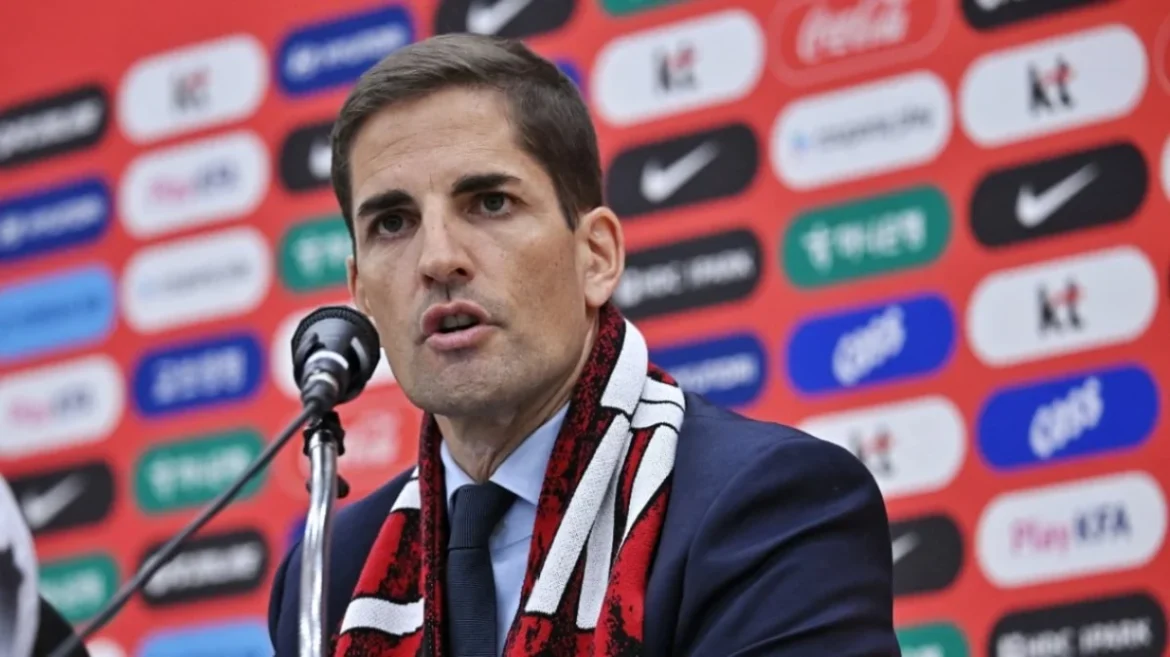
The landscape of modern professional football has increasingly embraced data analytics, algorithmic modeling, and advanced technological frameworks, yet the fundamental boundary between human tactical intuition and machine assistance remains a subject of intense scrutiny. This tension took center stage on Monday, September 14, 2026, during the inaugural press conference of Robert Moreno as the newly appointed head coach of the South Korean national football team. Facing immediate inquiries regarding his historical reliance on artificial intelligence—specifically generative models like ChatGPT during his managerial tenure with Russian club FC Sochi—the Spanish tactician offered a firm denial. Moreno asserted that media narratives surrounding his technological methodologies had been severely distorted, taken entirely out of context, and blown out of proportion.
The controversy, which has followed the 48-year-old manager across international borders, threatens to cast a shadow over his arrival in Seoul. However, Moreno’s primary mandate extends far beyond dispelling past rumors. Tasked with steering the Taegeuk Warriors through a critical transitional phase following a disappointing World Cup campaign, the former Spain national team coach must quickly consolidate a fractured locker room, restore public trust in the Korea Football Association (KFA), and prepare a star-studded squad for upcoming international fixtures and the looming horizon of the 2027 AFC Asian Cup in Saudi Arabia.
Origins of the Artificial Intelligence Controversy in Russian Football
The genesis of the artificial intelligence controversy dates back to Moreno’s tenure with Russian Premier League side FC Sochi, a stint that concluded in September 2025. During his time in Russia, reports surfaced across European and domestic sports media outlets alleging that the Spanish coach integrated artificial intelligence tools, including OpenAI’s ChatGPT, into his weekly tactical preparations, opponent analyses, and even player evaluation processes.
In an era where clubs routinely employ data scientists and proprietary algorithms to track physical loads and tactical positioning, the prospect of a high-profile manager outsourcing decisions to a consumer-grade generative language model sparked widespread debate. Critics questioned the professional rigor of utilizing such tools in high-stakes professional sports, while detractors framed the approach as a gimmick rather than an innovation.
Speaking to journalists in Seoul on Monday, September 14, 2026, Moreno addressed the reports head-on, dismissing them as inaccurate sensationalism.
"The news report was completely false and it went viral," Moreno stated during the press conference, as reported by AFP.
The manager elaborated that while technology inherently forms a vital component of a modern coaching staff’s arsenal—ranging from performance tracking software to video analysis databases—his tactical decisions were never generated by artificial intelligence. He maintained that anyone willing to invest even a modest amount of time investigating the original context would recognize that his statements and actions had been misconstrued.
Despite his efforts to put the matter to rest, the incident highlights a broader cultural anxiety within professional athletics: the uneasy coexistence of traditional human leadership and rapidly evolving technological automation. For Moreno, leaving the Russian club marked the end of a challenging chapter, but the digital footprint of the AI narrative proved resilient enough to cross over into his Asian football unveiling.
The Crisis at the Korea Football Association and the World Cup Fallout
Moreno’s arrival in South Korea occurs against a backdrop of institutional turbulence and sporting disappointment. The South Korean national team entered the managerial market following a tumultuous campaign at the 2026 FIFA World Cup. Despite boasting a roster laden with elite international talent, the Taegeuk Warriors suffered a premature elimination in the tournament’s group stage—a result that fell well short of domestic expectations and historical precedents.
The failure in North America served as the breaking point for Hong Myung-bo, who had been serving as the national team head coach. Hong’s departure did little, however, to quell the underlying discontent directed at the Korea Football Association (KFA). The governing body had already faced intense public scrutiny and administrative criticism surrounding the opaque and controversial process that led to Hong’s appointment in 2024. Fans and pundits alike expressed exhaustion with recurring administrative missteps, a lack of transparency in leadership appointments, and a perceived stagnation in the national program’s strategic direction.
Recognizing the urgent need to stabilize the national team and appease an increasingly vocal fan base, the KFA turned to the European managerial market. The association offered Moreno a short-term contract running through November 27, 2026. Crucially, the agreement includes a performance-based mechanism that could see Moreno’s tenure extended through the 2027 AFC Asian Cup in Saudi Arabia, contingent upon favorable evaluations of his initial matches.
By appointing Moreno, the KFA has historic precedent on its side, making him the very first Spanish manager to assume leadership of the South Korean national team. This bold administrative pivot signals a departure from traditional domestic coaching circles and a willingness to import continental European tactical philosophies in a bid to revitalize the squad.
A Distinguished European Pedigree and Tactical Background
To understand the scope of Robert Moreno’s appointment, one must examine a coaching career that bridges elite assistant roles and demanding managerial posts. Born in Barcelona, Spain, Moreno did not enjoy a prominent professional playing career, choosing instead to enter the coaching sphere through the analytical and tactical route.
His breakthrough in professional football came as a trusted tactical analyst and assistant coach working alongside Luis Enrique. Moreno served as an indispensable member of Enrique’s technical staff during highly successful stints at AS Roma, Celta Vigo, and FC Barcelona, where the Catalan club secured multiple domestic and international honors, including the UEFA Champions League. When Enrique assumed control of the Spanish national team, Moreno accompanied him as assistant manager.
In a dramatic turn of events in 2019, Moreno stepped into the role of head coach of La Roja after Enrique temporarily stepped down due to personal family matters. Moreno successfully guided Spain through their UEFA Euro 2020 qualifying campaign, securing qualification undefeated. However, his tenure ended controversially when Enrique returned to reclaim the position, leading to a public falling out between the two longtime colleagues.
Following his departure from the Spanish national team, Moreno sought independent managerial experience at club level. He took charge of French Ligue 1 side AS Monaco during the 2019–2020 season, navigating a difficult transitional period for the principality club. He later managed Spanish Segunda División club Granada before taking on the adventurous challenge in Russia with FC Sochi in late 2023.
This diverse resume—spanning elite European club football, international qualification pressure, and challenging reclamation projects abroad—provided the KFA with the institutional confidence that Moreno possesses the tactical acumen and psychological resilience required to manage a high-pressure national team environment.
Squad Architecture: Son Heung-min, Kim Min-jae, and Tactical Flexibility
One of Moreno’s immediate tasks upon taking charge was the curation and deployment of his inaugural national team roster. Despite the turbulence surrounding the federation and the coaching transition, the core foundation of the South Korean squad remains formidable, anchored by several world-class operators plying their trade in top global leagues.
In assembling his first squad, Moreno demonstrated an immediate commitment to leveraging the team’s established leadership core. Most notably, he retained veteran forward and national team captain Son Heung-min. Following a high-profile move to Major League Soccer side Los Angeles FC, questions had occasionally been raised regarding Son’s long-term physical management and international utility. Moreno quickly dispelled any doubts, making it clear that the 34-year-old attacker remains central to his sporting project, alongside defensive rock Kim Min-jae of Bayern Munich and creative midfielder Lee Kang-in of Paris Saint-Germain.
In discussing his tactical plans for the captain, Moreno emphasized the importance of positional fluidity. Rather than locking Son into a rigid, static role on the left wing or as a central striker, the Spanish coach intends to utilize the veteran forward’s extensive tactical intelligence and versatility across multiple attacking configurations.
"Son’s flexibility is a massive advantage for South Korea," Moreno noted in subsequent remarks following his introductory press conference. "We cannot and will not limit a player of his caliber to a single, predictable zone on the pitch. His ability to interpret space, link play, and finish chances makes him invaluable across various tactical phases."
This pragmatic approach signals that Moreno intends to build his tactical framework around the existing strengths of his players rather than forcing a rigid system onto a squad that has little time to adapt before upcoming competitive fixtures.
Implications and Outlook for South Korean Football
The implications of Robert Moreno’s appointment extend far beyond the immediate horizon of autumn friendlies. Korean football is at a crucial crossroads. The domestic talent pool has arguably never been stronger in terms of technical quality and international exposure, yet structural inefficiencies and administrative friction have frequently hampered the national team’s ability to convert potential into silverware.
For the KFA, hiring a foreign coach with Moreno’s analytical background and tactical pedigree is a calculated gamble. If Moreno can successfully implement a cohesive, modern playing style, optimize the output of veterans like Son Heung-min alongside rising domestic and European-based talents, and steer the team successfully through the autumn international window, he will secure a long-term contract leading directly into the 2027 AFC Asian Cup. A strong performance in Saudi Arabia would represent a vital step toward healing the rift between the governing body and the passionate fanbase.
Conversely, any early missteps—amplified by the inevitable media scrutiny surrounding his past controversies and the lingering frustration over the federation’s governance—could swiftly shorten his tenure. Moreno’s dismissal of the artificial intelligence controversy was a necessary first step in clearing the air, but the ultimate verdict on his managerial competency will be delivered on the pitch.
As the Taegeuk Warriors prepare for their upcoming international fixtures under their new Spanish mentor, the footballing world will be watching closely to see whether data-informed pragmatism and tactical flexibility can successfully guide South Korea into a new, stable era of international competitiveness.
