
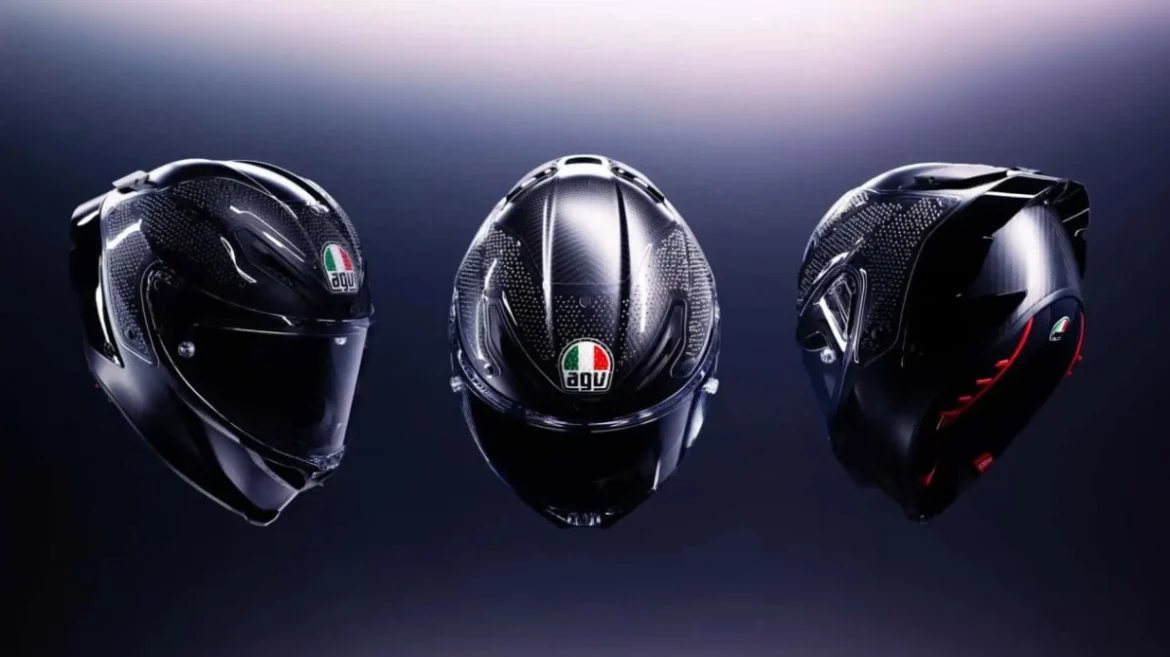
The global motorsport safety landscape has taken a monumental leap forward as legendary Italian helmet manufacturer AGV officially unveiled its latest flagship racing helmet, the Pista GP R3. Debuting at the high-stakes MotoGP San Marino Grand Prix held at the Misano World Circuit Marco Simoncelli, this cutting-edge headgear represents the pinnacle of protective engineering, blending state-of-the-art biomechanical research with decades of racetrack-proven expertise. The helmet made its competitive global debut on September 11, 2026, during the opening free practice sessions, immediately drawing intense scrutiny and praise from riders, teams, and safety analysts alike.
Serving as the direct and much-anticipated successor to the illustrious Pista GP RR—a model that has dominated premier-class motorcycle racing for several years—the new Pista GP R3 is far more than a mere cosmetic update. While retaining the sleek, aggressive silhouette that has become synonymous with AGV dominance, the R3 introduces groundbreaking structural and technological philosophies designed to mitigate one of the most perilous hazards in modern motorcycle racing: rotational acceleration forces during oblique impacts.
The Genesis of Pista GP R3 at the Misano Circuit
The timing of the launch at the San Marino Grand Prix was far from incidental. Misano serves as an ideal crucible for testing top-tier racing equipment, offering a demanding layout characterized by heavy braking zones, high-speed sweeping corners, and punishing asphalt temperatures. AGV utilized this premier stage to transition the Pista GP R3 from closed-door laboratory testing directly into the unforgiving environment of Grand Prix competition.
From the first practice session on September 11, 2026, contracted AGV riders across multiple classes—including premier MotoGP stars Marco Bezzecchi and Franco Morbidelli, alongside competitors in Moto2 and Moto3—trusted their safety to the new helmet. This synchronized rollout across multiple tiers of World Championship racing underscores AGV’s commitment to gathering comprehensive telemetry and real-world rider feedback across varying speeds, crash dynamics, and racing conditions.
The introduction at Misano marks a crucial phase in AGV’s product lifecycle strategy. By vetting the helmet under the extreme thermal, aerodynamic, and physical stresses of Grand Prix racing, the manufacturer ensures that the technologies perfected on the track are thoroughly validated before eventually trickling down to commercial consumer lineups available to everyday riders worldwide.
Revolutionizing Impact Management: AGV Sphera and the Release Layer System (RLS)
At the heart of the Pista GP R3’s unprecedented safety architecture is the introduction of AGV Sphera, featuring the proprietary Release Layer System (RLS). While traditional racing helmets have excelled at handling linear impacts—the direct, straight-line forces perpendicular to a surface—accident data and biomechanical research increasingly highlight rotational kinetic energy as the primary culprit behind severe traumatic brain injuries, concussions, and diffuse axonal injuries during motorcycle crashes.
The RLS addresses this critical vulnerability through a sophisticated mechanical design involving a multi-directional movable outer panel system. When a rider experiences an oblique impact—where the helmet strikes the ground or an obstacle at an angle rather than head-on—the outer layers of the Pista GP R3 are engineered to react dynamically.

Instead of remaining rigid, the specialized exterior panels can shift and glide across multiple vectors in fractions of a millisecond. This controlled displacement absorbs and redirects the rotational forces acting upon the helmet. Furthermore, under specific high-stress threshold conditions, the outer system is designed to deliberately release or shed energy, preventing the rotational torque from translating directly into the rider’s skull, cervical spine, and brain.
Rigorous Laboratory Validation and Biomechanical Metrics
The engineering prowess behind the Pista GP R3 is backed by extensive, peer-reviewed empirical testing. AGV partnered with the prestigious Aragon Institute for Engineering Research at the University of Zaragoza to subject the new helmet to hyper-realistic crash simulations and drop-test protocols.
According to data released by AGV following these rigorous laboratory trials, the implementation of the RLS technology within the Pista GP R3 yields a staggering reduction in concussion risk—up to six times lower compared to previous-generation benchmark helmets. To quantify these safety gains, researchers utilized the advanced Brain Injury Criterion (BrIC) metric, an industry-standard predictive measurement specifically designed to estimate the probability of Abbreviated Injury Scale (AIS2+) concussions resulting from rotational head accelerations.
The empirical results stunned even seasoned safety engineers. By effectively decoupling the initial impact force from the head’s rotational vector, the Pista GP R3 drastically lowers the BrIC score, pointing toward a future where catastrophic head trauma in high-speed motorsport accidents can be significantly minimized.
Evolution of Carbon Architecture, Aerodynamics, and Ergonomics
Beyond the revolutionary RLS technology, the Pista GP R3 boasts a comprehensive redesign of its foundational physical structure. The helmet’s outer shell is forged from 100 percent aerospace-grade carbon fiber, offering an optimal balance between featherlight weight and immense tensile strength. This material choice ensures that while the helmet incorporates complex mechanical layers for the RLS, it remains exceptionally light, thereby reducing neck fatigue for riders enduring grueling 45-minute Grand Prix races.
AGV’s aerodynamic department also went back to the drawing board. Utilizing extensive computational fluid dynamics (CFD) simulations and wind-tunnel testing, the exterior profile of the R3 was optimized to reduce drag at speeds exceeding 350 kilometers per hour. The aerodynamic spoiler at the rear has been re-contoured to enhance stability, eliminating buffeting and aerodynamic lift when riders tuck completely behind their motorcycle fairings down the straights of Misano.
Ventilation and interior comfort have similarly undergone a generational overhaul. The internal EPS (expanded polystyrene) liner features customized density zoning and redesigned internal air channels that force high-pressure air through the helmet, cooling the rider’s scalp even under sweltering Mediterranean racing conditions. The moisture-wicking interior lining uses premium, hypoallergenic fabrics with a micro-adjustable fit system, ensuring that the helmet remains securely and comfortably contoured to the rider’s unique cranial structure.
Rider Reception and Paddock Feedback

The immediate adoption of the Pista GP R3 by frontline factory and satellite riders served as a resounding endorsement of AGV’s engineering achievements. Marco Bezzecchi, known for his aggressive riding style and high-commitment cornering, expressed immense confidence upon trying the new helmet during practice sessions.
"From the moment you put it on, you notice the refined aerodynamics and how light it feels, especially when transitioning quickly from side to side through the chicanes," industry insiders noted from paddock interviews. "Knowing that there is an extra layer of scientific protection addressing rotational forces gives you that extra margin of psychological comfort when you are pushing the limit on the edge of adhesion."
Similarly, veteran contender Franco Morbidelli emphasized the seamless transition from the Pista GP RR to the new R3 model. Morbidelli noted that despite the introduction of complex internal mechanical layers for the RLS, the helmet maintained the familiar, uncompromising field of vision and precise peripheral clarity essential for reading braking markers and monitoring nearby competitors at 300 km/h.
Broader Implications for the Motorcycle Industry
The launch of the AGV Pista GP R3 at the 2026 San Marino Grand Prix is much more than a routine product update for a premier Italian brand; it represents a watershed moment for the entire motorcycle helmet industry.
For decades, helmet safety standards—such as ECE 22.06, DOT, and Snell—have steadily evolved, but the integration of advanced rotational management systems has primarily been pioneered by a handful of forward-thinking manufacturers. By introducing the Release Layer System (RLS) and publicly releasing empirical BrIC testing data demonstrating a sixfold decrease in concussion risks, AGV has effectively raised the bar for competitive homologation requirements.
The implications of this technological leap extend far beyond the elite confines of MotoGP. Historically, innovations first validated in Grand Prix racing inevitably find their way into consumer-grade street helmets within three to five years. As manufacturing processes scale and the RLS technology matures, everyday motorcyclists—from daily commuters to weekend canyon carvers—will reap the safety dividends of AGV’s research at Misano.
As the 2026 MotoGP season progresses toward its climax, all eyes will remain fixed on the performance of the Pista GP R3 under real-world racing duels. With safety having evolved from a secondary consideration into the absolute cornerstone of modern motorsport engineering, AGV’s latest masterpiece has firmly established a new benchmark for how the human head is protected in the thrilling, dangerous world of professional motorcycle racing.
