
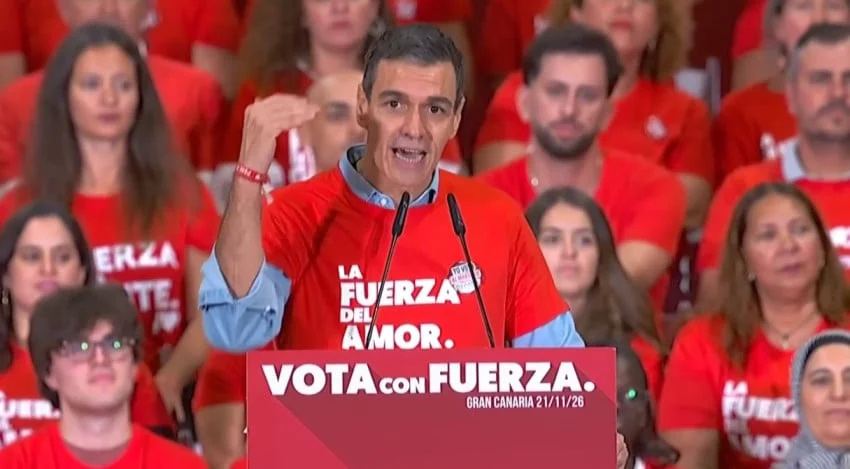
In a significant political maneuver ahead of the upcoming snap general elections, Spanish Prime Minister Pedro Sanchez has pledged to overhaul the nation’s defense legislation to explicitly prohibit the country’s involvement in any military conflicts deemed illegal under international law. Speaking to a fervent crowd of supporters in Barcelona, the leader of the Spanish Socialist Workers’ Party (PSOE) emphasized that his administration aims to codify a "no-war" doctrine, drawing sharp lines between defensive alliances and what he characterizes as interventionist, unauthorized military operations.
The announcement serves as a pivotal campaign platform, positioning Sanchez as a staunch defender of international humanitarian law. During his address, he drew direct parallels between current global flashpoints—specifically the ongoing conflicts in Gaza and the heightened tensions between Israel and Iran—and the 2003 U.S.-led invasion of Iraq. By framing these contemporary events as violations of the global order, Sanchez seeks to galvanize his base and appeal to a public that has historically expressed deep skepticism regarding overseas military deployments.
The Historical Context: The Iraq Precedent
To understand the gravity of Sanchez’s proposal, one must revisit Spain’s geopolitical trajectory over the last two decades. In 2003, the administration of then-Prime Minister Jose Maria Aznar committed Spanish troops to support the U.S.-led coalition in Iraq. The decision was deeply unpopular, sparking massive street protests across Spain and becoming a defining issue in the 2004 general election, which saw the defeat of Aznar’s People’s Party (PP) shortly after the Madrid train bombings.
For many Spaniards, the 2003 invasion remains a trauma of modern diplomacy. Sanchez’s proposal to "legally insulate" Spain from similar future entanglements is a calculated attempt to reassure voters that the executive branch will be constrained by stricter legal checks, preventing the unilateral decision-making that characterized the Iraq era. By invoking this memory, Sanchez is effectively signaling a departure from the traditional interventionist foreign policy that has often tied European security strategies to Washington’s regional priorities.
Legislative Overhaul and International Law
The core of Sanchez’s proposal involves a revision of the Organic Law of National Defense. Currently, the Spanish government has significant executive latitude to deploy military forces, provided they receive parliamentary authorization. However, the proposed amendments would introduce a qualitative threshold: the legality of the conflict under the United Nations Charter and international humanitarian law.
Legal analysts note that such a move is unprecedented in modern European parliamentary democracies. While most nations operate under the premise that their military actions are "legal," formally embedding this into domestic law would empower the Spanish judiciary and parliament to scrutinize the legal foundations of any proposed military mission. If enacted, this would mandate a rigorous legal review by the State Council or a dedicated parliamentary committee before any deployment, potentially slowing down Spain’s response time in crisis scenarios but significantly increasing the political and legal legitimacy of its actions.
Criticism of Current Geopolitics
Sanchez’s rhetoric in Barcelona was notably pointed, particularly regarding the Middle East. He explicitly criticized Israeli Prime Minister Benjamin Netanyahu, characterizing the actions in Gaza as disproportionate and challenging the legality of the escalating tensions between Israel and Iran.
"In the coming legislative term, we will revise the legislation so that Spain will never be involved in illegal wars—like the ones we experienced 20 years ago in Iraq, or those we are witnessing now in Iran," Sanchez declared.
This statement has resonated with a segment of the European electorate that feels disillusioned by what they perceive as a "double standard" in Western foreign policy. By taking this stance, Sanchez is also positioning Spain as a mediator and a moral voice within the European Union, a strategy he has consistently employed throughout his tenure, such as his vocal support for the recognition of a Palestinian state—a move that has drawn both praise from the Global South and diplomatic friction with Tel Aviv.

Implications for NATO and EU Alliances
The proposal naturally raises questions regarding Spain’s commitments to NATO. As a founding member of the alliance, Spain is bound by Article 5, which mandates collective defense in the event of an attack on a member state. Critics of Sanchez’s plan argue that "legality" is often a subjective interpretation in international conflict, and that rigid domestic laws could hamper Spain’s ability to act in concert with its allies.
However, supporters of the initiative argue that the law would apply specifically to offensive or interventionist wars—missions that fall outside the immediate scope of NATO’s collective defense mandate. The challenge for the Sanchez administration will be drafting language that satisfies the stringent requirement of international law without creating a constitutional crisis regarding treaty obligations.
The Spanish Ministry of Defense has yet to release a draft of the proposed changes, but officials suggest that the bill will include:
- Mandatory Legal Briefings: A requirement for the government to present a formal opinion from the Attorney General’s office regarding the legality of any military deployment before a vote in the Congress of Deputies.
- Parliamentary Oversight: Increased authority for the defense committee to veto deployments that do not align with UN Security Council mandates.
- Human Rights Compliance: A clause ensuring that any military participation must be pre-conditioned on the recipient or allied forces adhering to strict human rights standards.
Domestic Political Landscape
The timing of this announcement is not accidental. With the snap elections approaching, the issue of foreign policy has become a surrogate for deeper domestic divisions. The right-wing opposition has criticized the move as "populist posturing," arguing that it undermines Spain’s reliability as a partner in international security frameworks. Conversely, the left-wing coalition partners of the PSOE have welcomed the proposal, viewing it as a long-overdue rectification of Spain’s past diplomatic errors.
Polling data indicates that the Spanish public is increasingly weary of foreign military involvement. The economic pressures at home, coupled with a desire to see resources invested in domestic social services, have made "peace-focused" platforms particularly attractive. Sanchez’s ability to pivot from domestic economic concerns to high-stakes foreign policy rhetoric suggests he is confident in his ability to frame the election as a choice between "adventurism" and "responsible internationalism."
Global Reactions and Diplomatic Ripple Effects
The international community has reacted with a mix of caution and observation. Within the European Union, where there is a push for increased "strategic autonomy," some member states may view Spain’s move as a potential template for strengthening parliamentary control over defense. Others, particularly those on the eastern flank of the EU who feel threatened by regional instability, may fear that such legislation could lead to "decision paralysis" within the bloc.
In the United States, the Biden administration has remained officially silent, but diplomatic circles acknowledge that a more constrained Spain could change the dynamics of joint operations. If Spain demands a higher threshold of legal verification for its participation in international missions, it may create a precedent that other European nations could adopt, potentially changing how NATO conducts "out-of-area" operations in the future.
Looking Ahead
The path to passing this legislation is fraught with challenges. Even if Sanchez retains power, he will likely face a fractured parliament, requiring delicate negotiations to secure the necessary votes for such a significant legal change. Furthermore, the constitutional validity of restricting the executive’s power in national security will likely be tested by the judiciary.
Nevertheless, the discourse initiated by the Prime Minister in Barcelona represents a shift in how mid-sized powers perceive their role in the global order. By seeking to tie the hands of the state against the "temptation" of illegal war, Spain is signaling that it intends to play a role defined by multilateralism and strict adherence to the rule of law rather than one of reflexive alignment with global powers.
As the election draws closer, the "no-war" pledge will remain a focal point of the national conversation. Whether it becomes a cornerstone of a new security policy or remains a campaign promise will depend on the strength of the mandate Sanchez receives at the ballot box. One thing is clear: the debate over the legal limits of war has been moved to the center of Spanish politics, and the outcome will reverberate far beyond the borders of the Iberian Peninsula.
