
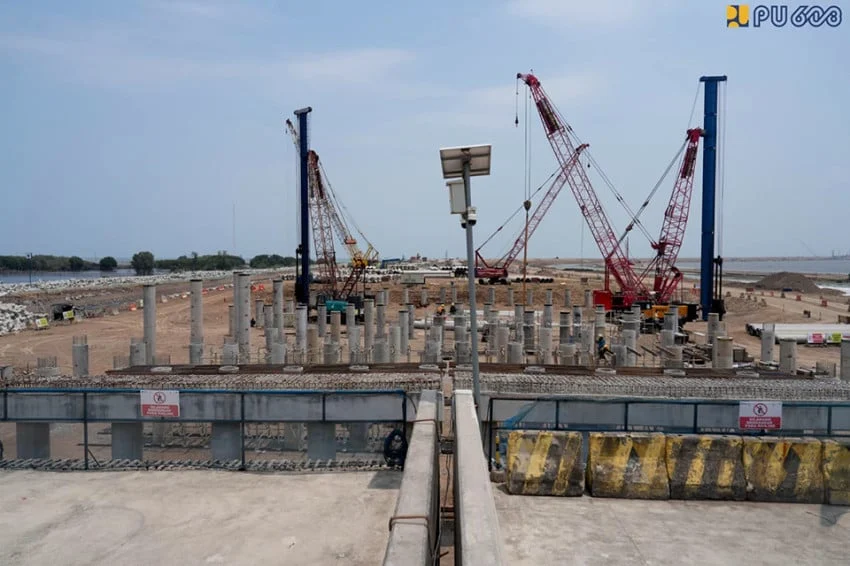
The construction of the Semarang-Demak Toll Road Section 1, specifically the segment connecting Kaligawe to Sayung, has reached a significant milestone with progress recorded at 79.42% as of October 22, 2026. This vital infrastructure project, which integrates a high-capacity toll road with a coastal sea dike system, remains a cornerstone of the Indonesian government’s strategy to mitigate chronic flooding in the northern coastal areas of Central Java while simultaneously enhancing regional logistics connectivity. The Ministry of Public Works (PU) has reaffirmed its commitment to completing the entire project by the end of 2027, marking a pivotal moment in the development of the Trans-Java Toll Road network.
Strategic Importance of the Semarang-Demak Toll Road
The Semarang-Demak Toll Road is not merely a transport link; it is a multi-functional infrastructure asset designed to address the dual challenges of economic connectivity and climate resilience. The project serves as a critical flood control mechanism. The northern coast of Semarang has long suffered from tidal flooding (rob) and land subsidence, which frequently paralyze the primary arterial road, Jalan Kaligawe. By integrating the toll road with a sea dike, the project functions as a barrier against rising sea levels, effectively shielding the hinterland from seawater inundation while allowing for the free flow of goods between Semarang—the provincial capital—and the industrial hubs of Demak.
The project encompasses a total length of approximately 26.7 kilometers, divided into two distinct sections. Section 1 (Kaligawe-Sayung) is the most technically complex, involving extensive soil stabilization and the construction of a sea wall. Section 2 (Sayung-Demak) has already been operational, serving as a testament to the utility of the corridor for heavy logistics vehicles and commuters alike.
Chronology and Project Evolution
The development of the Semarang-Demak Toll Road has been a multi-year endeavor marked by rigorous engineering challenges. Since the commencement of the project, the government has navigated complex land acquisition issues and the necessity of geological consolidation.
- Initial Planning (2018-2019): Feasibility studies identified the necessity of a combined toll road and dike system to address the urgent environmental threats posed by tidal flooding.
- Commencement (2020-2021): Construction activities began, prioritizing the land-based sections.
- Operational Milestone (2023): The successful completion and inauguration of Section 2 provided immediate relief to traffic congestion on the existing national highway.
- Current Phase (2024-2026): Focus shifted heavily to the challenging offshore and coastal segments of Section 1. The use of advanced ground improvement techniques, such as vertical drains and vacuum consolidation, became essential due to the soft soil characteristics of the coastal region.
- Target Completion (2027): With current progress at nearly 80%, the Ministry of PU is currently focusing on final structural integration and the finishing of elevated segments.
Detailed Breakdown of Work Packages
The Ministry of Public Works has segmented the construction of Section 1 into three distinct packages, each requiring specific engineering expertise to manage the environmental volatility of the Java Sea coast.
- Package 1A (Kaligawe-Sayung): This is the most advanced segment, currently reporting a progress rate of 97.49%. This package covers the critical Kaligawe interchange and surrounding infrastructure. It includes the construction of the Kaligawe Bridge and sophisticated elevated structures that connect the toll road to the existing urban network. As this segment nears completion, the focus has shifted toward the installation of safety systems, lighting, and final paving.
- Package 1B: Progress on this segment stands at 75.22%. This package represents a critical link, ensuring the continuity of the elevated structure. Engineers have been working on the foundation and column construction to bridge the gap between the coastal embankments and the inland toll sections.
- Package 1C: With 75.68% completion, this package focuses on the integration of the sea dike with the toll road structure. The complexity of this package lies in the marine construction aspect, where the interaction between the structural integrity of the road and the hydraulic pressure of the sea requires precise engineering.
Official Perspectives and Technical Challenges
Minister of Public Works, Dody Hanggodo, emphasized during his visit to the site on October 24, 2026, that the project remains "on the track." Despite the complexities inherent in marine infrastructure, the synergy between the government, contractors, and local stakeholders has been exemplary.
"For the progress, we are at 79.4 percent. It is on the track. So far, the progress is good. All parties are providing full support, and there are no significant obstacles," Dody stated.
The Minister highlighted that the primary challenge for the remaining work is the consolidation of the soil. Coastal areas in Northern Java are prone to high levels of soil compressibility. Before the final asphalt layers can be applied, the soil must undergo rigorous consolidation to ensure that the road structure does not experience uneven settlement in the future. This requires patience and technical precision, as rushing this phase could lead to long-term maintenance issues.
Socio-Economic Implications for Central Java
The completion of the Semarang-Demak Toll Road is expected to catalyze a significant shift in the regional economy. Currently, the Kaligawe area is notorious for traffic congestion caused by the interplay of high traffic volume and frequent tidal flooding. The new toll road will effectively separate long-distance logistics traffic from local commuters, leading to significant time savings and reduced fuel consumption.
From an industrial perspective, the road provides a vital artery for the transport of goods from the Tanjung Emas Port in Semarang to industrial estates in Demak and beyond. Improved logistics efficiency is anticipated to lower operational costs for businesses, thereby increasing the competitiveness of Central Java as an investment destination.
Furthermore, the environmental impact of the sea dike cannot be overstated. By preventing tidal floods, the project will protect thousands of hectares of residential, commercial, and agricultural land. This serves as a model for "climate-adaptive infrastructure," where the government seeks to solve environmental problems while simultaneously fulfilling the need for modern transport facilities.
Analysis: Beyond the Asphalt
The project represents a shift in Indonesian infrastructure policy—moving away from simple road construction toward integrated development. The toll road is not just a path for vehicles; it is a protective barrier that enables the survival of coastal communities.
However, the project is not without its analytical considerations. The reliance on heavy engineering to combat rising sea levels is a long-term commitment. The government must ensure that the maintenance of the dike remains a priority in the post-construction phase. Additionally, the success of the Semarang-Demak project serves as a pilot for similar initiatives in other coastal cities in Indonesia facing similar threats of subsidence and flooding.
As the 2027 deadline approaches, the Ministry of Public Works will need to maintain its current momentum. The high percentage of completion in Package 1A serves as a positive indicator, but the final 20%—which often involves finishing works, utility integration, and safety certifications—will require as much focus as the initial structural phase.
Conclusion and Outlook
As of October 2026, the Semarang-Demak Toll Road Section 1 stands as a testament to Indonesia’s engineering capabilities and its proactive approach to disaster mitigation. With the project 79.42% complete, the transition from heavy construction to system integration is underway. If the current pace is maintained, the road will likely meet its 2027 target, providing a long-term solution to the persistent issues that have plagued the northern coast of Central Java. The successful delivery of this project will likely set a new standard for infrastructure development in the country, proving that complex, multi-purpose projects can be executed successfully through careful planning, robust engineering, and multi-stakeholder collaboration. The coming months will be critical as the project enters its final phases, with the public eagerly awaiting the opening of a corridor that promises to reshape the landscape of the Semarang-Demak region.
