
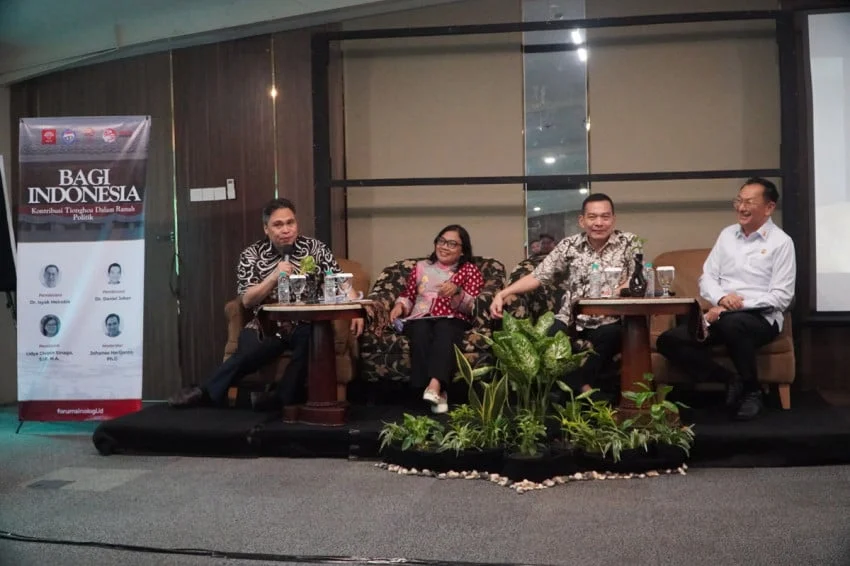
The landscape of Indonesian politics has undergone a profound transformation since the fall of the New Order regime, moving from an era of restricted identity to a vibrant period of inclusive participation. Recent public discourse, held in Jakarta and hosted by prominent organizations such as the Indonesian Chinese Association (INTI), the Indonesian Chinese Youth Association (IPTI), the Association of Indonesian Peranakan Chinese (Aspertina), and the Indonesian Sinology Forum (FSI), highlighted the shifting role of the Chinese Indonesian community. Scholars and political figures gathered to analyze how this demographic, once confined largely to the economic sector, has emerged as a vital pillar of the nation’s democratic framework.
Historical Context: From Economic Dominance to Political Exclusion
For three decades under President Suharto’s New Order regime, the Chinese Indonesian community occupied a unique and often precarious position in the national narrative. Official state policy, bolstered by regulations like Presidential Instruction No. 14 of 1967, effectively discouraged the public expression of Chinese cultural identity and limited the community’s participation in the formal political arena.
During this period, the stereotype of the "economically strong but politically weak" Chinese Indonesian became deeply entrenched. The regime favored a model where the community focused on business and trade, creating a socioeconomic dichotomy that shielded the government from political competition while simultaneously fostering social resentment. By the mid-1990s, this systemic exclusion, combined with economic disparity, contributed to significant social friction, culminating in the tragic unrest of 1998 that served as a turning point for the nation’s political structure.
The Reformasi Era: A Paradigm Shift in Identity
The advent of the Reformasi era in 1998 marked the beginning of a legislative and cultural dismantling of discriminatory policies. Key legal reforms, most notably under the administration of President Abdurrahman Wahid (Gus Dur), repealed the ban on the public celebration of Chinese traditions and restored the rights of the community to participate in national life.
This newfound freedom allowed for a gradual transition. As the democratic space expanded, Chinese Indonesians began to re-engage with the state, not merely as taxpayers or business owners, but as citizens with full political agency. The current era is characterized by an increasing number of Chinese Indonesians seeking public office, serving in political parties, and engaging in local and national governance. This shift is not merely numerical but represents a fundamental change in the community’s orientation toward the Indonesian state as their sole, undivided homeland.
Expert Analysis and Perspectives
The public discussion in Jakarta featured several high-profile voices who provided deep insight into this transition. Dr. Isyak Meirobie, a lecturer at Podomoro University and an Assistant to the Special Presidential Advisor for Communications, emphasized that the inclusion of Chinese Indonesians is an essential component of a healthy democracy. He argued that the current political involvement of the community is characterized by a "service-oriented" mindset, where political participation is viewed as a duty to the broader Indonesian public rather than a means to protect ethnic interests.
Dr. Daniel Johan, a member of the House of Representatives (DPR RI) from the National Awakening Party (PKB), echoed these sentiments. As a legislator, he noted that the barriers of the past have been replaced by a collaborative spirit. "The focus today is on the contribution to the nation," Johan stated. He pointed out that politicians from the Chinese Indonesian community are increasingly involved in drafting legislation that addresses national concerns—such as poverty alleviation, infrastructure, and education—rather than focusing on narrow, ethnic-centric issues.
Lidya Christin Sinaga, a researcher at the Research Center for Politics under the National Research and Innovation Agency (BRIN), provided a structural analysis of this change. According to Sinaga, the "loyalty question"—a lingering, unfounded stigma that has historically shadowed Chinese Indonesians—is being systematically dismantled by empirical evidence. She noted that when Chinese Indonesian politicians operate within mainstream political parties, they align their platforms with national ideology, thereby proving that ethnic background does not dictate political loyalty.
Supporting Data and Political Participation Trends
Statistical trends in the post-Reformasi era support the assertion of increased integration. Since the 2004 general elections, the number of candidates of Chinese descent running for local (DPRD) and national (DPR) parliamentary seats has steadily increased.
Data from the General Elections Commission (KPU) shows that political parties—including those with traditionalist or religious roots like the PKB—have increasingly welcomed candidates from diverse ethnic backgrounds. This is a significant deviation from the past, where such parties were once considered off-limits for non-indigenous candidates. The diversification of party candidate lists suggests a pragmatic and strategic shift within the Indonesian political elite, acknowledging that the future of the nation rests on inclusive representation.
Addressing the Stigma of Disloyalty
One of the most persistent, albeit baseless, narratives regarding the Chinese Indonesian community is the question of their loyalty to the Indonesian state. This trope has been used periodically by political actors to sow division. However, the panelists at the Jakarta discussion argued that the active, visible presence of Chinese Indonesians in the political, social, and charitable sectors makes this question increasingly obsolete.
From disaster relief efforts to community health initiatives and political advocacy, the actions of the community demonstrate a commitment to the "Pancasila" ideology. The discussion highlighted that the current generation of Chinese Indonesians is deeply rooted in the Indonesian educational system, culture, and social values, making the distinction between "indigenous" and "non-indigenous" increasingly irrelevant in the eyes of the younger generation of voters.
Broader Implications for Indonesian Democracy
The integration of Chinese Indonesians into the political fabric of the country has several positive implications for Indonesia’s future as a global democratic player:
- Strengthening Social Cohesion: By normalizing political participation across all ethnic groups, Indonesia reinforces its national motto, Bhinneka Tunggal Ika (Unity in Diversity).
- Economic Stability: As the community shifts from a purely economic focus to a balanced socio-political role, the perception of an "economic elite" is replaced by a more nuanced view of the community as a diverse group of professionals, workers, and leaders.
- Global Soft Power: A nation that successfully integrates its diverse ethnic populations presents a strong image to the international community. It demonstrates that Indonesia’s democracy is robust, inclusive, and capable of managing pluralism effectively.
Challenges Ahead
Despite the progress, the participants acknowledged that challenges remain. The rise of identity politics during election cycles can still trigger dormant prejudices. Furthermore, the need for continued civic education is paramount to ensure that the public understands the importance of merit-based political participation.
The consensus from the forum was clear: the narrative of the Chinese Indonesian community is no longer one of silent wealth or political invisibility. It is a story of active participation, shared responsibility, and an unshakeable commitment to the development of the Indonesian state.
Conclusion: A Future of Shared Governance
The transition from the constraints of the past to the inclusivity of the present is a testament to the resilience of Indonesia’s democratic project. As Chinese Indonesians continue to take their places in the legislative halls, ministerial offices, and political party structures, they are helping to define what it means to be a modern, democratic Indonesian.
The dialogue organized by INTI, IPTI, Aspertina, and FSI serves as a critical milestone in this journey. By bringing together scholars, policymakers, and community leaders, the event reaffirmed that the political future of Indonesia is not tied to the ethnic divisions of the past, but to the collective efforts of all its citizens. As the nation looks toward future election cycles, the continued integration of all ethnic components into the political process will remain a key indicator of Indonesia’s maturity as a diverse, democratic, and unified republic.
