
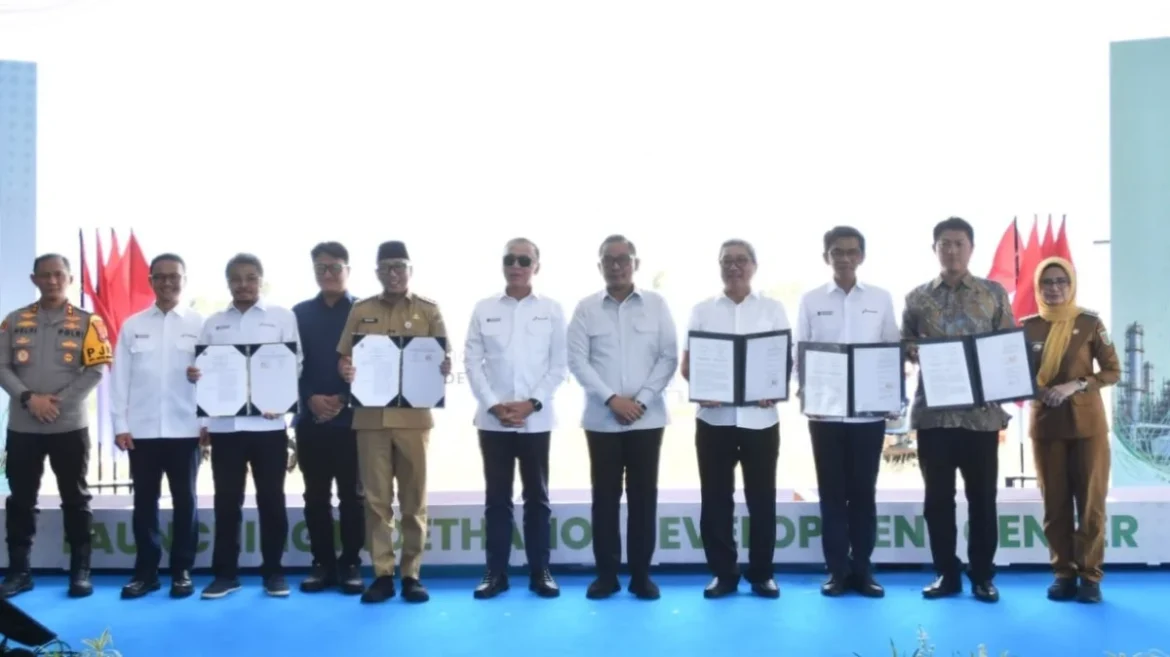
Jakarta, September 14, 2026 – In a decisive move toward achieving national energy security through sustainable green energy, Pertamina New & Renewable Energy (Pertamina NRE) officially inaugurated the Bioethanol Development Center on Monday, September 14, 2026. Situated in Tegineneng, Pesawaran Regency, Lampung Province, this state-of-the-art facility is designed to serve as a comprehensive operational hub for the nation’s growing bioethanol ecosystem. The inauguration marks a critical milestone in Indonesia’s ongoing energy transition roadmap, highlighting the strategic integration of domestic agricultural resources with cutting-edge clean energy technology.
The newly operational pilot facility is engineered to oversee and execute the entire lifecycle of bioethanol development. Its comprehensive scope encompasses precise feedstock selection, advanced cultivation methodologies, industrial production technology trials, and rigorous final product validation. By establishing a centralized foundation for research, development, and commercial testing, Pertamina NRE aims to streamline the commercialization of advanced biofuels, ensuring that future large-scale production facilities meet stringent global standards for quality, environmental sustainability, and economic viability.
Technological Innovation: Multi-Feedstock and Multi-Generation Approach
During the inauguration ceremony, Pertamina NRE President Director John Anis provided detailed insights into the engineering philosophy driving the new center. He emphasized that the facility operates on an innovative multi-feedstock and multi-generation technological framework. This advanced approach allows the center to process a diverse array of local agricultural inputs rather than relying on a single crop, thereby mitigating supply chain vulnerabilities caused by seasonal shifts or regional agricultural fluctuations.
Furthermore, the multi-generation capability enables the facility to seamlessly integrate and optimize both first-generation (1G) and second-generation (2G) bioethanol production processes. While 1G bioethanol typically utilizes food crops rich in starch and sugar, such as cassava and corn, 2G bioethanol expands the feedstock horizon to non-food biomass, agricultural residues, and lignocellulosic materials. By combining these methodologies under one roof, Pertamina NRE can maximize local resource utilization, minimize agricultural waste, and establish a highly efficient, scalable model for future commercial deployment across the Indonesian archipelago.
High-Profile Attendance and International Collaboration
The strategic significance of the facility’s commissioning drew a distinguished assembly of government officials, corporate executives, and international partners. Prominent figures in attendance included the Deputy Minister of Investment and Downstream Industry/Vice Chairman of the Investment Coordinating Board (BKPM), Todotua Pasaribu; PT Pertamina (Persero) President Commissioner Mochamad Iriawan; PT Pertamina (Persero) Risk Management Director Ahmad Siddik Badruddin; and Lampung Governor Rahmat Mirzani Djausal.
Signifying the international dimensions of Indonesia’s green energy strategy, top executives from key Japanese industrial partners were also present. These included PT Toyota Motor Manufacturing Indonesia (TMMIN) President Director Nandi Julyanto and Toyota Tsusho Indonesia (TTI) President Director Toru Murakami. Their presence underscores the vital nexus between the automotive sector and renewable fuel development, as major vehicle manufacturers actively participate in shaping the future of low-carbon mobility.
Strategic Memorandums of Understanding Signed
The inauguration event served as a formal platform for cementing strategic partnerships through the signing of two pivotal Memorandums of Understanding (MoUs) designed to fortify regional and national sustainability frameworks.
The first MoU was established between Pertamina NRE and the Provincial Government of Lampung. This agreement outlines a collaborative roadmap focused on reinforcing energy security, bolstering food security, and driving comprehensive agribusiness development throughout the province. By aligning energy objectives with agricultural productivity, the partnership ensures that the expansion of biofuel feedstock cultivation will positively reinforce, rather than compete with, local food supply chains.
The second MoU established a powerful multinational and cross-industry consortium comprising Pertamina NRE, TMMIN, TTI, and the Research Association of Biomass Innovation for Next Generation Automobile Fuels (raBit). This collaborative agreement mandates comprehensive technical and commercial feasibility studies regarding the sustainable production and utilization of bioethanol in Indonesia. Crucially, the pact includes robust provisions for knowledge transfer and advanced technological exchange, positioning Indonesian engineers and researchers at the forefront of next-generation automotive fuel innovation.
Government Perspective: Creating a Circular Economic Ecosystem
Addressing the gathered dignitaries and media representatives, Deputy Minister of Investment and Downstream Industry Todotua Pasaribu lauded the initiative as a transformative catalyst for the national economy. He highlighted that the expansion of the bioethanol sector will successfully forge a comprehensive, highly profitable circular economic ecosystem throughout the country.
"Lampung possesses a massive potential reaching 430 thousand kiloliters, anchored by a primary strategy involving asset reaktivasi, strategic synergy with PTPN, integrated first-generation (1G) and second-generation (2G) sorghum development, the Bioethanol Development Center biomass pilot project, downstream cassava processing, downstream corn processing, and factory conversions, all of which actively support national energy resilience," stated Todotua Pasaribu during the event.
According to the Deputy Minister, this integrated approach successfully weaves together the agricultural sector, heavy industry, technological research, foreign and domestic investment, and local farming communities into a unified, renewable economic chain. Rather than operating in isolated silos, each stakeholder group plays a dependent and mutually beneficial role in sustaining the green energy value chain.
Background Context and Chronology of Indonesia’s Biofuel Transition
The launch of the Bioethanol Development Center in Lampung does not occur in a vacuum; it is the culmination of years of targeted policy evolution and strategic planning within Indonesia’s energy sector. As an archipelago nation heavily reliant on imported fossil fuels historically, Indonesia has faced mounting economic and environmental pressures to diversify its primary energy mix.
In recent years, the Indonesian government has systematically scaled up its Nationally Determined Contributions (NDCs) under the Paris Agreement, pledging to achieve net-zero emissions by 2060 or sooner. Biofuels have consistently been identified as a critical pillar in this transition, particularly for the transportation sector, which accounts for a substantial share of national greenhouse gas emissions.
The timeline leading up to the September 2026 inauguration reflects a steady intensification of public-private partnerships and regulatory backing:
- 2020–2021: Initial exploratory studies are conducted by state-owned enterprises and academic institutions regarding the feasibility of scaling up domestic ethanol production beyond traditional palm oil-derived biodiesel.
- 2022–2023: Pertamina intensifies its corporate restructuring, carving out Pertamina NRE to spearhead commercial ventures in geothermal, solar, wind, and advanced biomass fuels. Discussions commence with Japanese automotive and research entities regarding low-carbon fuel standards.
- 2024–2025: Site selection and preliminary engineering design for the Tegineneng facility in Lampung are finalized. Strategic alliances are forged with regional agricultural bodies and state plantation holding companies like PTPN to secure stable, sustainable feedstock supplies.
- Early 2026: Construction and technology integration of the pilot facility conclude, paving the way for preliminary test runs and final regulatory validations.
- September 14, 2026: Official ribbon-cutting and commissioning of the Bioethanol Development Center, accompanied by the signing of landmark inter-institutional agreements.
Economic and Environmental Implications
The operationalization of the Tegineneng development center carries profound implications for both the regional economy of Lampung and the broader macroeconomic landscape of Indonesia.
From an environmental standpoint, the large-scale substitution of conventional fossil fuels with sustainably produced bioethanol directly reduces the carbon intensity of the transport sector. Because crops utilized for bioethanol absorb carbon dioxide during their growth phase, the net carbon lifecycle emissions are significantly lower than those of petroleum-derived equivalents. Furthermore, the incorporation of 2G technology—which utilizes agricultural waste products that would otherwise be discarded or openly burned—prevents unnecessary methane and carbon emissions while improving local air quality.
Economically, the initiative provides a powerful stimulus to rural development. By establishing formal offtake agreements and downstream processing facilities for staple crops such as cassava, corn, and sorghum, the project guarantees a more stable and predictable stream of income for smallholder farmers. Downstream processing adds tangible value to raw agricultural commodities within national borders, directly aligning with the government’s broader mandate to curb raw material exports and foster high-value domestic industries.
Moreover, the active participation of international automotive giants like Toyota signals global confidence in Indonesia’s green transition strategy. As global automotive markets increasingly demand low-carbon compliance across the entire supply chain—from manufacturing to fuel consumption—domestic availability of sustainable biofuels ensures that Indonesia remains a competitive hub for modern automotive manufacturing and green technology investment in Southeast Asia.
Future Outlook and Scalability
Looking ahead, Pertamina NRE plans to use the empirical data, technological insights, and operational metrics gathered from the Lampung pilot facility to blueprint future commercial-scale bioethanol refineries across the country. As the facility optimizes its multi-feedstock processing capabilities, successful models will be replicated in other high-potential agricultural regions throughout Indonesia.
The integration of rigorous academic research, government policy support, state-owned enterprise execution, and international industrial cooperation establishes a robust blueprint for future clean energy ventures. Through such comprehensive initiatives, Indonesia continues to solidify its position as a proactive leader in the global transition toward sustainable, renewable, and resilient energy systems.
