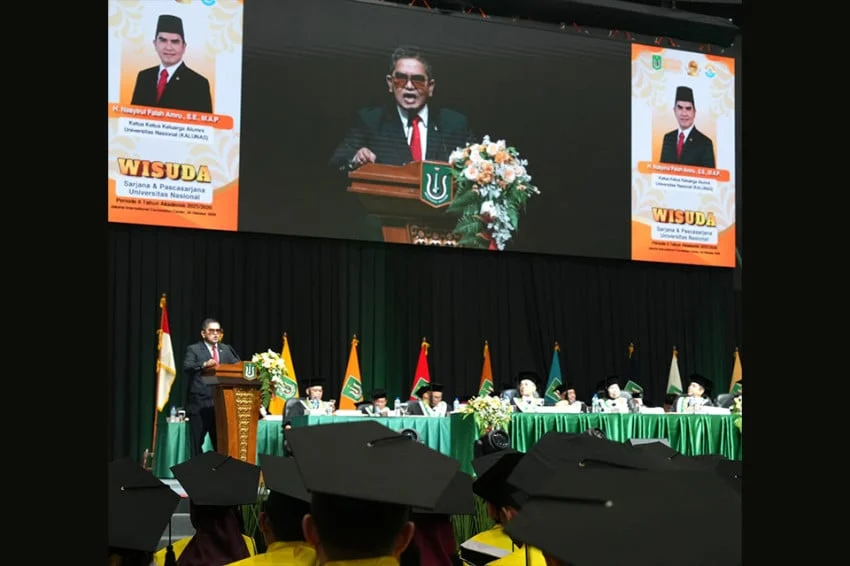
JAKARTA — In a compelling address that resonated with thousands of graduates, families, and academic leaders, Nasyirul Falah Amru, Chairman of the National University Alumni Association (Kalunas), articulated a bold vision for the future leadership of Indonesia. Speaking at the Graduation Ceremony for Period II of the 2025/2026 Academic Year, held at the prestigious Jakarta Convention Center (JCC) on Saturday, October 24, 2026, the prominent alumnus expressed strong confidence that Universitas Nasional (Unas) possesses the academic rigor, historical legacy, and moral framework necessary to cultivate a future President of the Republic of Indonesia.
The graduation ceremony served not only as a momentous milestone for the newly minted graduates but also as a reflective platform for alumni leadership to underscore the transformative power of higher education. Addressing an audience that included top-tier government officials, university administrators, and proud parents, the Kalunas chairman drew upon his own personal journey to illustrate the profound impact of an Unas education on national leadership and public service.
A Journey from Humble Beginnings to National Leadership
Reflecting on his formative years as a student at the historic institution, Nasyirul Falah Amru—affectionately known as Gus Falah—recalled the modest circumstances under which he pursued his higher education. Transporting himself back to the academic climate of 1994, he painted a vivid picture of student life during an era marked by distinct socio-political dynamics in Indonesia.
"Back in 1994, when I was a student, I carried a bag that contained nothing more than a toothbrush, two books, and a towel," Gus Falah shared with the attentive audience, eliciting nods of recognition and admiration from the crowd.
Despite the limitations of his undergraduate days, he emphasized that the exceptional educational foundation provided by Universitas Nasional empowered him to navigate the complex landscape of national politics. Through perseverance and the values instilled during his university years, he successfully transitioned into public service, currently serving his third consecutive term as a member of the House of Representatives (DPR RI).
Building upon this personal narrative, Gus Falah argued that the current generation of Unas students enjoys vastly superior resources, modern facilities, and guidance from distinguished professors compared to previous decades. Given these enhanced institutional capabilities, he asserted that it is entirely feasible—and indeed expected—for future alumni to ascend to the highest office in the land.
"With the facilities and the extraordinary professors we have now, Unas alumni should undoubtedly be capable of becoming the President of the Republic of Indonesia," he declared, urging the graduates to aim for the pinnacle of national leadership and governance.
Holistic Education at the Campus of Struggle
Universitas Nasional, historically celebrated as a "campus of struggle" due to its foundational role in Indonesia’s educational and national development landscape, has long prided itself on an academic philosophy that extends far beyond traditional classroom instruction. During his address, Gus Falah elaborated on the unique educational architecture of the university, which deliberately avoids an exclusive focus on cognitive development or mere intellectualism.
He stressed that academic brilliance must be inextricably linked to ethical grounding and social responsibility. At Unas, the learning process is meticulously designed to cultivate well-rounded individuals equipped to tackle the multifaceted challenges of a developing nation.
"In this campus of struggle, the learning process is structured in such a way that education at Unas does not merely emphasize cognitive aspects or intellectual intelligence alone," Gus Falah explained. "Education at Unas also places a strong focus on character building, moral development, and the integrity of one’s ethics. I hope these graduates will soar high and prove themselves truly useful to the nation and the state."
This holistic approach aligns with the growing demand in modern governance and corporate leadership for executives and public servants who demonstrate emotional intelligence, ethical resilience, and an unwavering commitment to anti-corruption and public welfare. By embedding these values into its curriculum, Unas aims to produce graduates who are not only technically competent but also morally anchored.
Distinguished Attendance and Institutional Prestige
The graduation ceremony for Period II of the 2025/2026 Academic Year was distinguished by the presence of several high-ranking state officials and academic dignitaries, underscoring the strategic importance of Universitas Nasional within Indonesia’s broader educational ecosystem.
Presiding over the academic procession was Unas Rector El Amry Bermawi Putera, whose leadership has continuously steered the institution toward academic excellence, accreditation enhancement, and expanded international partnerships. Under his administration, Unas has consistently focused on modernizing its infrastructure, expanding research output, and fostering robust collaborations with financial institutions and industrial sectors to improve graduate employability.
Significantly, the event was graced by the presence of Agus Harimurti Yudhoyono (AHY), the Coordinating Minister for Infrastructure and Regional Development. The inclusion of a coordinating minister whose portfolio directly intersects with national development, urban planning, and economic connectivity provided a fitting backdrop to discussions surrounding national leadership and institutional contributions to the state. Furthermore, the attendance of Afriansyah Noor, the Deputy Minister of Manpower, highlighted the critical nexus between higher education outcomes and national workforce development—a pressing priority for Indonesia as it navigates the opportunities and challenges of its demographic dividend.
The presence of these key government figures reinforces the symbiotic relationship between academia and statecraft. For graduates entering the professional sphere, seeing national leaders actively engage with their university’s milestone events serves as both an inspiration and a validation of their academic journey.
Broader Economic and Academic Engagements
The ambitious vision articulated by the Kalunas chairman arrives at a time of heightened dynamism for Universitas Nasional. Beyond academic ceremonies and political discourse, the university has been proactive in bridging the gap between theoretical knowledge and practical economic literacy. A testament to this progressive engagement is the recent collaboration between Unas and major financial institutions, exemplified by initiatives such as the UNAS Investival supported by prominent entities like MNC Sekuritas, featuring legendary Indonesian investors such as Lo Kheng Hong.
Such initiatives demonstrate that Unas is not only cultivating future political leaders but also fostering financial literacy, entrepreneurial spirit, and economic acumen among its student body. By exposing students to real-world capital market dynamics, investment strategies, and corporate governance early in their academic lifecycle, the university ensures its alumni possess the comprehensive skill set required to navigate contemporary global economies.
Implications and Future Outlook
The aspiration voiced by Nasyirul Falah Amru—that an alumnus of Universitas Nasional will one day hold the highest office in the executive branch—carries significant symbolic and practical implications for private higher education institutions in Indonesia.
Historically, the nation’s political leadership has often been associated with a select few large public universities. However, as the educational landscape democratizes and private institutions increasingly match or exceed state universities in specific areas of governance, research, and character education, the pathways to national leadership are widening.
For Unas, embracing this challenge requires a continuous commitment to academic innovation, transparent institutional governance, and the rigorous cultivation of ethical leadership. As the newly capped graduates step out of the Jakarta Convention Center and into various sectors of society—ranging from public administration and diplomacy to business, civil society, and technology—they carry with them the expectations of an institution that views itself not merely as a degree-granting body, but as a cradle for the nation’s future architects.
Ultimately, whether the future witnesses an Unas alumnus taking the oath of office as President of the Republic of Indonesia will depend on the sustained dedication of the university community to its core principles. By maintaining a delicate equilibrium between intellectual rigor and moral integrity, Universitas Nasional continues to cement its legacy as a vital pillar in the intellectual and leadership development of the Indonesian nation.