
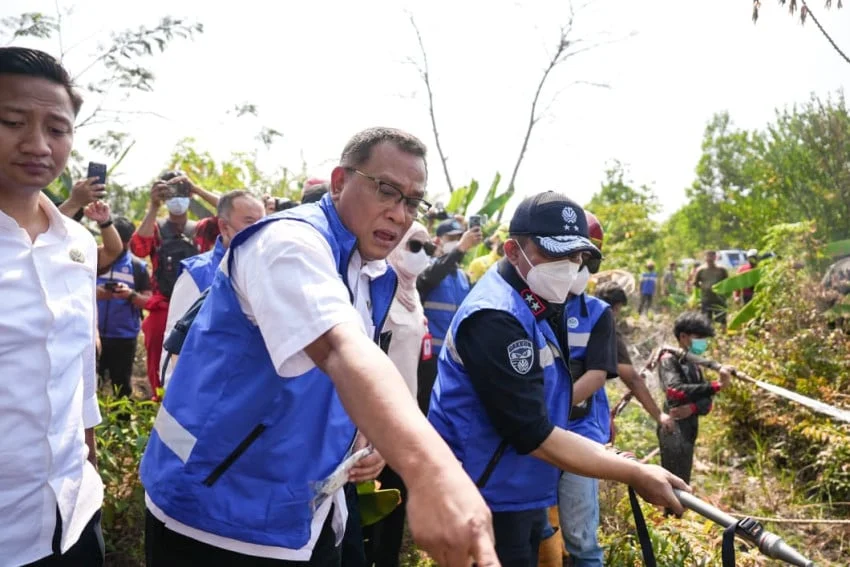
The Indonesian Ministry of Environment (KLH) has initiated a sweeping series of enforcement actions targeting corporate entities implicated in forest and land fires (karhutla) across the archipelago. This rigorous crackdown serves as the immediate implementation of Presidential Instruction (Inpres) Number 11 of 2026, which mandates a zero-tolerance policy regarding the use of fire for land clearing. With the nation facing mounting pressure from climate change, prolonged droughts, and the associated public health risks of toxic haze, the government has signaled that legal impunity for environmental degradation is effectively at an end.
The Mandate: Inpres 11/2026 and Zero Tolerance
President Prabowo Subianto’s administration formally introduced Inpres 11/2026 earlier this year as a definitive legislative instrument designed to curb the perennial scourge of forest fires. The directive provides clear, actionable mandates for all government tiers—from provincial governors to local district heads—to prioritize prevention, monitoring, and, crucially, the strict prosecution of entities that utilize fire to prepare land for agricultural or industrial use.
Minister of Environment Jumhur Hidayat emphasized that the instruction removes ambiguity from environmental law enforcement. "The President’s directive is unequivocal: there is no room for tolerance when it comes to the intentional burning of land," Hidayat stated. He noted that the urgency of this mandate is dictated by the current meteorological challenges, where extreme weather patterns have significantly heightened the combustibility of peatlands and forest ecosystems.
Extensive Enforcement: A Snapshot of the Crackdown
As part of the initial phase of this enforcement campaign, the Ministry of Environment has successfully identified and sealed the operations of 50 business entities. These companies are located across eight provinces, with the total area under investigation spanning an alarming 27,333.79 hectares. The geographical distribution of these fire incidents highlights a systemic issue, particularly within the plantation sector, where land preparation often historically relied on fire due to its perceived cost-effectiveness.
The data released by the Ministry indicates that Kalimantan remains the primary epicenter of these incidents. Out of the 50 businesses currently facing administrative and legal sanctions, 36 are based in the Kalimantan region, accounting for 23,634.72 hectares of charred land.
The breakdown of the affected areas in Kalimantan is as follows:
- West Kalimantan: 18 entities, 12,920.88 hectares
- South Kalimantan: 6 entities, 6,476.94 hectares
- Central Kalimantan: 6 entities, 2,684.02 hectares
- East Kalimantan: 4 entities, 1,244.81 hectares
- North Kalimantan: 2 entities, 308.07 hectares
These figures represent a significant portion of the total land impact, underscoring the Ministry’s focus on large-scale concessions where the legal responsibility of the leaseholders is most easily documented.
Chronology of the Crisis and Legislative Response
The recurring issue of forest fires in Indonesia has long been a source of domestic unrest and international concern, particularly regarding transboundary haze affecting neighboring nations in Southeast Asia.
- Early 2026: Scientific reports indicated a severe El Niño-induced drought, leading to high-risk assessments for fire-prone peatlands in Sumatra and Kalimantan.
- Mid-2026: Following a series of high-intensity fires in the first quarter, President Prabowo Subianto convened a national cabinet meeting to address the failure of existing mitigation strategies.
- Q3 2026: The President signed Inpres 11/2026, creating a legal framework that empowers the Ministry of Environment to bypass bureaucratic bottlenecks in penalizing corporate violators.
- Late 2026: The Ministry of Environment launched the current inspection phase, utilizing satellite imagery and ground verification teams to seal affected concessions and initiate litigation.
This timeline illustrates a shift from reactive firefighting to a proactive, punitive legal strategy intended to act as a deterrent for future land clearing activities.
Economic and Environmental Implications
The sealing of 50 corporate concessions carries profound economic and environmental implications. Economically, the move threatens the operations of palm oil, timber, and pulp and paper companies, which are vital to the regional economies of Kalimantan. However, experts argue that the long-term cost of environmental degradation—including loss of biodiversity, soil degradation, and carbon emissions—far outweighs the short-term gains of inexpensive land clearing.
The Ministry’s approach also acknowledges the carbon-sink value of Indonesian forests. As a signatory to various international climate accords, Indonesia is under constant pressure to meet its Nationally Determined Contributions (NDCs). By curbing fires, the government is not only protecting public health but also fulfilling its international commitments to reduce greenhouse gas emissions.
Expert Perspectives and Broader Impact
Environmental legal experts have lauded the move as a long-overdue application of "strict liability" principles. In many past instances, companies escaped prosecution by claiming that fires were started by smallholder farmers or external parties. Under the current enforcement model, concession holders are held responsible for ensuring that fire does not occur within their boundaries, regardless of the source.
Dr. Aris Pratama, a policy analyst focusing on forestry management, suggests that the success of this initiative will depend on the Ministry’s ability to follow through with criminal prosecutions. "Sealing the land is the first step," Pratama noted. "However, the true deterrent effect will only be realized when we see the revocation of business licenses and substantial financial penalties that exceed the profit margins gained from the illegal clearing."
Public health organizations have also supported the crackdown. The reduction of haze is essential to prevent the spike in respiratory illnesses that typically occurs during the peak fire season. Hospitals in Kalimantan and Sumatra have historically faced overwhelming surges in cases of Acute Respiratory Infection (ARI) during these periods. By aggressively targeting the source of the smoke, the Ministry is effectively prioritizing the right of citizens to breathe clean air over corporate expansion.
Future Challenges and Sustained Monitoring
While the initial success of the crackdown is evident, the Ministry faces significant challenges in maintaining this momentum. The vastness of the Indonesian territory, much of it remote and difficult to access, makes constant monitoring a logistical nightmare. The Ministry is increasingly relying on the "Sipongi" monitoring system, which uses real-time satellite data to detect thermal hotspots.
Furthermore, the government must address the underlying socioeconomic factors that drive smallholders to use fire, as these groups often work in close proximity to, or within, larger corporate concessions. Future policy adjustments may need to include subsidized mechanical land clearing tools for local communities to ensure that the prohibition on burning is not only enforced but also practical for small-scale agriculture.
The Ministry of Environment has signaled that it will continue its investigations in other provinces beyond the initial eight identified. Minister Hidayat confirmed that the teams are currently auditing concessions in Sumatra and parts of Papua, indicating that the scope of the enforcement will likely expand as the dry season progresses.
Conclusion: A New Era for Environmental Governance
The enforcement of Inpres 11/2026 marks a pivotal transition in Indonesia’s environmental history. By moving away from a culture of administrative warnings toward one of direct, large-scale legal action, the government of President Prabowo Subianto is attempting to decouple economic development from environmental destruction.
The current operation involving the 50 entities is a clear message to the private sector: the era of lax oversight has concluded. As the government continues its work, the effectiveness of these measures will be measured by the decline in total burned area and the long-term restoration of the affected lands. For the millions of Indonesians living in the shadow of potential haze, the success of this initiative is not merely a matter of policy—it is a matter of survival and the preservation of the nation’s ecological future.
